Setting Healthy Boundaries:
How to Protect Your Peace
By Notion of Worth Editorial · August 2026
Healthy boundaries are not about pushing people away.
They are about knowing where you end and someone else begins.

Setting boundaries is often misunderstood.
They can sound harsh. Rigid. Cold. Like walls between you and other people.
But healthy boundaries are not about pushing people away.
They are about knowing where you end and someone else begins.
They help you protect your time, energy, values, emotional capacity, and self-respect without requiring you to stop caring.
And in many cases, the absence of boundaries does not create more love.
It creates more resentment. More exhaustion. More confusion. More self-abandonment.
You say yes when you want to say no. You stay available when you need rest. You tolerate things that repeatedly hurt you. You explain yourself until your boundary starts sounding like an apology. You keep giving because you are afraid that pulling back will disappoint someone.
Eventually, peace becomes something you try to create for everyone else while losing it inside yourself.
That is why boundaries matter.
Not because you should care less.
Because you should not have to lose yourself in order to stay connected.
The way we respond to closeness, distance, and emotional safety is often connected to deeper
attachment patterns in relationships.
Understanding those patterns can make it easier to see why some boundaries feel surprisingly difficult to hold.
What This Article Is Based On
This article draws on research and established psychological concepts related to personal boundaries, assertive communication, differentiation of self, relationship functioning, conflict, and the balance between autonomy and connection, combined with practical interpretation for everyday life.
What a Boundary Actually Is
A boundary is not a demand that controls another person.
It is a statement about what you will accept, participate in, give, tolerate, or do.
A demand says:
“You are not allowed to behave this way.”
A boundary says:
“If this continues, this is what I will do.”
That difference matters.
You cannot control whether someone respects you. But you can decide what access they have to you when they repeatedly do not.
You cannot force someone to communicate calmly. But you can end a conversation when it becomes abusive.
You cannot make someone value your time. But you can stop repeatedly rearranging your life for someone who treats your time as disposable.
Setting boundaries are not about controlling other people. They are about taking responsibility for yourself.
Why Setting Boundaries Feels So Difficult
For many people, setting a boundary is not difficult because they do not know what they need.
It is difficult because they fear what will happen after they say it.
What if they get angry?
What if they think I am selfish?
What if they pull away?
What if they stop needing me?
What if they think I have changed?
What if I disappoint them?
So instead of protecting the boundary, you protect the relationship from discomfort — a pattern closely connected to people-pleasing.
You soften your no. You make exceptions. You keep explaining. You accept behavior you know is not okay.
There is another reason new boundaries can feel uncomfortable: your behavior may be changing faster than your identity. Saying no can feel “unlike you” simply because the older version of you had more practice saying yes. This is part of why personal growth can happen before your self-image catches up.
And eventually, the message becomes:
Their discomfort matters more than my limit.
This can happen so gradually that you barely notice it.
Until resentment appears.
Resentment Is Often a Boundary Signal
Resentment is not always proof that someone else is wrong.
But it is often useful information.
You may feel resentful when you repeatedly give what you did not freely want to give.
When you agree while internally resisting.
When you keep helping after your capacity is gone.
When someone assumes your availability because you have rarely protected it.
When your kindness becomes an expectation.
The feeling may sound like:
“Why do they always ask me?”
But underneath it may be:
“Why do I keep saying yes?”
That distinction is powerful.
Because boundaries are not only about asking other people to behave differently.
They are also about noticing where you repeatedly override yourself.
5 Signs Your Boundaries May Be Too Weak
1. You Say Yes Before You Check With Yourself
Someone asks for something.
Your answer comes immediately.
Sure.
Then later, the frustration starts.
You did not actually have the time. You were already tired. You did not want to go. You needed the evening to yourself.
But saying yes felt easier than tolerating the possibility of disappointing someone.
A healthier response can be simple:
“Let me check and get back to you.”
That pause creates room for one important question:
2. You Feel Responsible for Other People’s Reactions
You set a limit.
They become upset.
Now you feel guilty.
So you start repairing. Explaining. Reassuring. Changing the boundary. Sometimes even apologizing for having it.
But another person’s disappointment does not automatically mean you have done something wrong.
Healthy relationships can survive discomfort.
Someone can dislike your boundary and still respect it.
Someone can feel disappointed and still understand that you have the right to make decisions for yourself.
If every boundary must keep everyone happy, it is not really a boundary.
It is permission-seeking.
3. You Need a “Good Enough” Reason to Say No
You believe no is only acceptable when your explanation is convincing.
You need to be busy enough. Exhausted enough. Hurt enough. Overwhelmed enough.
You build a case. You justify. You explain every detail.
But sometimes:
“I can’t do that.”
is enough.
Or:
“That doesn’t work for me.”
Or even:
“No, thank you.”
You can choose to explain when explanation helps connection.
But your boundary should not depend on winning a debate.
4. You Keep Moving the Line
You say:
“This is the last time.”
Then it happens again.
You say:
“I won’t accept this anymore.”
Then you accept it.
You decide to create distance.
Then guilt pulls you back.
Over time, people learn something from your boundaries.
Not from what you say.
From what happens after you say it.
If there is never a consequence, the boundary becomes a preference.
A real boundary requires consistency.
If this keeps happening, it may help to understand why you keep moving your boundaries to keep the peace.
Not perfection.
But enough consistency that your own nervous system learns:
I mean what I say to myself.
5. You Feel Guilty for Protecting Your Energy
You need rest. Space. Quiet. Time alone. Less communication. Fewer obligations.
And yet you feel selfish for needing any of it.
This often happens when you have built an identity around being available, helpful, understanding, or strong.
But your capacity is not infinite.
Rest is not something you have to earn by reaching total exhaustion.
Protecting your energy is not rejection.
Sometimes it is what allows you to stay connected without becoming resentful.
Boundaries Are a Form of Self-Respect
A boundary says:
My time matters.
My body matters.
My emotional capacity matters.
My values matter.
My peace matters.
That does not mean they matter more than everyone else’s.
It means they finally belong in the equation.
Research on differentiation of self similarly points to the importance of maintaining a distinct sense of self while staying connected to others.
People with poor boundaries often become experts at considering everybody else.
What will they think?
How will they feel?
What do they need?
What will make things easier?
The missing question is often:
What does this cost me?
Self-respect begins when that question becomes legitimate.
Boundaries do more than protect you from what drains you. They also create room for what you want more of. If you are trying to define that more clearly, you can create a vision board around the life you want your boundaries to make possible.
Protecting Your Peace Does Not Mean Avoiding Every Difficult Conversation
This distinction is important.
“Protect your peace” can easily become a reason to avoid discomfort.
But healthy boundaries do not mean running from every disagreement.
Sometimes protecting your peace means having the conversation you have been avoiding.
Saying what hurt.
Clarifying the limit.
Asking for what you need.
Allowing another person to disagree.
Leaving a dynamic that repeatedly violates what matters to you.
Real peace is not always comfortable in the moment.
Sometimes it requires tension first.
When keeping the peace consistently requires you to silence your needs, soften your limits, or make yourself smaller, the pattern may go beyond conflict avoidance. These can be signs you’re abandoning yourself to keep the peace.
PROTECTING YOUR PEACE
FALSE PEACE
“Do not say anything. Keep everything calm.”
REAL PEACE
“I am willing to tolerate discomfort rather than keep abandoning myself.”
How to Set Boundaries Without Becoming Harsh.
Boundaries can be clear without being cruel.
You do not need a speech. You do not need to become emotionally distant. You do not need to justify every choice.
Often, simple language works best.
When you need time:
“I can’t answer that right now. Let me think about it.”
When you do not want to participate:
“That doesn’t work for me.”
When a conversation becomes disrespectful:
“I’m willing to talk about this, but not while we’re speaking to each other this way.”
When someone repeatedly asks for more than you can give:
“I care about you, but I don’t have the capacity for this today.”
When you need space:
“I need some time to myself. I’ll reach out when I’m ready.”
When behavior crosses a line:
“If this continues, I’m going to step away from the conversation.”
Notice what these statements do not contain.
A long defense.
An attack.
A character judgment.
A request for permission.
A healthy boundary is often calm. Clear. Specific. And connected to your own behavior.
The Hardest Part Comes After You Set It
Setting boundaries is only the beginning.
The real test often comes afterward.
Someone pushes back. Questions it. Ignores it. Tests whether you really mean it.
This is where many boundaries collapse.
You feel guilty. You fear losing the relationship. You start doubting yourself. You wonder whether you were too harsh.
That is why boundaries require more than communication.
They require self-trust.
You have to be able to tolerate the fact that someone may not like your limit.
You have to resist immediately undoing it just to restore comfort.
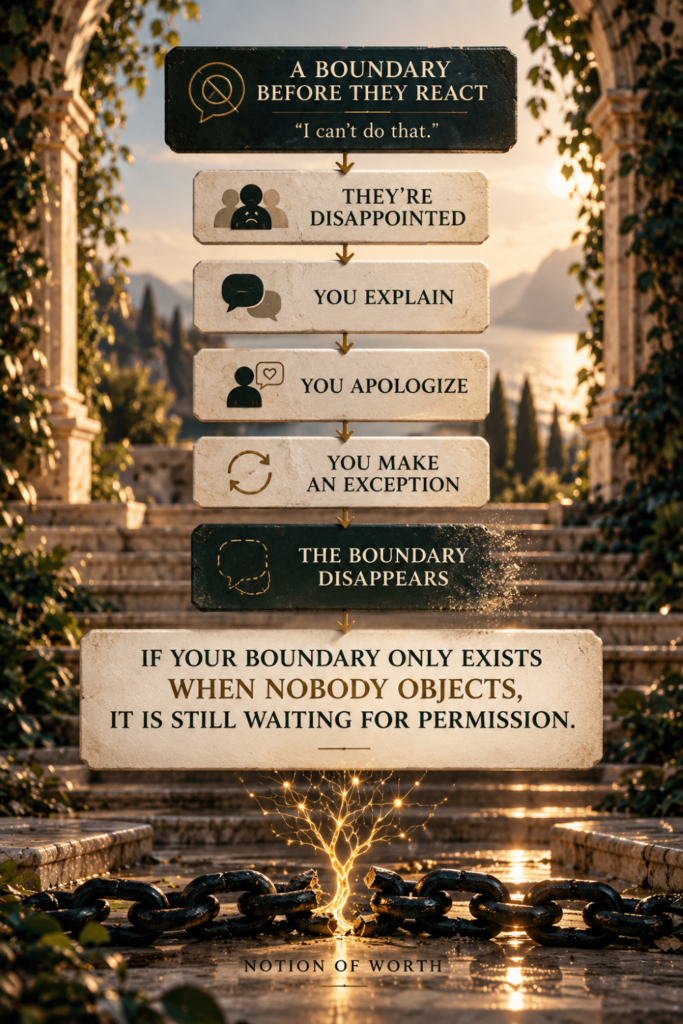
A boundary is not tested when it is easy to respect. It is tested when someone is disappointed — and you choose not to abandon it just to restore comfort.
And sometimes you have to accept a painful truth:
A relationship that only works when you have no boundaries was never truly peaceful.
A Simple Boundary Check-In
Ask yourself:
- Where am I currently saying yes while feeling no?
- Which relationship leaves me consistently drained?
- Where do I feel resentful because I keep giving too much?
- What behavior do I keep calling “not a big deal” even though it repeatedly hurts me?
- Which boundary do I keep explaining instead of enforcing?
- Whose disappointment feels hardest for me to tolerate?
- What would I stop doing if I believed protecting my peace was a valid reason?
Do not rush to fix every answer.
Notice the pattern first.
You Do Not Need to Earn the Right to Have Limits
You are allowed to have limits before you are exhausted.
Before you are angry.
Before the relationship becomes unbearable.
Before you can prove that someone meant to hurt you.
You do not need a dramatic reason to protect yourself.
Sometimes:
This does not feel good anymore.
is information.
Sometimes:
I do not have the capacity for this.
is enough.
Sometimes:
I want something different.
is enough.
Setting boundaries does not make you unkind.
It can make your relationships more honest.
Because when your yes is genuine, it means more.
When your presence is chosen rather than forced by guilt, it feels different.
When your care no longer requires self-erasure, it becomes sustainable.
Protecting your peace is not about shutting everyone out.
It is about creating enough space inside your relationships that you are still allowed to exist there too.
And sometimes the most important boundary is not the one you explain to someone else.
It is the one you finally stop breaking with yourself.
Related Reading
MOVING BOUNDARIES
SELF-ABANDONMENT
Sources & Research
- Cleveland Clinic.
How To Set Healthy Boundaries
2026. - Calatrava M, Martins MV, Schweer-Collins M, Duch-Ceballos C, Rodríguez-González M.
Differentiation of self: A scoping review of Bowen Family Systems Theory’s core construct
Clinical Psychology Review, 2022. - Kluwer ES, Karremans JC, Riedijk L, Knee CR.
Autonomy in Relatedness: How Need Fulfillment Interacts in Close Relationships
Personality and Social Psychology Bulletin, 2020. - Knee CR, Lonsbary C, Canevello A, Patrick H.
Self-determination and conflict in romantic relationships
Journal of Personality and Social Psychology, 2005. - Righetti F, Sakaluk JK, Faure R, Impett EA.
The link between sacrifice and relational and personal well-being: A meta-analysis
Psychological Bulletin, 2020.
This article is for general educational and informational purposes only. It does not diagnose, treat, or replace professional health care. Read our Editorial & Research Standards and Disclaimer for more information.
Ready to Build Stronger Boundaries Without Losing Yourself?
The Self-Worth Starter Guide will help you identify where you may be over-giving, shrinking, or placing other people’s approval above your own needs — and begin rebuilding a steadier relationship with yourself.
Understand Yourself. Growth from inside.
NotionOfWorth