Why You Still Feel Like the Old You
- Even After You’ve Changed -
You can change your habits, relationships, boundaries and choices — and still feel strangely like the person you used to be. Sometimes growth happens faster than your self-image can update. Here’s what happens when the story you carry about yourself is still based on old evidence.

Why your self-image can lag behind your life — and how to help it catch up.
You can change your habits.
Leave a relationship.
Build better boundaries.
Stop chasing the same approval.
Choose differently.
Become more confident.
Trust yourself more.
If you have ever wondered why you still feel like the old you even after your life and choices have changed, the answer may lie in the way your self-image updates.
And still, somewhere underneath all of it, feel strangely like the person you used to be.
You may still expect yourself to react the old way.
Still hesitate before doing things you are now perfectly capable of doing.
Still describe yourself using words that belonged to a previous chapter of your life.
Still wait for someone else to confirm a change you have already made.
It creates a strange tension:
Your life has moved forward, but part of your identity is still living from an older version of the map.
That does not necessarily mean your growth was superficial.
Sometimes change happens faster than recognition.
And until your self-image catches up, you may continue consulting an outdated version of yourself when making decisions about the person you are becoming.
When Your Identity Hasn’t Caught Up Yet
There is a useful way to think about this gap.
You could call it identity lag.
Not a diagnosis.
Not a psychological disorder.
Simply the experience of changing faster than your internal picture of yourself.
Your behavior may already contain new evidence.
Your standards may have changed.
Your relationships may be different.
You may tolerate less.
Choose more carefully.
Recover faster.
Speak more honestly.
Or trust your own judgment more than you once did.
And yet your internal description can remain strangely outdated.
Psychologists sometimes use the term self-concept to describe the beliefs, perceptions and ideas we hold about ourselves.
Psychologists use the term self-concept for the knowledge and beliefs we hold about ourselves. Research on self-concept clarity examines how clearly, consistently and confidently those beliefs are organized over time.
Those beliefs are not necessarily fixed forever.
They develop through experience, relationships, behavior, feedback and the meaning we make from what happens to us.
But they do not always update the moment something changes.
That creates a period in which your life may already be providing evidence of growth while your identity is still organized around older evidence.
You have changed.
You just haven’t fully recognized yourself yet.
Your Identity May Still Be Using Old Evidence
Imagine that, for years, your mind has been collecting evidence about who you are.
Every rejection.
Every success.
Every embarrassing moment.
Every relationship.
Every time you stayed quiet.
Every time you gave too much.
Every time you failed.
Every time you survived something you thought you could not handle.
Gradually, those experiences become a story.
And eventually, the story becomes shorthand.
I’m bad at confrontation.
I always choose the wrong people.
I’m not disciplined.
I overthink everything.
I’m the one who keeps everyone together.
I need other people to reassure me.
I’m not someone who takes risks.
At some point, you stop hearing these statements as interpretations.
They begin to sound like facts.
The problem is not that the old story was completely false.
It may once have described you remarkably well.
The problem is that it may have stopped collecting new evidence.
Maybe you used to avoid confrontation.
But last month you had the difficult conversation.
Maybe you spent years seeking external validation.
But recently you made a major decision without asking five people whether it was acceptable.
Maybe you used to abandon your boundaries when someone became disappointed.
But this time you tolerated the discomfort and kept the boundary anyway.
The old story contains real evidence.
It just may not contain all of the evidence anymore.
An identity can become outdated without becoming obviously wrong.
7 Signs Your Self-Image May Be Outdated
Identity lag rarely announces itself dramatically.
More often, it appears in small moments where the person you believe yourself to be no longer quite matches the person doing the living.
1. You Keep Introducing Yourself With Old Limitations
Listen to the sentences that follow:
I’m just…
They can reveal more than we realize.
“I’m just bad with change.”
“I’m just not very confident.”
“I’ve never been disciplined.”
“I’m terrible at making decisions.”
“I always overthink everything.”
Sometimes these descriptions are accurate.
But sometimes they are simply familiar.
If you have repeated a sentence about yourself for ten years, you may stop checking whether it still deserves to be true.
Try replacing:
“That’s just who I am.”
with:
“Is that still what the evidence says?”
Those are very different questions.
2. Compliments Feel Like They Describe Someone Else
Someone tells you that you are resilient.
Capable.
Confident.
Disciplined.
Creative.
Calm under pressure.
Your immediate reaction is:
They don’t really know me.
Sometimes that reaction is humility.
Sometimes it reflects insecurity.
But sometimes something simpler is happening.
They may be responding to evidence that your own self-image has not incorporated yet.
You are comparing yourself with years of private memories.
They are responding to the person standing in front of them now.
Sometimes other people meet the current version of you before you do.
3. You Keep Preparing for Problems You Already Know How to Handle
There was a time when certain situations overwhelmed you.
Conflict.
Rejection.
Being alone.
Making a decision without reassurance.
Someone disapproving of you.
Not knowing what comes next.
So your nervous system and your expectations learned to prepare for those situations accordingly.
But perhaps you have developed better judgment since then.
More experience.
Stronger boundaries.
More emotional awareness.
More independence.
A greater ability to recover.
Yet part of you may still enter every difficult situation as if none of that growth has happened.
You prepare using yesterday’s vulnerability while overlooking today’s capacity.
The difficulty may still be real.
But the person meeting it is no longer exactly the same.
4. New Behavior Feels Fake
You say no.
And immediately feel rude.
You speak clearly.
And wonder whether you have become difficult.
You ask for what you need.
And feel demanding.
You rest.
And feel lazy.
You stop overexplaining.
And feel cold.
You walk away sooner.
And feel guilty.
Then comes the thought:
This isn’t really me.
But unfamiliar does not necessarily mean inauthentic.
Sometimes healthier behavior feels unnatural simply because the old behavior had years of rehearsal.
What feels familiar and what reflects your values are not always the same thing.
5. You Still Seek Permission for Decisions You Are Capable of Making
You already know what you want.
You have enough information.
You have probably even made the decision internally.
And yet you ask another person.
Then another.
Then perhaps one more.
Not because they possess information you need.
But because their agreement temporarily makes your own judgment feel safer.
If this pattern feels familiar, it may also be connected to external validation — the habit of looking outside yourself for reassurance that your choices, feelings or direction are acceptable.
This is especially common when you have spent years learning to trust other people’s reactions more than your own internal signals.
Growth may mean that your decision-making has improved before your confidence in that decision-making has caught up.
You are already capable of choosing.
Part of you simply still remembers being the person who did not trust themselves.
6. You Feel Guilty When You Stop Playing an Old Role
Maybe you used to be:
the fixer.
the peacemaker.
the dependable one.
the easy one.
the endlessly available friend.
the person who never needed much.
the person who made everything okay.
Over time, roles can become difficult to distinguish from personality.
Sometimes what feels like personality may actually be a role you learned to play for approval, safety, belonging or connection.
Then you begin changing.
You stop fixing what other people refuse to take responsibility for.
You say no.
You become less available.
You admit that you have needs too.
And something unexpected happens.
You feel guilty.
Not necessarily because the new behavior is wrong.
But because belonging may once have depended on remaining recognizable.
When you stop performing the role, you are not only changing your behavior.
You are changing an agreement that may have existed between you and the people around you for years.
7. You Keep Waiting to Become Someone You Already Partly Are
This may be the most subtle sign.
You tell yourself:
One day I’ll trust myself.
One day I’ll become more disciplined.
One day I’ll stop needing everyone’s approval.
One day I’ll become someone with boundaries.
One day I’ll be confident enough.
Meanwhile, there may already be dozens of moments proving that this process has begun.
You kept one boundary.
Made one hard decision.
Walked away once.
Recovered faster than before.
Told the truth where you once would have stayed silent.
Did the uncomfortable thing without waiting until you felt fearless.
Growth often does not arrive as a dramatic transformation.
It arrives as evidence.
And sometimes your identity simply has not incorporated that evidence yet.
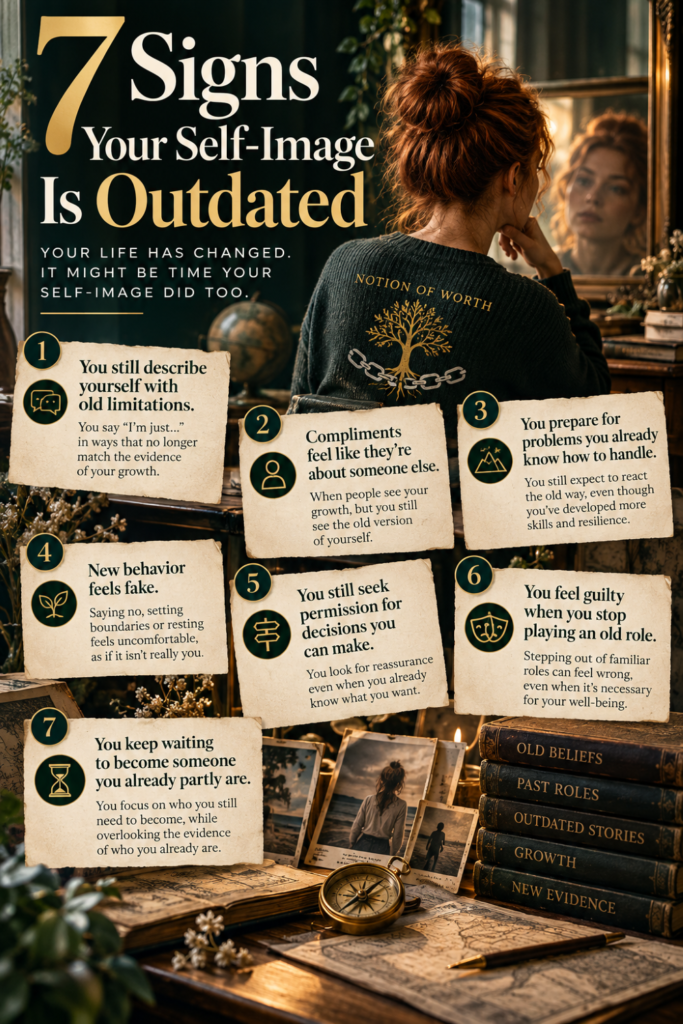
Growth can happen before your self-image catches up. These seven patterns may reveal where you are still living from old evidence.
Unfamiliar does not mean inauthentic.
Sometimes growth feels wrong simply because the old pattern had more practice.
Why Growth Can Feel Like Pretending
One of the strangest stages of personal growth happens after the old behavior stops fitting but before the new behavior feels natural.
You are no longer fully operating as the person you were.
But you do not yet feel completely at home in who you are becoming.
That middle ground can feel surprisingly uncomfortable.
The old version was at least predictable.
You knew its rules.
You knew how other people reacted to it.
You knew what was expected from you.
Even painful patterns can create familiarity.
Growth removes some of that predictability.
That is why becoming more assertive can initially feel aggressive.
Why resting can feel irresponsible.
Why leaving an unhealthy dynamic can feel cruel.
Why confidence can feel arrogant.
Why taking your own needs seriously can feel selfish.
Why refusing to chase someone can feel like giving up.
The feeling itself is real.
But the interpretation may be outdated.
Discomfort is not always evidence that you are betraying yourself.
Sometimes it is the sensation of an old identity losing its authority.
The People Around You May Still Be Meeting the Old You
We do not construct identity entirely alone.
Other people participate.
Families develop roles.
Friendships develop expectations.
Romantic relationships develop patterns.
Workplaces decide who is dependable, ambitious, flexible, quiet, emotional, easygoing or capable.
Once those patterns become familiar, they can continue long after one person begins to change.
Someone may still expect you to say yes.
Still ask you to solve everything.
Still make the joke about the person you used to be.
Still expect you to tolerate behavior you no longer tolerate.
Still assume you will stay quiet.
Still treat your new boundary as temporary.
This does not automatically mean those people are intentionally trying to keep you small.
Often, other people simply update their picture of us slowly too.
But their expectations can create a powerful gravitational pull.
You behave differently.
They respond as though nothing changed.
And suddenly the old version of you feels real again.
This is why some growth becomes easier when your environment changes — and harder when every relationship around you keeps inviting you back into an old role.
It raises an uncomfortable question:
Are you becoming who you choose to be — or repeatedly returning to the version of you that other people already know how to understand?
Stop Asking Your Past to Approve Your Future
There is another way the old identity maintains influence.
We keep giving it voting rights.
You consider an opportunity and think:
I’m not someone who could do that.
You think about ending a pattern and hear:
But I’ve always been this way.
You imagine speaking differently and think:
That’s not like me.
But which “me” gets to decide?
The person you were five years ago?
The version of you inside an old relationship?
The version who had less experience?
The version who had not yet learned what you know now?
The version who developed certain habits because they were useful at the time?
Your past self was making decisions with different information, different circumstances, different resources and different fears.
You do not need to disrespect that person.
You do not need to erase them.
But you also do not need to keep giving them the deciding vote.
This tension can become especially noticeable when you are outgrowing an old version of yourself but have not yet fully adjusted to what comes after it.
Your past can explain you without being allowed to define you.
Update Your Identity With Evidence
Trying to force a new identity rarely works.
Standing in front of a mirror and repeating:
I am confident.
I am powerful.
I trust myself.
may feel inspiring for a moment.
But identity tends to become more believable when it has evidence underneath it.
Instead of trying to persuade yourself that you are confident, notice:
I said what I actually thought even though I was nervous.
Instead of declaring that you have perfect boundaries, notice:
I said no without writing a three-paragraph explanation.
Instead of insisting that you trust yourself, notice:
I made the decision before asking everyone else what they thought.
Instead of trying to become “a disciplined person,” notice:
I followed through even when motivation was low.
Instead of deciding you are suddenly fearless, notice:
I was afraid and moved anyway.
These observations may seem small.
But repeated small evidence can gradually make an old description harder to defend.
Behavior does not merely express identity.
Over time, repeated behavior can also help reshape the way you understand yourself.
Behavior does not merely express identity. Research examining the relationship between habits and identity suggests that repeated behavior and the way we see ourselves can reinforce one another over time.
You begin with:
I’m trying to set boundaries.
Then:
I’ve been setting better boundaries.
Eventually:
I am someone who takes my boundaries seriously.
The change is not created by the label.
The label becomes believable because the evidence accumulated underneath it.
Try the Old Evidence / New Evidence Check
Choose one belief you regularly repeat about yourself.
For example:
“I always abandon myself to keep the peace.”
Now separate the evidence.
Old Evidence
What experiences created that belief?
Maybe you avoided difficult conversations.
Stayed too long.
Changed your opinion to prevent conflict.
Ignored what bothered you.
Said yes when you wanted to say no.
Kept accepting something after you knew it was hurting you.
That evidence matters.
Do not erase it.
Do not rewrite your history just because you want a better story.
Now look again.
New Evidence
What has happened since?
Maybe you told someone that something bothered you.
Declined something without inventing an excuse.
Stopped chasing someone who repeatedly withdrew.
Allowed someone to be disappointed in you.
Walked away from something sooner than you would have before.
Admitted what you actually wanted.
Asked a difficult question.
Chose temporary discomfort over another round of self-abandonment.
The point is not to prove that the old version of you never existed.
It did.
The point is to stop pretending that it is the only evidence available.
You Don’t Need to Destroy the Old Version of Yourself
Personal growth is often described using the language of war.
Destroy your old self.
Become unrecognizable.
Kill your old habits.
Never look back.
Leave the old you behind.
It sounds powerful.
But it can also create another form of self-rejection.
Because the person you used to be did not appear randomly.
They were often adapting.
The agreeable version of you may have learned that harmony created safety.
The overachieving version may have learned that performance earned approval.
The hyper-independent version may have learned that relying on other people was risky.
The invisible version may have learned that taking up less space reduced conflict.
The fixer may have learned that being useful secured belonging.
The person who needed constant reassurance may have learned that connection could disappear without warning.
Understanding these patterns does not mean continuing them.
It means recognizing that some behaviors we later call “bad habits” once had an emotional purpose.
You can appreciate what an old identity protected without continuing to live inside it.
Growth does not require contempt for the person who got you here.
Sometimes it requires saying:
That version of me made sense then. It just doesn’t need to run my life now.
A More Flexible Identity May Be Better Than a Better Label
There is another trap waiting on the other side of change.
You can replace one rigid identity with another.
“I am insecure” becomes:
“I am confident.”
“I am a people-pleaser” becomes:
“I never need anyone.”
“I avoid conflict” becomes:
“I always say exactly what I think.”
“I used to be weak” becomes:
“I am strong now.”
The labels sound better.
But rigidity is still rigidity.
Personal growth does not necessarily mean finding the perfect description of yourself and defending it forever.
A healthier identity may have more room.
You can be confident and uncertain.
Independent and deeply connected.
Strong and exhausted.
Disciplined and occasionally inconsistent.
Kind and boundaried.
Courageous and afraid.
Growing and still carrying traces of old patterns.
You do not have to become a perfectly coherent character.
You are a person responding to different circumstances with a growing range of choices.
And perhaps that is a more useful kind of identity:
not one that tells you exactly who you must always be,
but one that gives you more freedom in deciding how you want to respond.
Which part of the way you describe yourself is based on who you are now — and which part is simply a memory you have repeated for a long time?
Stop Asking “Who Am I?” for a Moment
“Who am I?”
sounds like the ultimate self-discovery question.
But sometimes it puts too much pressure on identity.
It suggests that somewhere underneath everything there is one final answer waiting to be uncovered.
A fixed personality.
A final definition.
The true version of you.
Perhaps there is a more useful question:
What does the evidence say about who I am becoming?
That small shift changes the direction of attention.
Instead of searching only through the past, you begin noticing the present.
Different choices.
Changing standards.
Unexpected courage.
New boundaries.
What you tolerate less.
What you value more.
What you recover from faster.
Where you no longer need the reassurance you once depended on.
Where an old pattern still appears — but no longer controls the entire outcome.
You begin collecting evidence from the life you are actually living.
Not just the life you remember.
A Small Identity Check-In
Choose one sentence you still regularly use to describe yourself.
Maybe:
I’m bad at boundaries.
I never follow through.
I always need reassurance.
I don’t trust myself.
I’m too afraid of conflict.
I’m not confident enough.
I always sabotage good things.
Write it down.
If the same behavior keeps returning despite knowing what you would rather do, it may also be worth exploring why self-sabotaging patterns can persist even when you know better.
Then ask:
1. What originally taught me this?
Which experiences made this belief reasonable?
Acknowledge them.
You do not need to invalidate your past in order to grow beyond it.
2. When do I remember this version of myself most clearly?
Notice whether your strongest evidence comes from yesterday — or from years ago.
3. What recent evidence no longer fits the description?
Look for specific moments.
Not aspirations.
Not affirmations.
Evidence.
A conversation.
A decision.
A boundary.
A reaction.
A choice.
A moment when you behaved differently.
4. What would a more accurate description sound like?
Not:
I am completely confident now.
Perhaps:
I still doubt myself sometimes, but I make more decisions without needing permission.
Not:
I have perfect boundaries.
Perhaps:
I am getting better at allowing other people to be disappointed without automatically abandoning my needs.
The most believable new identity is usually not dramatic.
It is accurate.
5. If I stopped treating the old description as a fact, what might I do differently next?
This is where identity becomes practical.
Perhaps you send the application.
Have the conversation.
Say no.
Start something.
Leave something.
Ask for what you need.
Stop overexplaining.
Or simply refuse to make one more decision based on a version of yourself whose circumstances no longer exist.
You do not need to invent a new identity.
You may simply need to let new evidence count.
Maybe You Are Not Stuck
You may simply be measuring yourself using an outdated map.
The person you remember being is real.
But so is the person who has learned since then.
So is the person who chooses differently now.
So is the person who has survived things the old version had never encountered.
So is the person developing standards they once did not have.
So is the person becoming more selective about where they give their energy.
So is the person building evidence that another way of living is possible.
Growth does not always arrive with a dramatic feeling of transformation.
Often it happens quietly.
A different answer.
A boundary you keep.
A decision you make faster.
A room you finally leave.
A conversation you no longer avoid.
A pattern you recognize before automatically repeating it.
A moment when you realize you no longer want what your old self spent years chasing.
And eventually, the story you tell about yourself begins to catch up.
You may never wake up feeling like a completely new person.
Perhaps that was never the point.
Maybe one day you simply notice that the old version of you is no longer making every decision.
You remember them.
Understand them.
Sometimes even feel like them.
But you no longer automatically obey them.
The old version of you does not have to disappear. It just has to stop being the only version you believe.
CONTINUE EXPLORING
Growth is rarely about becoming someone completely different. More often, it is about noticing the patterns, beliefs and identities that no longer fit the life you are building.
Explore more Personal GrowthA quieter place for the things worth
thinking about.
The Worth Letter brings psychology-informed reflections on self-worth, relationships, emotional patterns and personal growth directly to your inbox — without the noise.