Why You Keep Distracting Yourself — And What You May Be Avoiding
By Notion of Worth Editorial · October 2026
Distraction doesn’t always look like scrolling. Sometimes it looks like productivity, constant busyness, helping others, or filling every quiet moment — until there is no space left to notice what you feel, what you need, or what you may be avoiding.

There are obvious ways to run from yourself.
And then there are the socially acceptable ones.
You answer messages.
You finish another task.
You check the news.
You clean something that could have waited.
You put on a podcast while making dinner, open another tab while working, reach for your phone while waiting for the elevator, and find something — anything — to fill the ten quiet seconds before your mind catches up with you.
None of these things is inherently unhealthy.
That is exactly why distraction can be so difficult to recognize.
It does not always look like avoidance.
Sometimes it looks like productivity.
Responsibility.
Helping.
Staying informed.
Being available.
Getting things done.
You can move through an entire day responding to what is happening around you without once asking what is happening inside you.
And because you are functioning, no one worries.
Maybe you do not either.
Until the noise stops.
Then something feels strangely uncomfortable.
The room is quiet, but your mind wants somewhere to go.
You have time to rest, but you immediately look for something to do.
You put your phone down and pick it back up without consciously deciding to.
You finally have a moment to yourself — and discover you do not quite know what to do with it.
The problem is not distraction itself.
Understanding why you keep distracting yourself begins with noticing what tends to appear in the moment before you reach for more noise.
The deeper question is:
What happens when distraction becomes the place you go every time something inside you begins asking for your attention?
Distraction is the politest form of self-abandonment.
Not because every distraction means you are abandoning yourself.
But because it is possible to become so skilled at directing your attention outward that you slowly stop noticing what your inner life has been trying to tell you.
What This Article Is Based On
This article draws on research related to experiential avoidance, emotion regulation, attention, smartphone use, boredom, and the ways distraction can function as short-term relief from uncomfortable internal experiences, combined with practical interpretation for everyday life.
Distraction Does Not Always Look Like Distraction
When we hear the word distraction, we usually imagine something obvious.
Scrolling when we should be working.
Checking notifications during a conversation.
Watching one more video instead of going to sleep.
Opening social media without remembering why.
But some of the most powerful distractions look productive.
You can distract yourself by working longer than necessary.
By constantly reorganizing your plans.
By making yourself useful to everyone around you.
By always having somewhere to go.
By consuming endless information about how to improve yourself without ever sitting still long enough to ask what actually needs to change.
Even self-improvement can become distraction.
You can read about healing instead of grieving.
Research boundaries instead of setting one.
Learn everything about attachment styles instead of acknowledging that a particular relationship is hurting you.
Journal for an hour about a decision you already know you need to make.
Distraction is not defined only by what you are doing.
Sometimes it is defined by what the activity prevents you from noticing.
The same activity can serve completely different purposes on different days.
Watching a film can be genuine rest.
Or it can be a desperate attempt not to think.
Going to the gym can be healthy movement.
Or it can become one more place where you refuse to slow down.
Helping someone can come from care.
Or it can conveniently keep you focused on their needs instead of your own.
The behavior does not always tell you what is happening.
Its function often does.
A useful question is not simply:
“Am I distracting myself?”
It is:
“What happens inside me when there is nothing left to distract me?”
Why We Reach for Noise When Something Feels Uncomfortable
Human beings naturally move away from discomfort.
If something hurts, overwhelms, frightens, embarrasses, or unsettles us, we often look for relief.
Psychology sometimes describes a broader version of this pattern as experiential avoidance — attempts to escape, suppress, or change unwanted thoughts, emotions, memories, sensations, or other internal experiences. Research does not suggest that every act of avoidance is harmful; short-term avoidance can sometimes be protective or regulating. The difficulty begins when avoiding internal experience becomes rigid, habitual, and starts narrowing how we live.
And modern life gives us an extraordinary number of ways to leave an uncomfortable moment without physically going anywhere.
A difficult thought appears.
Your hand reaches for your phone.
A feeling begins to surface.
You remember an email.
You feel lonely.
You check who has messaged you.
You feel uncertain.
You start researching.
You feel restless.
You look for stimulation.
Sometimes this happens before we have even consciously identified the feeling.
That matters.
A large experience-sampling study published in 2026 followed more than 1,000 adults and over 50,000 observations. Participants were more likely to use smartphones for both emotional expression and avoidance after experiencing negative emotions. But researchers did not find clear evidence that these smartphone-based strategies reliably reduced subsequent negative affect.
In other words, discomfort can make the phone more attractive.
But reaching for it does not necessarily resolve what made us reach for it.
That distinction sits at the center of this article.
Because distraction can provide relief without providing resolution.
And relief is not always the same thing as rest.
What “Self-Abandonment” Means Here
Self-abandonment is not a clinical diagnosis.
Here, we are using it as a way to describe something quieter:
the repeated habit of leaving your own internal experience unattended.
It can happen when you consistently override tiredness because there is more work to do.
When you notice resentment but immediately explain it away.
When your body says no and your mouth says yes.
When you know something feels wrong but keep yourself busy enough not to investigate why.
When you automatically prioritize what everyone else needs, expects, thinks, or wants while treating your own internal signals as interruptions.
Over time, you may know exactly what is happening around you while becoming increasingly uncertain about yourself.
What do I actually want?
Am I tired or unhappy?
Do I really agree with this?
Why am I irritated?
Do I even enjoy this anymore?
What am I afraid will happen if I stop?
That is why chronic distraction can become more than an attention problem.
It can become a relationship-with-yourself problem.
You cannot respond to information you never allow yourself to receive.
And your emotions, needs, limits, discomfort, boredom, resentment, curiosity, grief, desire, and uncertainty are all forms of information.
They do not always tell you exactly what to do.
But they often tell you that something deserves to be noticed.
The problem is not that you
distract yourself.
The problem begins when distraction becomes the only place you know how to go when something inside you asks to be noticed
When Busyness Becomes Avoidance
Busyness has one enormous psychological advantage:
It rarely looks suspicious.
We praise people for being busy.
For being productive.
Reliable.
Available.
Driven.
High-functioning.
You can therefore spend years avoiding yourself in ways that receive applause.
This is what makes the pattern so difficult to recognize.
Your life may look organized.
Your work may be getting done.
People may depend on you.
You may appear calm, competent, and responsible.
And still have almost no space in which you are not performing a function.
Being high-functioning does not automatically mean being well cared for.
Productivity tells us something about output.
It tells us very little about the quality of the relationship you have with yourself.
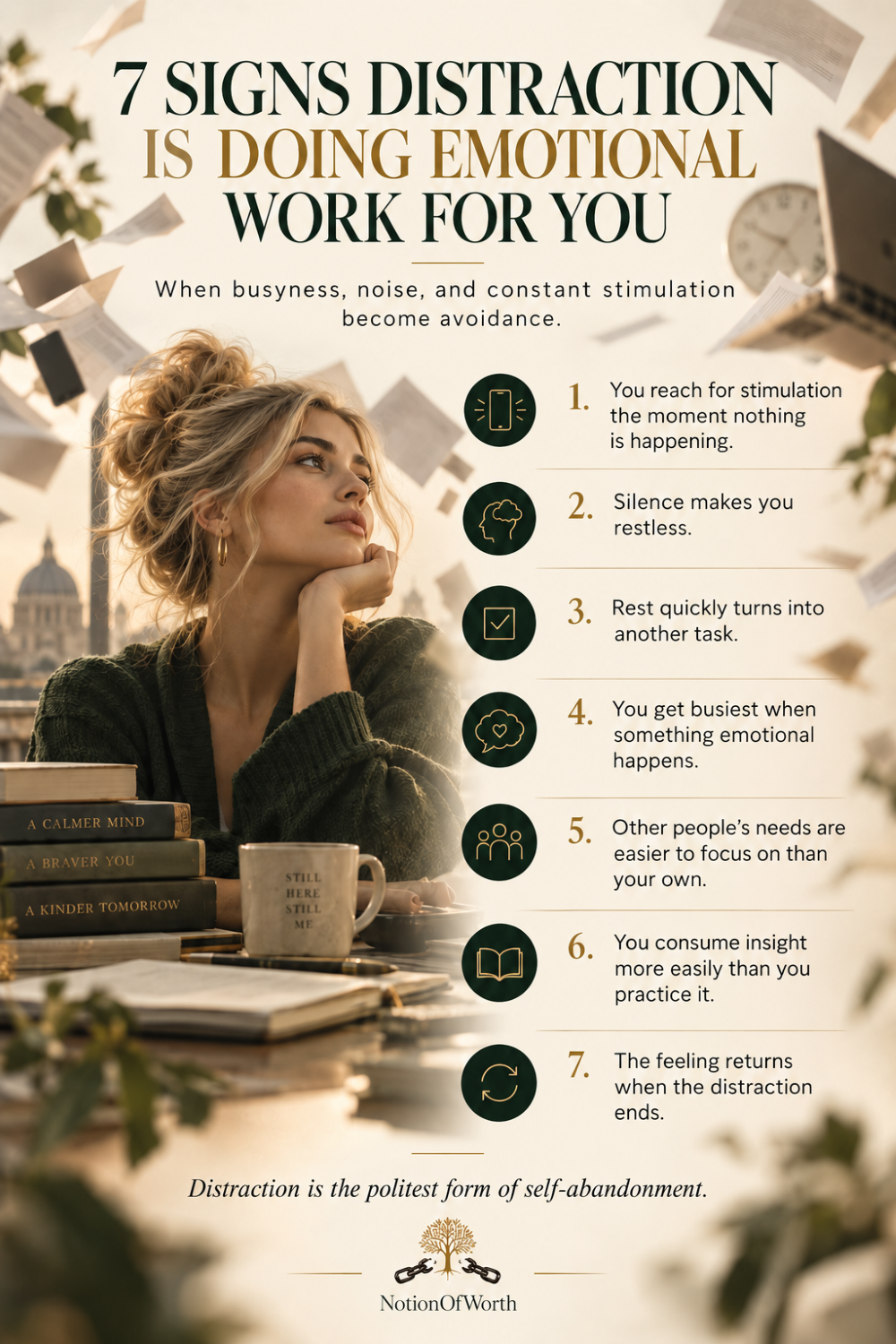
7 Signs Distraction May Be Doing Emotional Work for You
1. You reach for stimulation the moment nothing is happening
A queue.
A red light.
A few minutes before an appointment.
The moment your work is finished.
The second a conversation ends.
Every empty space immediately needs content.
Not necessarily because the content matters.
Because emptiness feels strangely difficult to tolerate.
2. Silence makes you restless
There always needs to be music.
A podcast.
A television in the background.
Messages.
Conversation.
Something playing while you cook.
Something playing while you walk.
Something playing while you fall asleep.
Again, none of this is inherently a problem.
But if silence consistently feels intolerable, it may be worth asking what becomes more noticeable without sound.
3. Rest quickly turns into another activity
You finally sit down.
Within minutes, you are cleaning something.
Checking something.
Planning something.
Learning something.
Fixing something.
Rest feels acceptable only when it can somehow be justified as productive.
4. You become busiest when something emotional happens
A difficult conversation.
Rejection.
Uncertainty.
Conflict.
Loneliness.
Bad news.
And suddenly you have ten things that urgently need your attention.
Activity can sometimes help regulate emotion.
But if movement is always your first response to feeling, you may never discover what the feeling was asking you to understand.
5. Other people’s needs are easier to focus on than your own
You know what everyone else is struggling with.
You remember what they need.You offer solutions.You check in.You help.You organize.You carry.Then someone asks:“What do you need?”And your mind goes blank.6. You consume insight more easily than you practice it
Another book.
Another podcast.
Another psychology account.
Another article.
Another video explaining exactly why you behave the way you do.
Understanding can feel like movement.
But sometimes consuming explanations about yourself becomes a substitute for actually changing how you treat yourself.
7. The feeling returns when the distraction ends
This may be the clearest signal.
The activity works.
For a while.
Then you stop.
And the loneliness is still there.
The decision is still waiting.
The resentment returns.
The uncertainty comes back.
The conversation still needs to happen.
The exhaustion has not gone anywhere.
You succeeded in leaving the feeling.
You did not necessarily move through it.
Rest, Regulation, and Avoidance Are Not the Same Thing
This distinction matters because the goal is not to become suspicious of everything that feels good.
You are allowed to watch television.
Scroll.
Play a game.
Read something easy.
Spend an evening doing absolutely nothing meaningful.
Distract yourself after a difficult day.
Not every uncomfortable feeling needs immediate analysis.
In fact, research on emotion regulation in daily life suggests that distraction is one of the strategies people use when negative emotions intensify — but its effects appear to depend on context rather than distraction simply being “good” or “bad.”
The question is not:
“Did I distract myself?”
The better question is:
“What relationship do I have with the thing I am distracting myself from?”
Rest says:
I know I am tired, and I am choosing recovery.
Regulation says:
This feeling is intense. I am giving myself enough space to become steadier before I return to it.
Avoidance says:
I cannot let myself feel, know, face, or acknowledge this.
From the outside, all three may look identical.
You could be lying on the same sofa holding the same phone.
The difference is what happens next.
Real rest tends to give something back.
A little energy.
A little space.
A little capacity.
Avoidance often needs another avoidance activity when the first one ends.
One episode becomes four.
One check becomes forty minutes.
One busy day becomes a life in which stopping always feels slightly dangerous.
You do not need to eliminate distraction.
You need enough self-awareness to notice what job you are asking it to perform.
The Digital Layer: Why Your Phone Makes Escape So Easy
Your phone did not invent avoidance.
Humans found ways to avoid uncomfortable thoughts long before smartphones existed.
But the phone removed almost all friction from the process, making constant stimulation and mental overload easier to normalize.
There is no need to make a conscious decision to escape a moment.
A new stimulus is always available.
News.
Messages.
Videos.
Music.
Work.
Shopping.
Advice.
Games.
Other people’s lives.
An answer to almost any question.
And another question immediately after it.
That matters because attention follows opportunity.
The easier something is to access, the less intentional the choice needs to become.
When scrolling itself starts becoming automatic or difficult to stop, understanding the psychology of social media addiction can help explain why one quick check so easily becomes another.
Researchers studying boredom and digital media have argued that digital stimulation can divide attention and sometimes function as an ineffective way of coping with boredom. Paradoxically, attempts to escape boredom through constant digital stimulation may in some situations intensify it rather than resolve it.
This does not make your phone the enemy.
It makes it an exceptionally efficient exit.
If you want to change that relationship without simply deleting everything, a digital detox can help you create more friction, reclaim your attention, and make technology use intentional again.
And efficient exits become tempting whenever staying feels uncomfortable.
You do not have to ask:
Why do I feel restless?
You can scroll.
You do not have to ask:
Why did that conversation affect me so much?
You can answer emails.
You do not have to ask:
Am I happy with the way I am living?
You can consume someone else’s life instead.
The technology is not creating every uncomfortable feeling.
Sometimes it is simply helping us postpone the moment when we meet it.
What You May Notice When the Noise Stops
There is a reason “just be present” is often terrible advice.
Presence is not always peaceful.
Sometimes presence is where everything you have been postponing becomes audible.
If quiet suddenly feels overwhelming rather than restorative, the window of tolerance can help explain why your system may be carrying more activation than stillness first reveals.
You may notice exhaustion.
Not ordinary tiredness.
The kind that makes you realize how long you have been pushing yourself.
You may notice loneliness.
Even if you are constantly connected.
You may notice resentment.
Because you have been saying yes while quietly wanting to say no.
You may notice uncertainty.
Because the next decision cannot be solved by collecting more information.
You may notice grief.
Something ended months ago, but you never really stopped moving long enough to feel the ending.
You may notice boredom.
And beneath the boredom, perhaps a lack of meaning.
You may notice desire.
A wish you keep dismissing because acknowledging it might require changing something.
When that happens, the next step is not always another explanation. Sometimes it helps to make the direction more visible. You can create a vision board for a life that feels more like your own — not as an escape from the present, but as a way to clarify what you may actually want to move toward.
You may notice that you are no longer sure why you are doing some of the things you do.
None of these discoveries means you have failed.
They mean attention has returned.
This is one of the quieter costs of chronic distraction:
There can be “no space to notice what you feel,” “no pause to ask what you need,” and “no silence where you can actually hear yourself.”
If you want to explore what tends to surface when the noise finally stops, these shadow work prompts for self-discovery can help you examine the emotions, beliefs, and recurring patterns you may be avoiding.
That is what chronic distraction can cost.
Not simply concentration.
Contact.
How to Come Back Without Making Presence Another Performance
There is a predictable trap here.
You realize you are distracted.
Then you decide to become exceptionally good at being present.
You create rules.
Delete everything.
Track your screen time obsessively.
Build a perfect morning routine.
Turn mindfulness into another performance metric.
And somehow, you are still running.
Just in a more impressive direction.
Coming back to yourself does not require creating a new identity around being undistracted.
It requires recovering small moments of choice.
1. Notice the moment before the distraction
Instead of beginning with:
“Why am I always on my phone?”
Try to catch what happened five seconds earlier.
Were you bored?
Anxious?
Lonely?
Overwhelmed?
Waiting?
Unsure what to do next?
Did a difficult thought appear?
Did you just receive a message that changed your mood?
The distraction itself is often less informative than the moment that preceded it.
2. Create a tiny amount of friction
Do not begin by attempting to eliminate the behavior.
Make automatic distraction slightly less automatic.
Put the phone on the other side of the room for ten minutes.
Finish the meal before opening an app.
Walk around the block without headphones.
Wait thirty seconds before responding to the impulse to check.
The purpose is not discipline.
It is creating enough space to make a choice.
3. Name what is happening without trying to fix it
You do not need an advanced emotional vocabulary every time.
Start with:
Something feels uncomfortable.
I feel restless.
I do not want to think about this.
I feel lonely.
I am angry.
I am not ready to deal with this yet.
Even the final sentence is awareness.
There is an enormous difference between consciously deciding:
“I do not have the capacity for this right now.”
and automatically disappearing from yourself before you even know what happened.
4. Ask what you actually need
Not every feeling needs analysis.
Sometimes you need sleep.
Food.
Movement.
A conversation.
A boundary.
Reassurance.
Time alone.
A decision.
Information.
Less information.
Sometimes you genuinely need harmless distraction.
But there is power in choosing it intentionally.
“I know I am upset. I am going to watch something for an hour because I need a break. I will return to this tomorrow.”
That is different from spending six hours escaping a feeling you refuse to name.
5. Leave some parts of your day unfilled
Not because boredom is morally superior.
Because an attention system that is continuously occupied has very few opportunities to notice anything that is not demanding immediate attention.
You do not need an hour of meditation.
Try five unfilled minutes.
No input.
No optimization.
No task.
See what arrives.
6. Act on one piece of information you receive
Awareness becomes meaningful when it eventually changes how you respond.
If you notice exhaustion, something may need to be reduced.
If you notice resentment, a boundary may be overdue.
If you notice loneliness, connection may need to become more intentional.
If you notice that you keep researching a decision you already understand, perhaps information is no longer the problem.
The purpose of listening to yourself is not endless introspection.
It is learning to respond to yourself.
Attention is not simply something
you give to the world.
It is also one of the ways you show yourself that your own experience is worth noticing.
A Small Distraction Check-In
Before you leave this page, ask yourself:
When during the day do I reach for stimulation most automatically?
What emotion or situation usually comes immediately before it?
What do I find hardest to do without background noise?
When I say I am “resting,” do I usually feel more restored afterward — or simply more numb?
Do I become unusually productive when something emotional is happening?
Is there a conversation, decision, feeling, or truth I keep postponing?
What part of my life receives plenty of activity but very little attention?
When was the last time I spent ten minutes with myself without consuming anything?
What have I already noticed that I keep distracting myself from?
You do not need to answer every question.
Pay attention to the one you wanted to skip.
If I had nothing available to distract me tonight, what would I be most reluctant to notice?
Do not force an answer.
Notice what appears.
Then notice how quickly you want to move away from it.
That movement may tell you something too.
You Do Not Need to Be Available to Everything to Be Present in Your Own Life
Your attention will wander.
You will scroll when you are bored.
You will watch things because you do not want to think.
You will occasionally work because work feels easier than feeling.
You will sometimes need a break from yourself.
That is human.
The goal is not perfect presence.
It is not eliminating entertainment, noise, productivity, ambition, technology, or anything else that occasionally gives you relief.
The goal is to notice when temporary relief begins turning into permanent distance.
Because you can answer every message and still stop listening to yourself.
You can meet every deadline and miss what your exhaustion has been saying.
You can become indispensable to everyone else while becoming increasingly unfamiliar to yourself.
You can fill every empty moment and still feel strangely empty when the day ends.
Your life does not need to become quieter everywhere.
But somewhere inside it, there needs to be enough quiet for you to hear yourself.
Enough space to notice what you feel.
Enough pause to recognize what you need.
Enough attention left over for the person who has been present through every part of your life:
you.
You do not have to stop distracting yourself forever.
You only need to stop disappearing every time something inside you asks to be seen.
Related Reading
DIGITAL DISTRACTION
Sources & Research
- Wang Y, Tian J, Yang Q.
Experiential Avoidance Process Model: A Review of the Mechanism for the Generation and Maintenance of Avoidance Behavior
Psychiatry and Clinical Psychopharmacology, 2024. - Sheppes G, Scheibe S, Suri G, Radu P, Blechert J, Gross JJ.
Emotion regulation choice: A conceptual framework and supporting evidence
Journal of Experimental Psychology: General, 2014. - Hossain S, Kyron MJ, DeMarree KG, Naragon-Gainey K.
Emotion regulation in daily life: Testing bidirectional temporal associations with positive and negative affect
Emotion, 2025. - De Segovia Vicente D, Van Gaeveren K, Murphy S, Vanden Abeele MMP.
Tapping into feelings: An experience sampling study examining the dynamics of smartphone-based emotion regulation and negative affect
Emotion, 2026. - Tam KYY, Inzlicht M.
Fast-forward to boredom: How switching behavior on digital media makes people more bored
Journal of Experimental Psychology: General, 2024.
This article is for general educational and informational purposes only. It does not diagnose, treat, or replace professional health care. Read our Editorial & Research Standards and Disclaimer for more information.
Understanding yourself is not about analyzing
every thought or emotion
It is about learning to recognize the patterns shaping your choices — so you can respond with more clarity, intention, and self-trust.
EXPLORE KNOW YOURSELF →A quieter kind of growth, delivered to your inbox.
Reflections on self-worth, emotional clarity, relationships, and the patterns that shape how you live — without the constant noise.
No constant advice. Just thoughtful ideas worth sitting with.