Attachment Styles in Relationships: Understanding Your Attachment Blueprint
By Notion of Worth Editorial · September 2026
The way you respond to closeness, distance, reassurance, and conflict may follow patterns you learned long ago. Explore attachment styles in relationships and learn how to recognize your own attachment blueprint without turning it into another label.

The way you respond to closeness, distance, reassurance, and conflict may follow patterns you learned long before you had words for them.
A delayed reply.
A partner asking for space.
A difficult conversation.
A subtle change in someone’s tone.
You may think you are reacting only to what is happening now.
But sometimes, the intensity of what you feel is also connected to what closeness, distance, uncertainty, and emotional safety have come to mean to you.
This is where attachment theory can become useful.
Not as a label.
Not as a diagnosis.
And not as proof that every relationship difficulty began in childhood.
But as a framework for understanding the expectations and protective strategies we may bring into close relationships.
Your attachment blueprint is the name we will use here for those patterns: the ways you tend to seek connection, respond to uncertainty, protect yourself from rejection, and manage the tension between closeness and independence.
And although some of these patterns can feel deeply ingrained, they are not necessarily permanent.
Understanding your attachment blueprint is not about deciding what type of person you are.
It is about noticing what happens inside you when connection begins to feel uncertain.
What This Article Is Based On
What Is an Attachment Blueprint?
Attachment theory began with a simple but powerful idea: human beings develop expectations about whether important others are likely to be available, responsive, and safe when we need them.
Over time, experiences of connection can contribute to internal expectations about relationships.
Can I depend on someone?
Will they still be there when I need them?
Is it safe to need another person?
Will closeness cost me my independence?
Am I still valued when someone becomes distant?
These expectations do not necessarily operate as conscious beliefs.
Often, they appear as reactions.
You check your phone again.
You replay a conversation.
You analyse a short message.
You feel an urge to fix the relationship immediately.
Or you suddenly want to pull away from a conversation that feels emotionally demanding.
What looks irrational from the outside may sometimes be an attempt to restore a sense of safety.
That is why understanding attachment becomes less useful when we only ask:
“Which attachment style am I?”
A more revealing question is:
“What do I tend to do when connection feels uncertain?”
Attachment Is a Pattern, Not a Personality
One of the easiest mistakes to make with attachment theory is turning it into another personality test.
I’m anxious.
She’s avoidant.
He’s secure.
My ex was fearful-avoidant.
These labels can provide useful shorthand, but they become misleading when we treat them as fixed identities.
Adult attachment is often understood through two broad dimensions: attachment anxiety and attachment avoidance.
Attachment anxiety relates to how strongly we may worry about rejection, abandonment, or whether another person is emotionally available.
Attachment avoidance relates to how uncomfortable we may feel with dependence, vulnerability, emotional closeness, or relying on other people.
Different combinations of these tendencies are often described using familiar attachment patterns such as secure, anxious, avoidant, and fearful-avoidant.
These descriptions can help us recognise broad tendencies.
But human attachment is better understood as a spectrum than as four rigid boxes.
You may feel relatively secure with close friends and much more anxious in romantic relationships.
You may feel comfortable with intimacy until conflict begins.
You may once have pursued reassurance constantly and later become more guarded after betrayal.
You may also respond very differently to a consistently responsive person than to someone unpredictable.
Your attachment tendencies can influence your relationships.
They do not define your entire personality.
A pattern can explain your reaction without becoming your identity.
Understanding your attachment pattern should create more choice — not give you another label to live inside.

Secure Attachment: Closeness Without Losing Yourself
Secure attachment does not mean never feeling insecure.
It does not mean never becoming jealous, hurt, angry, lonely, or afraid.
Security is better understood as a relationship with closeness in which connection does not constantly feel like something that must be earned, controlled, or escaped.
Someone functioning relatively securely can usually move between intimacy and independence without interpreting either one as a threat.
Closeness does not automatically mean losing autonomy.
Space does not automatically mean abandonment.
Conflict does not automatically mean the relationship is ending.
A more secure response might sound like:
Something feels different. I want to understand what is happening.
Rather than:
Something feels different. I need to make this feeling disappear immediately.
Security allows uncertainty to exist without turning every uncertain moment into a verdict about your worth or the future of the relationship.
And that distinction matters.
Anxious Attachment: When Distance Feels Like Danger
For someone with stronger attachment anxiety, uncertainty in a relationship can become emotionally loud.
A delayed message may not feel like a delayed message.
It may feel like:
Something has changed.
They’re losing interest.
I did something wrong.
I’m about to be left.
Uncertainty creates an urgent need for resolution.
So the person may seek reassurance, analyse communication, increase contact, monitor emotional changes, or try to restore closeness as quickly as possible.
From the outside, this can look like neediness.
From the inside, it may feel like trying to make the relationship safe again.
The problem is not wanting reassurance.
Reassurance is a normal human need.
The difficulty begins when another person’s immediate response becomes the only thing capable of quieting the fear.
Then the question can slowly shift from:
“Is this relationship working for me?”
to:
“What can I do to make sure this person doesn’t leave?”
When preserving connection begins to require silencing your needs, changing your limits, or becoming smaller, it can turn into a pattern of abandoning yourself to keep the peace.
And somewhere in that shift, self-worth can begin negotiating with uncertainty.
You may start adjusting yourself.
Explaining more.
Accepting less clarity.
Looking for signs of reassurance instead of asking whether the relationship itself feels consistent.
The goal becomes preserving connection — even when preserving connection requires moving further away from yourself.
Learning to set and maintain healthy boundaries can help interrupt that pattern by making room for both connection and autonomy.
Healthy connection looks different: it leaves room for boundaries, disagreement, autonomy, and respect. These are some of the green flags of emotionally safe character that can be easy to overlook when intensity feels more familiar than security.
These patterns can become especially visible as a relationship moves beyond early attraction and begins asking for more reality, negotiation, repair, and intimacy. The 5 Stages of a Relationship explores how those demands can change as a relationship deepens.
Avoidant Attachment: When Closeness Feels Like Pressure
Avoidant patterns can look almost opposite.
Instead of responding to relationship uncertainty by moving closer, the person may create distance.
Emotionally intense conversations can feel overwhelming.
Dependence can feel uncomfortable.
Requests for reassurance may feel like demands.
Conflict may activate an urge to withdraw, minimise the problem, become highly rational, focus on something else, or restore independence.
The internal message may sound less like:
Please don’t leave me.
and more like:
I need space.
This is becoming too much.
I can handle things myself.
Why does everything need to be discussed?
But avoidance does not necessarily mean a lack of emotion.
Sometimes distance itself is the strategy used to manage emotion.
If needing someone feels risky, not needing anyone can begin to feel safer.
Independence can be healthy.
Space can be healthy.
Boundaries can be healthy.
The important question is whether independence is freely chosen — or whether it has become protection against vulnerability.
Fearful-Avoidant Attachment: When You Want Love and Fear It at the Same Time
Some relationship patterns contain both strong attachment anxiety and strong attachment avoidance.
This is commonly described as fearful-avoidant attachment.
Here, closeness can be deeply wanted and deeply threatening.
When connection feels available, part of you may move toward it.
When intimacy becomes real, another part may become afraid.
You may fear abandonment when someone pulls away — but feel trapped when they come too close.
You may want reassurance — but distrust it when you receive it.
You may long to be fully known — while simultaneously fearing what might happen if someone actually sees you.
This can create an exhausting contradiction:
Come closer.
Not that close.
The behaviour can appear inconsistent because the underlying protection is trying to solve two different fears at once:
the fear of losing connection
and
the fear of being hurt by connection.
Understanding this pattern does not mean assuming that every conflicted relationship response is evidence of trauma or a specific childhood experience.
It simply gives us another way to examine why intimacy can sometimes activate both longing and self-protection.
Why Closeness Feels Different to Different People
Two people can experience exactly the same event and assign completely different meanings to it.
One person hears:
“I need an evening to myself.”
and thinks:
Of course. See you tomorrow.
Another hears:
You’re pulling away from me.
Another hears:
Good. I needed some space too.
Someone else might simultaneously feel rejected and relieved.
The event is the same.
The meaning is different.
Attachment patterns help explain part of that difference.
We do not only respond to what another person does.
We also respond to what we believe their behaviour means.
And that is why seemingly small relationship moments can trigger disproportionately large reactions.
The reaction may be happening in the present.
But the meaning attached to it may have been shaped much earlier.
The Anxious–Avoidant Trap
One of the clearest examples of attachment patterns interacting is the anxious–avoidant cycle.
One person senses distance and seeks more connection.
The other experiences the increased pursuit as pressure and seeks more space.
The first person experiences that space as further evidence that something is wrong and intensifies the pursuit.
The second experiences the intensified pursuit as even more overwhelming and withdraws further.
The cycle becomes:
Distance → anxiety → pursuit → pressure → withdrawal → more anxiety → more pursuit.
Eventually, both people may believe the other person is causing the problem.
The anxious partner thinks:
If you would stop pulling away, I wouldn’t need so much reassurance.
The avoidant partner thinks:
If you would stop demanding reassurance, I wouldn’t need to pull away.
Both experiences can feel completely true from inside the pattern.
And that is what makes the cycle difficult.
Each person’s protective strategy may accidentally activate the other’s.
This does not mean every anxious–avoidant relationship follows the same cycle, or that either partner can be reduced to an attachment label.
The useful part is recognising the interaction pattern when it appears.
The shift begins when the question changes from:
“Who started this?”
to:
“What happens between us when connection stops feeling safe?”
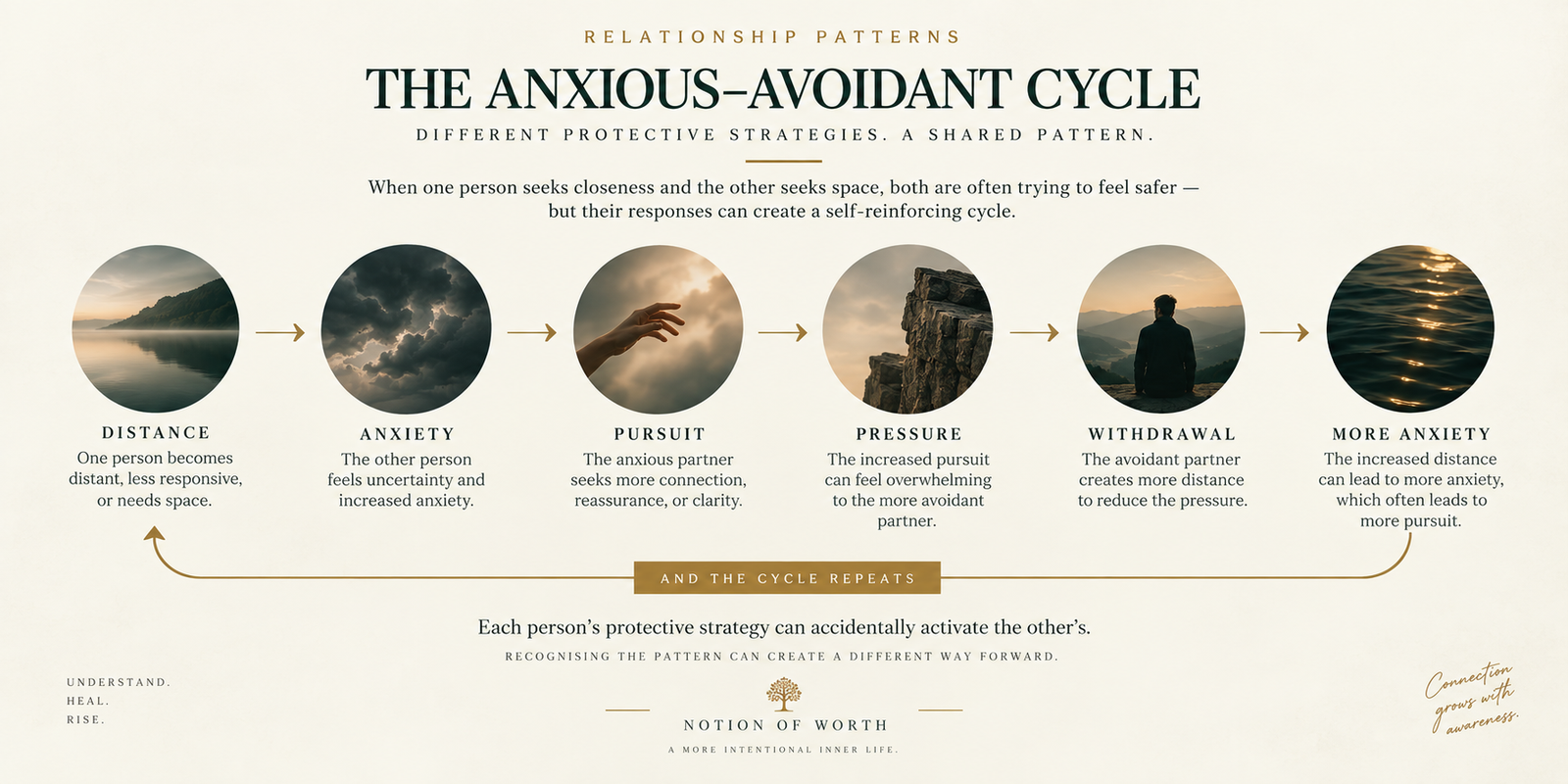
The anxious–avoidant cycle can become self-reinforcing when each person’s attempt to feel safer activates the other’s protective response.
What Anxious Attachment Says vs. What It Actually Needs
Anxious attachment does not always communicate its underlying need directly.
It may say:
“Why haven’t you texted me back?”
while underneath sits:
“I need to know that our connection is still safe.”
It may say:
“Do you even care about me?”
while underneath sits:
“I need clarity about where I stand.”
It may say:
“Tell me we’re okay.”
when the deeper need is consistency.
The goal is not to eliminate the need for connection.
It is to become better at recognising the need beneath the reaction.
Because when we cannot identify the real need, we often communicate through protest instead.
And protest tends to ask for connection in ways that can sometimes make connection harder.
The question becomes:
What am I really asking for right now?
Reassurance?
Clarity?
Consistency?
Presence?
A direct conversation?
Knowing the difference can change how the need is expressed.
What Avoidant Attachment Says vs. What It May Be Protecting
Avoidant patterns have their own surface language.
“I don’t want to talk about it.”
may sometimes protect against emotional overwhelm.
“I don’t need anyone.”
may protect against the vulnerability of depending on someone.
“Relationships are too complicated.”
may protect against expectations that closeness will eventually become painful, demanding, or restrictive.
Again, this does not mean every desire for space is avoidance.
Healthy people need boundaries.
Healthy people need independence.
Healthy people sometimes need time before talking.
The important question is not whether you want space.
It is:
What happens inside you when someone gets emotionally close?
Space can be a boundary.
Or it can become armour.
They are not the same thing.
Your Relationship Can Activate a Different Version of You
Your attachment tendencies do not necessarily look identical in every relationship.
A highly inconsistent relationship may amplify anxiety.
A controlling relationship may amplify withdrawal.
A reliable and emotionally responsive relationship may make security easier.
Major life experiences, betrayal, loss, stress, healthier relationships, therapy, and personal development can also influence how people experience closeness over time.
That is why saying:
“I am anxiously attached.”
may sometimes be less helpful than saying:
“I notice that uncertainty activates anxiety in me, and this is what I tend to do next.”
The second sentence contains something the first one does not.
Movement.
If something becomes an identity, you may begin defending it.
If something is recognised as a pattern, you can observe it.
And what you can observe, you can begin responding to differently.
Can Your Attachment Blueprint Change?
Yes.
But probably not because you simply decide that from now on you will be securely attached.
Deep patterns usually change through repeated experiences.
Experiences of expressing a need without being punished for having one.
Experiences of allowing someone space without immediately assuming abandonment.
Experiences of staying present during a difficult conversation instead of disappearing from it.
Experiences of setting a boundary and discovering that connection can survive it.
Experiences of depending on someone without losing yourself.
Experiences of noticing your first reaction without automatically obeying it.
Over time, experiences like these can challenge old expectations about what connection means.
Attachment patterns can show continuity over time, but research also suggests that change is possible as relationships and life experiences change.
The goal is not to become someone who never needs reassurance.
It is not to become someone who never needs space.
And it is not to become emotionally unaffected.
Security is not emotional perfection.
It is increasing your ability to experience closeness, distance, vulnerability, and conflict without repeatedly abandoning yourself in order to feel safe.
When connection feels uncertain, what do I automatically do — and what am I trying to protect?
Security may begin with noticing the pattern before automatically repeating it.
What Secure Attachment Can Be Learned
Becoming more secure often looks less dramatic than people expect.
It may look like recognising that you are activated before sending another message.
It may look like saying what you need instead of testing whether someone will guess.
It may look like remaining in a difficult conversation for five minutes longer than your instinct to withdraw wants you to.
It may look like allowing another person to have a boundary without immediately interpreting it as rejection.
It may look like setting your own boundary without assuming that doing so will cost you the relationship.
It may look like asking for clarity instead of trying to decode ambiguity.
It may look like noticing when you are working harder to preserve a relationship than to ask whether the relationship is healthy.
And sometimes it means learning one of the hardest relationship truths:
Feeling attached to someone is not the same thing as being safe with them.
And even after a relationship ends, unresolved patterns can leave emotional baggage that shapes how future connection feels.
Understanding attachment should never be used to rationalise chronic disrespect, manipulation, emotional neglect, coercion, or abuse.
Sometimes the task is not learning to tolerate more.
Sometimes the task is recognising what should no longer be tolerated.
A Small Attachment Pattern Check-In
Think about a close relationship — present or past — in which you felt emotionally activated.
Then consider:
What usually happens when I sense emotional distance?
Do I move toward the person?
Move away?
Or alternate between both?
What am I afraid the situation means?
That I am being rejected?
That I am losing control?
That I will be abandoned?
That someone expects too much from me?
What do I usually do to make that fear disappear?
Seek reassurance?
Over-explain?
Withdraw?
Become emotionally unavailable?
Test the relationship?
Ignore the problem?
Does that strategy create more connection — or only temporary relief?
And then ask:
What do I actually need in that moment?
Reassurance?
Clarity?
Consistency?
Space?
A boundary?
A direct conversation?
Or simply time to understand what I am feeling before reacting?
You are not trying to diagnose yourself.
You are looking for the sequence.
Trigger → meaning → feeling → protection → consequence.
That sequence is often more useful than the attachment label itself.
Your Pattern Is Not Your Fate
Attachment theory can give language to experiences that once felt confusing.
Why distance sometimes feels unbearable.
Why closeness sometimes feels threatening.
Why one person pursues while another withdraws.
Why we may ask for reassurance without ever feeling fully reassured.
Or why we may protect our independence long after independence has quietly become isolation.
But there is a danger in learning the language of attachment and using it to build a new identity around an old protection.
You are not a relationship category.
You are a person whose mind learned ways of navigating connection.
Some of those strategies may still serve you.
Some may belong to situations that no longer exist.
And some may become visible only when something important feels at risk.
The question is not simply:
“What is my attachment style?”
A deeper question is:
“What does closeness make me believe I need to do in order to stay safe — and is that still true?”
That is where understanding becomes useful.
Not when it gives you another label.
When it gives you another choice.
Related Reading
Sources & Research
- Hazan C, Shaver P.
Romantic love conceptualized as an attachment process
Journal of Personality and Social Psychology, 1987. - Simpson JA, Rholes WS.
Adult Attachment, Stress, and Romantic Relationships
Current Opinion in Psychology, 2017. - Mikulincer M, Florian V, Cowan PA, Cowan CP.
Attachment security in couple relationships: A systemic model and its implications for family dynamics
Family Process, 2002. - Overall NC, Simpson JA.
Partner Buffering of Attachment Insecurity
Current Directions in Psychological Science, 2015. - Zhang X, et al.
The relationship between adult attachment and mental health: A meta-analysis
Journal of Personality and Social Psychology, 2022.
This article is for general educational and informational purposes only. It does not diagnose, treat, or replace professional health care. Read our Editorial & Research Standards and Disclaimer for more information.
Go Deeper Than the Pattern.
Explore how boundaries, self-worth, emotional needs, and relationship patterns shape the way you connect with others.
EXPLORE RELATIONSHIPS & BOUNDARIESKeep Growing Without Turning
Against Yourself
Personal growth does not require constant self-correction.
Sometimes it begins with understanding why a pattern exists well enough that you no longer need to obey it automatically.
If you want thoughtful reflections on self-worth, identity, relationships, emotional health, and meaningful personal change, join The Worth Letter.
Weekly reflections. No noise. Unsubscribe anytime.
Understand Yourself. Growth from inside.