How to Create a Vision Board
for a Life That Feels Like You
A vision board can be more than a collage of things you want. Learn how to create one around your values, relationships, self-trust, rest, purpose, and the life you actually want to live.
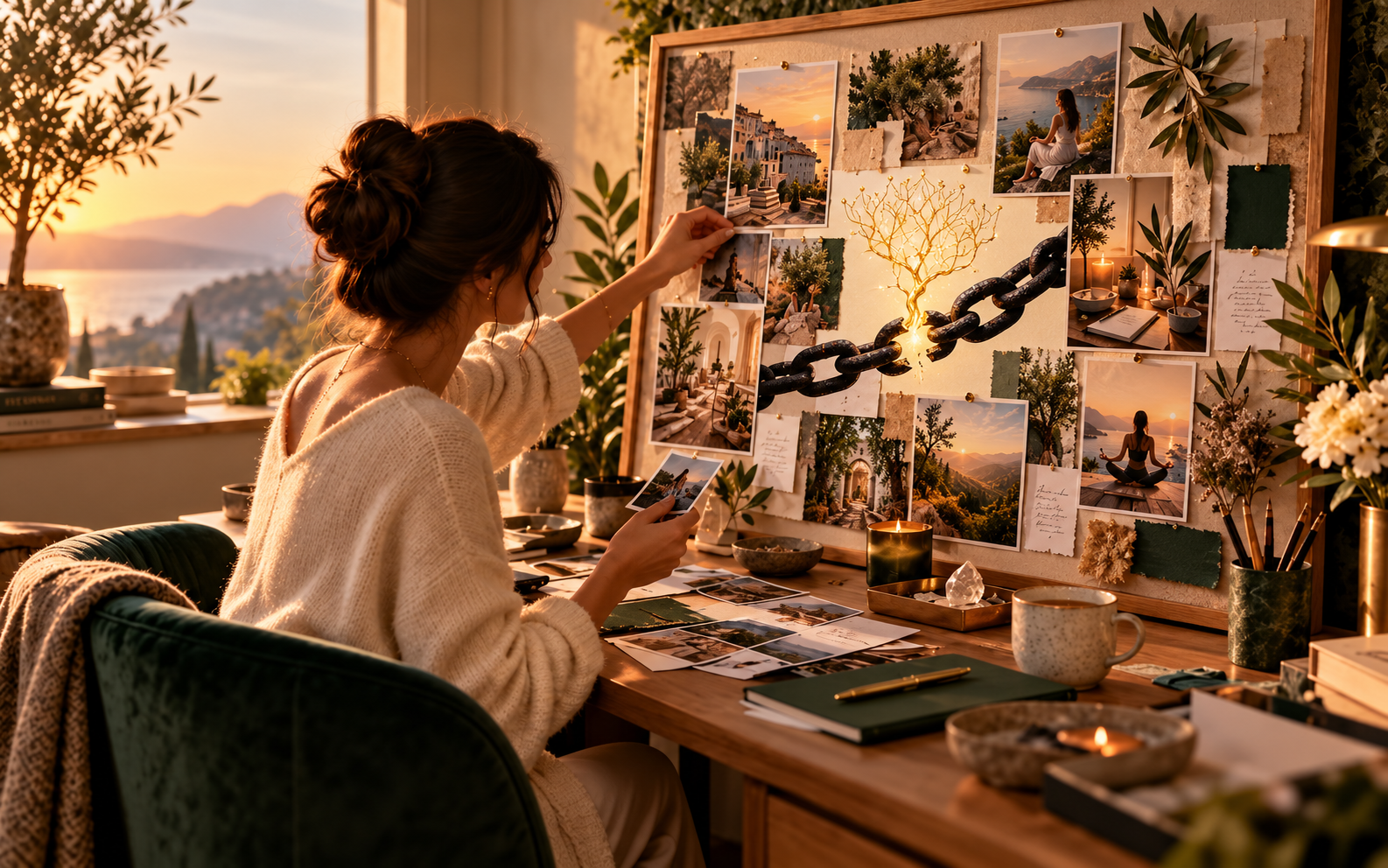
It is surprisingly easy to create a vision board for a life you do not actually want.
You collect beautiful homes, impressive careers, perfect routines, distant places, ideal bodies, expensive things, and versions of success that look convincing from the outside.
Then you step back and realize something is missing.
You.
A meaningful vision board is not simply a collection of things that would make your life look better. At its best, it can become a visual reminder of what you want your life to feel like, make room for, protect, and move toward.
That changes the question.
Instead of asking:
What should my future look like?
you begin asking:
What kind of life would actually feel like mine?
And that is a very different board.
Learning how to create a vision board that feels personal begins with separating what genuinely matters to you from what simply looks desirable from the outside.
What a Vision Board Can Do — and What It Cannot
A vision board is a collection of images, words, places, experiences, ideas, and symbols that represent a direction you want your life to move toward.
It can help make something abstract more visible.
A quieter home.
Work that feels meaningful.
More time outside.
Relationships where you do not have to perform for belonging.
The confidence to make decisions without asking everyone else first.
A morning that does not begin in panic.
A life with enough space to hear yourself think.
But a vision board is not evidence that something will happen simply because you pictured it.
Visualization cannot replace decisions, circumstances, effort, opportunity, or action.
And sometimes imagining the ideal future without acknowledging the distance between that future and your current life can actually become another way of escaping the present.
The useful question is not:
“How do I make the universe give me this?”
It is:
“What is this image showing me about what matters to me — and what would moving toward it look like in real life?”
That is where a vision board becomes more than decoration.
Before You Build a Vision Board, Ask Whose Life You Are Designing
Some desires feel personal long before we have ever questioned where they came from.
A certain kind of career.
A certain relationship timeline.
A certain home.
A certain body.
A certain level of productivity.
A certain definition of success.
When you see those things repeatedly — in families, culture, workplaces, advertising, and social media — they can begin to feel like your own preferences.
Sometimes they are.
Sometimes they are not.
This is why creating a vision board can reveal something more interesting than what you want.
It can reveal whose approval is still shaping what you think you should want.
Before saving another image, pause over it.
Would you still want this if nobody could see that you had it?
Would the experience itself matter to you, or mainly what it would seem to say about you?
Are you drawn to the life behind the image — or to the status attached to it?
You do not have to reject ambition, beauty, money, achievement, travel, or comfort in order to build an authentic life.
You simply need to know when you are choosing them.
And when you are performing them.
If separating your own preferences from other people’s expectations feels difficult, that question often reaches deeper than a vision board. Sometimes the first step is learning to recognize what you actually want beneath all the voices telling you what you should want.
Start With Feelings, Not Things
Before searching for images, try beginning somewhere less visual.
Ask:
How do I want my life to feel?
Not every day. Not perfectly.
But often enough that the feeling becomes part of the architecture of your life.
You might choose:
Peace
Not a life without difficulty.
A life with less unnecessary chaos.
Perhaps peace looks like fewer rushed mornings, a calmer home, more financial breathing room, less conflict, more time outside, or relationships where uncertainty is not constantly mistaken for chemistry.
Self-Trust
Self-trust may not look dramatic on a board.
It might look like someone walking alone.
A closed notebook.
A train ticket.
A person taking a different path.
The image matters less than what it represents:
making a decision without needing everyone else to agree with it first.
That kind of self-trust becomes easier when your sense of value is not constantly being negotiated through other people’s reactions. If that feels familiar, explore how to stop relying on external validation to determine your worth.
Boundaries
A boundary does not have to be represented by a wall.
It might be an uncluttered calendar.
A closed laptop at dinner.
A quiet room.
A person leaving.
A door.
Time with people who respect a no without requiring an explanation.
The question is not simply what you want more of.
It is also:
What would need to stop consuming your time, attention, and energy for that life to exist?
Sometimes creating more space begins with recognizing where stronger boundaries could protect your peace.
Purpose
Purpose does not always mean finding one great calling.
Sometimes it means having enough of your life pointed toward things that matter to you.
Work you care about.
Something you are building.
Something you are learning.
Someone you are helping.
A creative practice that belongs to you even if nobody applauds it.
Rest
Rest deserves a place on a vision board too.
Not only holidays.
Not only spa days.
A life that does not require constant recovery from the way it is structured.
A slower breakfast.
Enough sleep.
Unscheduled space.
A weekend that is not simply catching up with everything the week took from you.
The goal is not to create a board that looks calm.
It is to notice what would have to change for calm to become more available in your actual life.
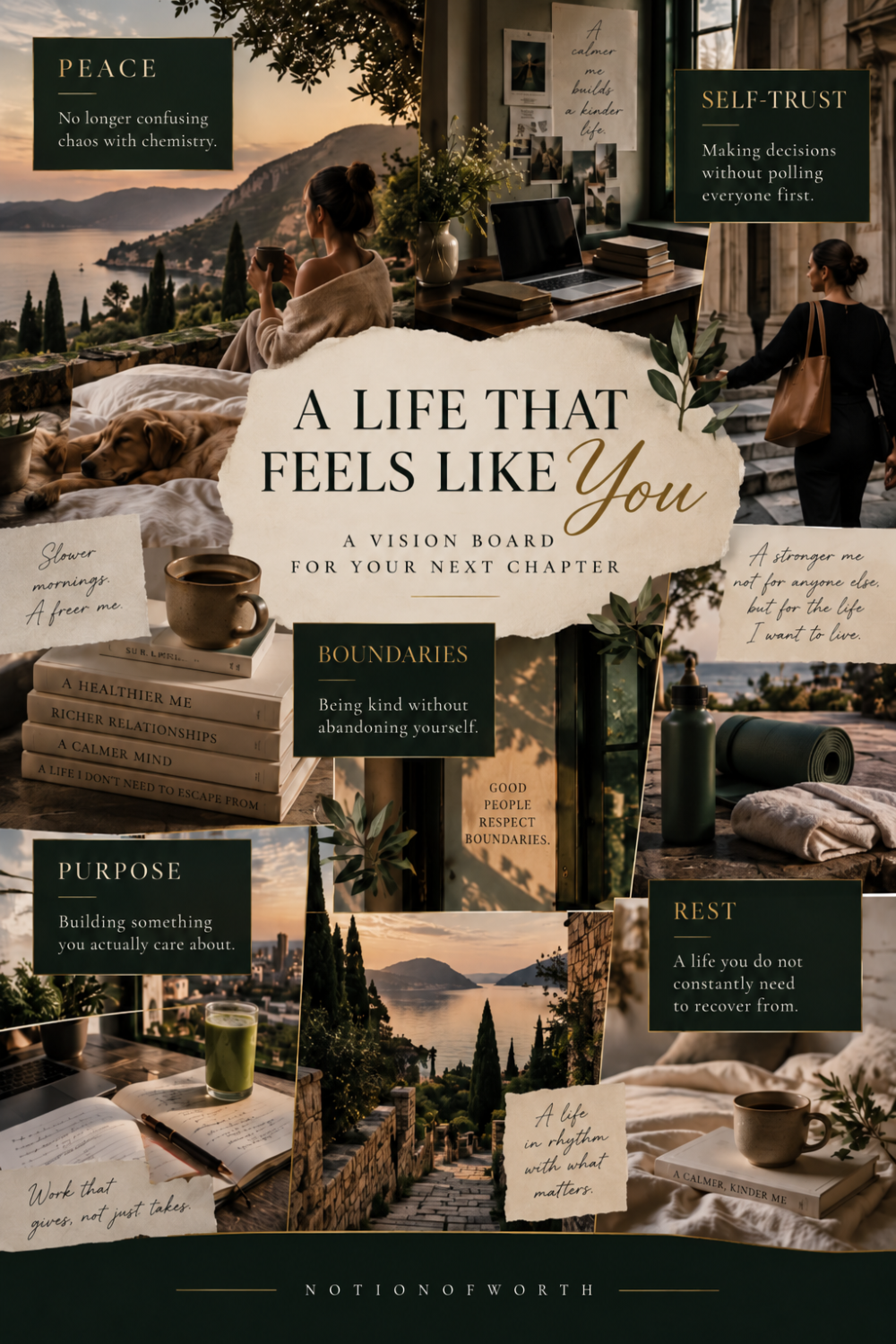
A vision board can be less about collecting impressive outcomes — and more about choosing how you want your life to feel.
Picture an Ordinary Tuesday, Not Just Your Dream Life
Vision boards tend to collect exceptional moments.
The beach.
The promotion.
The wedding.
The perfect house.
The plane ticket.
The finish line.
But most of your life will not happen at the finish line.
It will happen on ordinary Tuesdays.
So imagine one.
Where do you wake up?
How rushed are you?
What does the room feel like?
Who is there?
What do you do before looking at your phone?
What kind of work fills most of the day?
How much control do you have over your time?
How does your body feel by the afternoon?
Who do you speak to?
What do you eat?
Is there enough space for boredom, movement, conversation, thought, or rest?
What happens after work?
How do you feel when the day becomes quiet?
This exercise can change a vision board completely.
You may discover that what you want is not a more impressive life.
You want a less fragmented one.
Not a larger house, but a home that feels safe.
Not constant travel, but enough freedom to leave occasionally.
Not more people around you, but relationships where you can exhale.
Not endless achievement, but work you can respect without allowing it to become your entire identity.
A future becomes more useful when you can imagine living inside it, not simply photographing it.
Choose Goals That Belong to You
There is a useful idea in psychology known as self-concordance.
Self-concordant goals are goals that fit a person’s genuine interests, values, and developing sense of self rather than being pursued mainly because of external pressure or internalized expectations.
Research on self-concordant goals has found that people tend to put more sustained effort into goals that feel genuinely their own, and attaining those goals is more closely connected with psychological need satisfaction and well-being.
That distinction belongs at the center of a vision board.
Because two images can look almost identical while representing completely different motivations.
One person may want a leadership role because they enjoy building, solving problems, and guiding people.
Another may want the same role because finally being important enough feels like it might quiet an old sense of inadequacy.
One person may want a beautiful home because space, comfort, and hospitality genuinely matter to them.
Another may want it because they imagine what other people will think when they see it.
The object is not the problem.
The reason matters.
A useful vision board does not only ask:
What do I want?
It also asks:
Why does this matter to me?
A Vision Board Needs Reality Too
There is a subtle danger in imagining the future.
The imagined version can feel so satisfying that it temporarily gives you some of the emotion you wanted from achieving it.
The picture feels like progress.
But the life itself remains unchanged.
Research on mental contrasting offers a more grounded approach: imagine the desired future, then deliberately consider the real obstacle standing between you and it. When combined with concrete implementation intentions — simple “if this happens, then I will do that” plans — this approach has shown a small-to-moderate positive effect on goal attainment across studies.
That gives us a better way to use a vision board.
For every meaningful image, ask:
What could keep this from becoming real?
And then:
What is one action within my control?
If your board includes deeper friendships, perhaps the obstacle is that you keep waiting for other people to initiate.
If it includes a calmer home, perhaps the obstacle is not decorating but owning too many things.
If it includes creative work, perhaps the obstacle is giving your best hours to scrolling.
If it includes stronger boundaries, perhaps the obstacle is the discomfort you feel when someone is disappointed in you.
If it includes rest, perhaps the obstacle is believing you must earn it first.
The purpose is not to turn every dream into another productivity system.
It is to connect desire with reality.
A meaningful vision is not a picture of what will impress other people. It is a picture of a life you would still want if nobody else could see it.
Your board does not need to prove that your future will be extraordinary.
It only needs to help you recognize what is worth moving toward.
How to Create a Vision Board That Actually Feels Personal
There is nothing wrong with including specific goals.
The problem begins when the board contains only outcomes and nothing about the person who will have to live inside them.
A more complete vision includes both.
Relationships
Do not only picture a partner, wedding, family, or group of friends.
Picture the qualities of connection you want to experience.
Safety.
Reciprocity.
Humor.
Honesty.
Affection.
Repair after conflict.
People who respect your limits.
A relationship you do not have to disappear inside in order to keep.
Work and Purpose
You can include a job title, business, creative project, degree, studio, income goal, or workspace.
But also ask what you want work to give you beyond status.
Autonomy?
Mastery?
Creativity?
Stability?
Meaning?
Flexibility?
Contribution?
A career that looks successful but repeatedly violates what matters to you may not feel successful once you are living it.
Home and Environment
Instead of choosing only the most beautiful room you can find, notice what the room communicates.
Light.
Privacy.
Nature.
Warmth.
Order.
Space for other people.
Space away from other people.
Perhaps what you want is not that exact kitchen.
Perhaps you want the feeling of having enough time to cook in it.
Health and Energy
A health vision does not have to begin with appearance.
It can include strength, sleep, mobility, energy, nourishment, time outside, medical care, movement you enjoy, or a relationship with your body that is less adversarial.
Ask what you want your body to help you experience, not only how you want it to be seen.
Money and Freedom
Money can represent many things.
Security.
Choice.
Generosity.
Independence.
Travel.
A home.
Time.
The ability to leave a harmful situation.
The ability to work less.
Try to identify what the number means beneath the number.
That meaning often produces a much more honest vision.
Rest and Attention
This category is easy to forget because there is nothing particularly glamorous about having enough mental space.
But attention shapes a life.
If your ideal future still has every quiet moment filled with notifications, urgency, comparison, and endless input, changing the scenery may not change the experience very much.
Your vision board can include what you want to protect from constant access.
Vision Board Ideas for Different Seasons of Your Life
You do not need one board that contains every possible dream.
Sometimes a board becomes more useful when it answers one particular question.
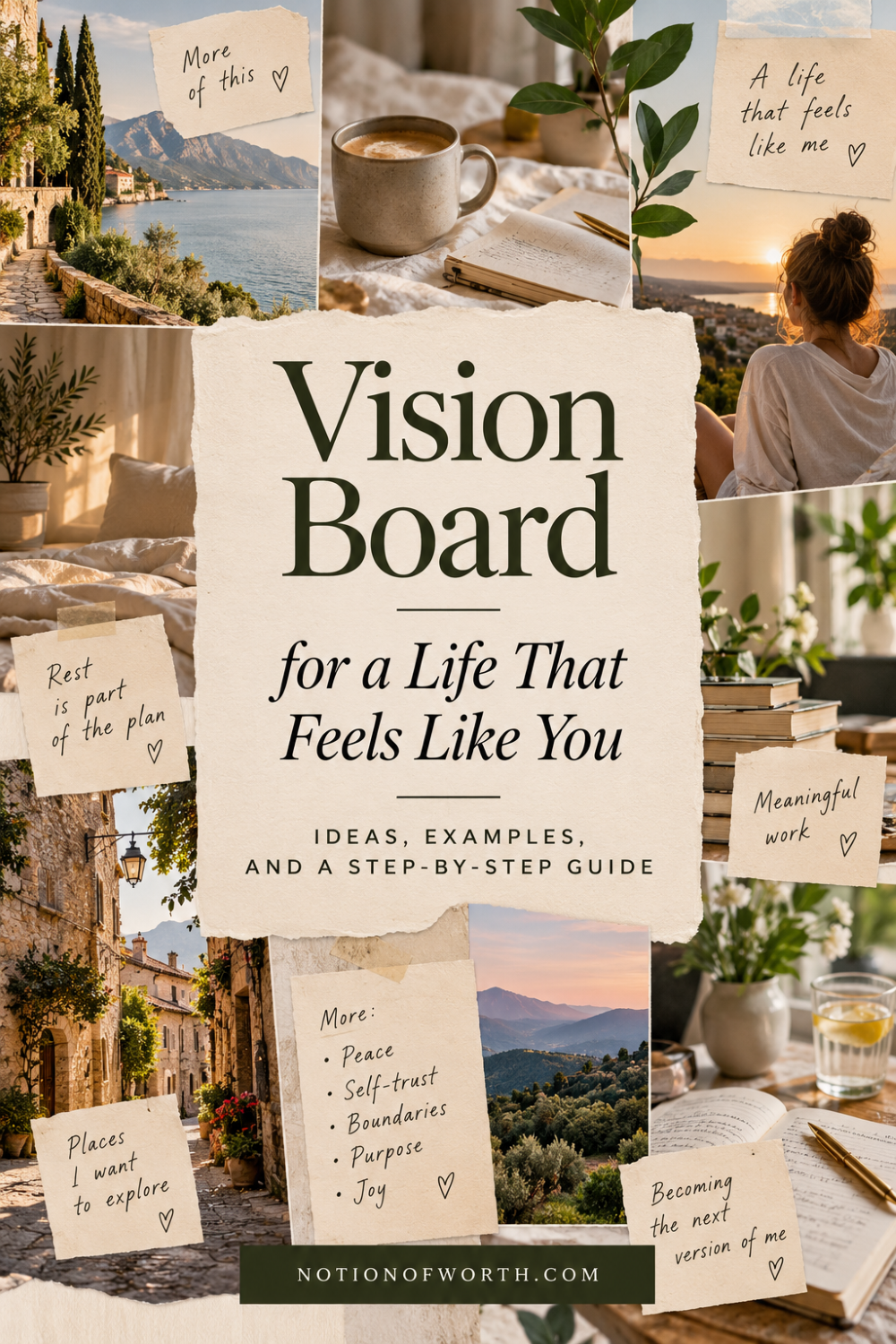
A vision board can focus on more than achievements — it can make room for peace, self-trust, meaningful work, rest, purpose, and the kind of life you want to grow into.
A Life That Feels Like You
Build this board around alignment.
Peace.
Self-trust.
Boundaries.
Purpose.
Rest.
Relationships.
Meaningful work.
Ask what would make your life feel more recognizable from the inside.
Not more impressive.
More yours.
Quiet Confidence
A quiet confidence vision board is less about becoming fearless and more about becoming less dependent on constant reassurance.
Choose images that represent self-trust, competence, independence, calm decision-making, personal style, boundaries, and the ability to be seen without constantly editing yourself for approval.
Confidence does not always look loud.
Sometimes it looks like no longer explaining every choice.
Who I’m Becoming
This board is useful when an old identity no longer fits but the next one has not fully formed.
That in-between period can feel disorienting, especially when you are outgrowing an older version of yourself before the next one feels fully familiar.
Instead of asking only what you want to achieve, ask:
What does this version of me protect?
What does this person stop tolerating?
What do they practice?
How do they respond differently?
What no longer follows them into the next chapter?
The goal is not to invent a perfect future self.
It is to give emerging parts of yourself somewhere visible to exist.
Peace Is Part of the Plan
Some people build futures full of goals without noticing that every goal requires more speed, more availability, more performance, and more pressure.
A peace-centered vision board asks a different question:
If I actually reached everything on my board, would I enjoy living the life it created?
Include space.
Time.
Nature.
Financial stability.
Supportive relationships.
Boundaries.
Unhurried moments.
A nervous system does not experience success as a résumé.
It experiences the conditions of your everyday life.
A Life I Don’t Need to Escape From
This board is not about eliminating difficulty.
It is about noticing what makes escape feel constantly necessary.
Work that consumes everything.
Relationships that drain you.
A schedule with no margin.
A phone that fills every silence.
If every quiet moment becomes something to escape, it may be worth noticing what constant distraction may be helping you avoid.
A home that never feels restorative.
A version of success built around permanent exhaustion.
Instead of asking what you want to escape to, ask what you would need to change so that your ordinary life became more inhabitable.
Things I Want to Feel More Of
Sometimes goals are difficult to name, but feelings are easier.
Curiosity.
Safety.
Play.
Freedom.
Connection.
Pride.
Ease.
Courage.
Wonder.
Belonging.
If naming what you feel is difficult in the first place, developing greater emotional clarity can help you understand what your emotions are actually pointing toward.
Use those feelings as prompts.
Then ask what kinds of environments, relationships, behaviors, boundaries, and experiences make each feeling more likely.
A feeling cannot always be commanded.
But you can often change the conditions in which it has a better chance of appearing.
Do Vision Boards Work?
A vision board is not a scientifically established shortcut to achievement.
There is an important difference between research on goal-setting, visualization, self-concordance, mental contrasting, and implementation intentions — and a claim that putting pictures on a board directly causes desired outcomes.
The evidence does not justify that claim.
What a board can do is give you a visible place to clarify a direction.
It can remind you what you said mattered before the noise of everyday life returned.
It can reveal contradictions.
It can show you that three different pictures are actually expressing the same unmet need.
It can make an abstract desire easier to name.
And if you connect that clarity to realistic choices and behavior, the board can become part of a much larger process of intentional change.
That may be less magical.
But it is much more useful.
Turn the Vision Into Choices
Knowing how to create a vision board is only the beginning; its real value comes from connecting what you see on the board with choices you can make in everyday life.
When your board is finished, do not ask only whether it looks beautiful.
Look at it slowly.
Then choose one image.
What does it represent?
What is already present in your life?
What is missing?
What is within your control?
What would moving one percent closer look like this month?
Perhaps the image of a peaceful morning does not require a new apartment.
It requires not opening your inbox in bed.
Perhaps the image of close friendship does not require meeting entirely new people.
It requires reaching out to someone you already miss.
Perhaps the image of meaningful work does not require immediately leaving your job.
It requires protecting two hours each week for something you want to build.
Perhaps the image of confidence does not require feeling completely certain.
It requires making one decision without turning it into a referendum.
A vision becomes part of your life through choices.
Usually small ones.
Usually repeated ones.
And often long before the final picture looks anything like the one on your board.
If nobody could ever see my future — no social media, no approval, no status, no one to impress — what parts of the life I am imagining would I still choose?
Stay with whatever remains. It may tell you more about your direction than the most beautiful image on the board.
Your Vision Does Not Have to Be Final
You are allowed to change the board.
You are allowed to discover that something you once wanted no longer fits.
You are allowed to remove goals that belonged to an earlier version of you.
You are allowed to realize that the picture was right but the reason was wrong.
You are allowed to want less.
You are allowed to want more.
You are allowed to build a life that would make no sense to someone who values different things.
Ultimately, how to create a vision board matters less than whether the board helps you recognize a direction that genuinely belongs to you.
The purpose of a vision board is not to lock your future into place.
It is to help you notice where you want to move next.
And sometimes the most important thing on the board is not a destination.
It is permission to choose differently.
Your attention shapes how you experience your days, make choices, and stay connected to what matters.
Explore more on distraction, habits, intentional change, and the patterns that shape how you move through everyday life in Personal Growth.
EXPLORE Personal Growth →A Quieter Way to Keep Going Deeper.
A quieter place for thoughts about self-worth, emotional clarity, relationships, and becoming more honest about the life you want to live.
No noise. No constant advice. Just thoughtful ideas worth sitting with.