Why You Keep Seeking Validation
(And How to Finally Stop)
By Notion of Worth Editorial · September 2026
If your sense of worth rises and falls with other people’s approval,
validation can start to feel less like reassurance – and more like
something you need to feel okay.

There is a particular kind of exhaustion that comes from seeking validation and constantly needing proof that you are enough.
You look for it in praise. In attention. In being chosen. In someone replying quickly. In your partner seeming pleased with you. In your work being noticed. In people agreeing with your decisions. In likes, compliments, invitations, messages, results, reactions.
And when the reassurance arrives, it works. For a moment. You feel calmer. More certain. More valuable.
Then something changes. Someone becomes distant. A compliment does not come. A message goes unanswered. Another person gets the opportunity you wanted. You are criticized, misunderstood, rejected, or simply overlooked.
And suddenly, your sense of worth begins to move with them.
That is the hidden cost of external validation: you begin asking other people to confirm something they were never meant to control.
Wanting validation does not make you weak. It makes you human. But when validation becomes the main source of your self-worth, your emotional stability starts depending on factors you cannot control.
And that is where the problem begins.
What This Article Is Based On
This article draws on research related to external validation, contingent self-worth, reassurance seeking, social comparison, and the psychological effects of relying on approval from others, combined with practical interpretation for everyday life.
What External Validation Actually Is
External validation is any form of reassurance that tells you:
You are doing well.
You are accepted.
You are attractive.
You are wanted.
You made the right choice.
You belong here.
There is nothing inherently wrong with that. Praise feels good. Recognition matters. Being loved matters. Being understood matters.
The goal is not to become emotionally detached or to stop caring what anyone thinks.
The real question is:
What happens to you when validation disappears?
If someone disagrees with you, do you immediately question yourself? If someone pulls away, do you assume you did something wrong? If nobody notices your effort, does the effort suddenly feel less meaningful? If you are not chosen, do you turn rejection into evidence that you are not enough?
If your answer is often yes, external validation may have moved from something you enjoy to something you depend on.
THE DIFFERENCE
“I like being appreciated.”
VS.
“I need to be appreciated to feel secure in who I am.”
That difference changes everything.
Why You Keep Seeking Validation
Most people do not consciously decide to outsource their worth. They learn to.
Usually, the pattern starts much earlier than the moment you first notice it.
1. Approval May Have Once Meant Safety
Maybe you learned that life felt easier when people were pleased with you. When you performed well. When you stayed agreeable. When you caused fewer problems. When you were helpful. When you made someone proud. When you kept the peace. When you succeeded. When you stayed strong. When you did not ask for too much.
If approval brought warmth, stability, closeness, or safety, your brain may have learned a simple lesson:
Being liked is safer than being fully yourself.
That same need to preserve approval can also develop into people-pleasing — adapting yourself to keep connection, avoid conflict, or prevent disappointment.
Over time, you may become very good at adjusting. You read the room. You anticipate reactions. You soften your opinions. You avoid disappointing people. You become useful. Easy. Reliable. Flexible.
From the outside, this can look like kindness, maturity, ambition, or emotional intelligence. But inside, it may feel like you are constantly being evaluated
2. You May Have Learned to Confuse Achievement With Worth
Achievement is rewarded everywhere. At school. At work. Online. In families. In social circles.
We learn to measure ourselves through grades, promotions, productivity, income, appearance, status, attention, and performance.
Achievement itself is not the problem. The problem begins when success stops being something you do and becomes proof of who you are. Research on contingencies of self-worth has identified several areas people may base their self-esteem on, including achievement, appearance, competition, family support, and approval from others.
Then the equation becomes:
Success = worthy.
Failure = unworthy.
A good result gives you relief. A bad result feels like exposure.
You do not simply think: “This did not work.”
You think: “Maybe I am not good enough.”
And because that feeling is painful, you start chasing more proof. More productivity. More praise. More wins. More reassurance. More visible evidence that you matter.
The cycle looks productive from the outside. But internally, it can feel like running toward a finish line that keeps moving.
If achievement has become one of the main ways you prove your value, the pattern can deepen into self-worth tied to productivity — where success brings temporary relief but never quite settles the question of whether you are enough.
3. Rejection May Feel Bigger Than Rejection
Rejection hurts everyone.
But if your worth depends heavily on being chosen, rejection can feel like a verdict.
A relationship ends. You think: I was not enough.
Someone loses interest. You think: I am not attractive enough.
A job goes to someone else. You think: I am not talented enough.
A friend becomes distant. You think: I must have done something wrong.
One event becomes a global conclusion.
But rejection does not always measure value. Sometimes it measures compatibility. Timing. Preference. Circumstance. Capacity. Another person’s needs. Another person’s limitations. Or simply the fact that not every door is yours.
Rejection can tell you that something did not work. It cannot automatically tell you what you are worth.
4. Social Comparison Keeps Moving the Goalposts
It has never been easier to compare your private life with other people’s public presentation.
You see someone’s success. Their relationship. Their body. Their confidence. Their lifestyle. Their audience. Their progress. Their certainty.
You rarely see the full context. But your brain compares anyway.
Research on social comparison on social media has found that more frequent and more extreme upward comparisons can reduce momentary self-evaluations and negatively affect mood and life satisfaction.
And once comparison enters the picture, enough becomes difficult to define.
Someone is always doing more. Earning more. Looking better. Growing faster. Receiving more attention. Appearing happier.
The problem is not that someone else is ahead. The problem is that comparison quietly replaces your own internal standard.
Instead of asking:
“Am I living in a way I respect?”
you begin asking:
“Am I doing as well as they are?”
That is a question with no stable answer.
5. You May Be Using Validation to Regulate Anxiety
Sometimes seeking validation and reassurance is not really about ego. It is about anxiety.
You send a message and wait. You replay the conversation. You check whether the tone changed.
You ask:
“Are we okay?”
“Did I do something wrong?”
“Are you sure?”
“Do you still feel the same?”
The reassurance helps. Temporarily.
But the relief does not last. So you ask again.
In clinical research, reassurance seeking has been identified across several anxiety disorders, including reassurance about decisions, relationships, and perceived threats.
This is why external validation can become addictive in a subtle way.
It solves discomfort in the short term while making you less able to tolerate uncertainty in the long term.
The more often you need someone else to calm the doubt, the less practice you get calming it yourself.
Signs You May Be Too Dependent on External Validation
External validation becomes a problem when your relationship with yourself changes according to other people’s reactions.
Here are some of the most common signs.
You Over-Explain Your Choices
You make a decision. Then you feel compelled to defend it.
You explain why you said no. Why you need space. Why you changed your mind. Why you cannot help. Why you chose differently.
Often, over-explaining is not really about clarity. It is an attempt to secure permission.
Sometimes this need for permission remains even after your judgment has become stronger. Your abilities may have changed before your self-image has caught up — one reason you can still see yourself through an older version of who you were.
You are not only saying:
“Here is my reason.”
You may also be asking:
“Please tell me I am still a good person for having this boundary.”
You Struggle to Feel Proud Unless Someone Notices
You complete something meaningful. But it does not fully register until someone praises it.
You make progress. But the progress feels invisible without recognition.
You create something you like. Then doubt it because it did not get enough engagement.
External response begins to determine internal satisfaction.
You stop asking:
“Does this matter to me?”
and begin asking:
“Will this matter to them?”
You Change Yourself to Stay Acceptable
You become quieter around certain people. Less ambitious around others. More agreeable when disagreement feels risky. Less emotional when your feelings seem inconvenient. More available because distance might disappoint someone.
There is nothing wrong with adapting socially.
But there is a point where adaptation becomes self-erasure.
If belonging repeatedly requires you to abandon your needs, values, preferences, or boundaries, the cost is too high.
Sometimes that need for reassurance is also connected to the way we experience closeness and uncertainty in relationships.
Understanding your attachment style and relationship patterns can help reveal why another person’s response can begin to feel like evidence of your worth.
Criticism Feels Like Exposure
Healthy criticism can sting.
But if your worth depends on appearing capable or acceptable, criticism may feel devastating.
Instead of hearing:
“Something about this could improve.”
you hear:
“You have been revealed as inadequate.”
That makes defensiveness almost inevitable.
A steadier sense of worth lets you separate:
what you did
from
who you are.
That separation makes growth possible.
You Feel Safest When You Are Useful
You help. Fix. Support. Carry. Solve. Make things easier.
There is beauty in generosity.
But usefulness can become a substitute for worth.
You may start believing your place in relationships must be earned through what you provide.
Then rest feels selfish. Receiving feels uncomfortable. Boundaries feel cruel. And simply existing without performing a function feels strangely vulnerable.
Ask yourself:
If I stopped being useful for a while, would I still believe I deserved love and belonging?
The answer can reveal a lot.
External validation becomes especially powerful when confidence and self-worth begin to blur together.
A setback can then feel less like information about what happened and more like evidence about who you are.
Why “Just Stop Caring What People Think” Does Not Work
This advice sounds strong.
It is also unrealistic.
Human beings are relational. We are affected by connection, feedback, belonging, and rejection.
Trying to care about nobody’s opinion is not self-worth. It can become avoidance.
The healthier goal is different:
Care without surrendering authority.
Listen to feedback. Consider criticism. Enjoy praise. Notice rejection.
But do not allow every reaction to rewrite your identity.
The way you speak to yourself after those reactions matters too — because external feedback can become an internal voice long after the moment has passed.
Other people can give you information. They should not have total control over your definition of yourself.
How to Finally Stop Chasing Validation
The goal is not to eliminate validation. It is to reduce your dependence on it.
That happens slowly, through practice.
1. Start Noticing the Moment You Reach for Reassurance
Do not judge it. Notice it.
Before you send the message. Before you ask:
“Are you mad?”
Before you refresh the app. Before you explain your decision again. Before you ask someone what they think.
Pause.
Ask:
What am I hoping they will tell me?
Usually, the answer is something like:
You are okay.
You are still liked.
You did the right thing.
You are enough.
You did not ruin anything.
Once you know what reassurance you are seeking, try giving yourself a version of it first.
Not as fake positivity.
As grounding.
I may not know what they think yet, but uncertainty is not proof that something is wrong.
When approval becomes the system that decides whether you are good enough, the goal is not to earn better verdicts. It is to stop outsourcing the standard by which you define yourself.

2. Build an Internal Standard
If you do not decide what matters to you, other people’s reactions will keep filling the gap.
Instead of asking:
“Do they approve?”
ask:
“Did I act in a way I respect?”
An internal standard gives you something to return to when outside feedback changes.
When other people’s expectations have been louder than your own for a long time, the problem may go beyond approval — you may also lose touch with what you actually want.
If you want to build that internal foundation more deeply, explore how to know your worth without needing external validation.
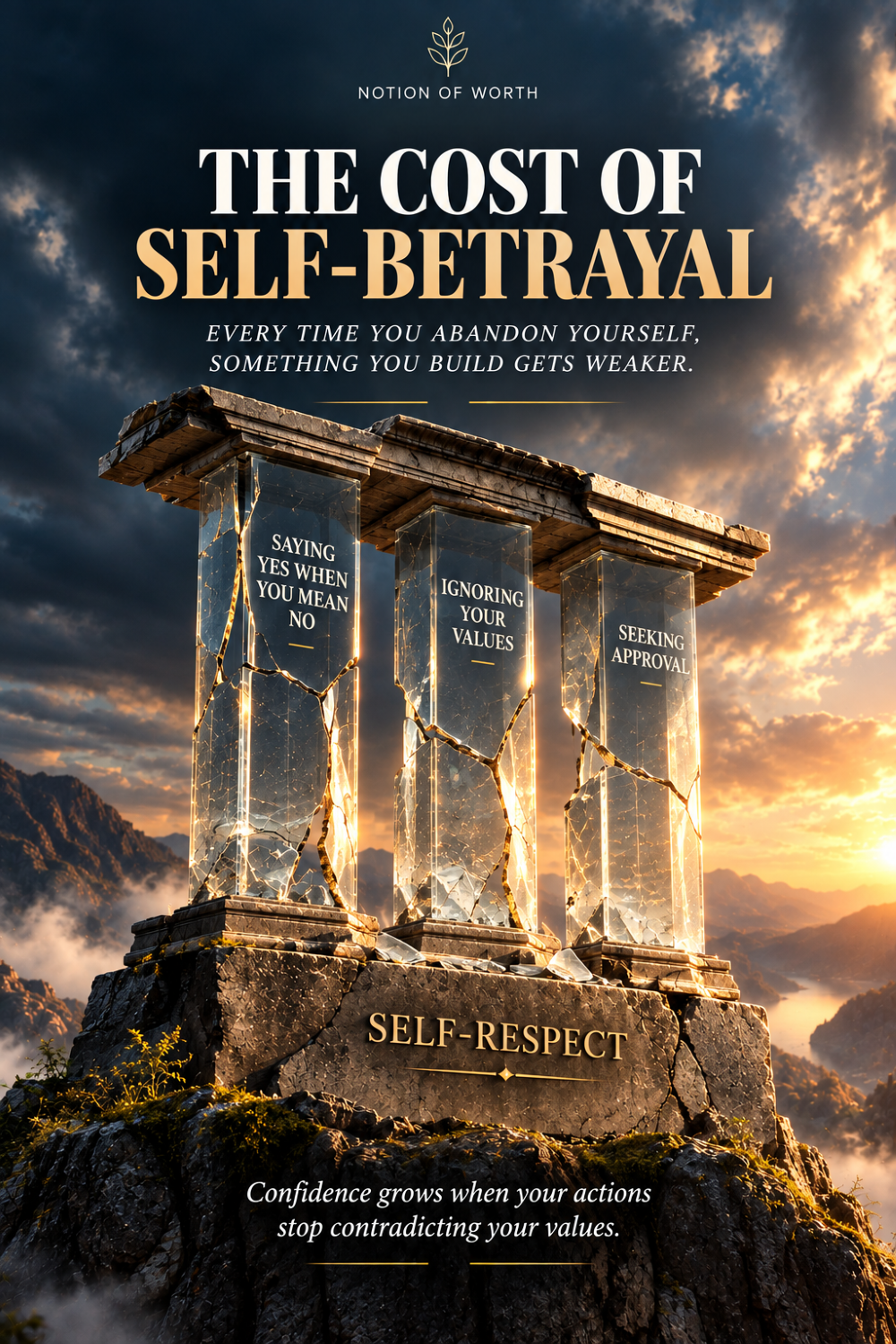
Self-respect grows when your choices stop repeatedly contradicting what matters to you.
3. Practice Tolerating Disapproval
This is uncomfortable.
And necessary.
You cannot build an internally anchored life while requiring everyone to approve of every decision.
Sometimes a boundary will disappoint someone. Sometimes saying no will make you less convenient. Sometimes choosing differently will change a relationship. Sometimes becoming more honest will make you less universally liked.
When avoiding that disappointment repeatedly causes you to soften, explain, or abandon your limits, you may find yourself moving your boundaries to keep the peace.
That does not automatically mean you are doing something wrong.
A stronger sense of self is built partly through learning:
I can survive being misunderstood.
I can survive disagreement.
I can survive not being everyone’s preferred version of me.
4. Separate Feedback From Identity
Feedback can be useful.
But feedback is about a behavior, a decision, a result, or an interaction.
It is not always a statement about your worth.
Try replacing:
“They did not like it, so maybe I am bad at this.”
with:
“They did not like this version. What can I learn?”
Replace:
“They are disappointed in me, so I must have failed.”
with:
“They are disappointed. I can still decide whether my choice was right for me.”
Replace:
“I was rejected, so I am not enough.”
with:
“I was rejected. That hurts, but it is not a complete definition of me.”
This is not denial. It is perspective.

Your worth was never meant to depend on someone else’s approval.
5. Let Compliments Become Confirmation, Not Construction
Enjoy praise. Receive it. Let it feel good.
But do not make it responsible for building your identity from scratch.
A compliment should be able to say:
“I see something valuable in you.”
without your mind translating it into:
“Now I finally have permission to believe I am valuable.”
Validation can support your self-worth.
It should not be the only thing holding it up.
6. Let Some Questions Remain Unanswered
Not every silence needs interpretation.
Not every change in tone needs analysis.
Not every interaction needs closure.
Not every person needs to understand you perfectly.
One of the hardest parts of reducing validation seeking is learning to tolerate uncertainty.
You may not know what they think. You may not know why they acted differently. You may not know whether everyone agrees with your decision.
And still:
You can continue.
That is emotional freedom.
This is what reducing the habit of seeking validation gradually begins to look like in everyday life.
A Simple Validation Audit
Take a few minutes and answer these honestly:
- Whose opinion has the most power over how I see myself?
- Where do I seek reassurance repeatedly?
- What kind of criticism affects me most?
- What do I do mainly because I want to be admired, accepted, or chosen?
- Where am I over-explaining instead of trusting my own decision?
- What would I still care about if nobody applauded?
- What part of myself do I hide because I am afraid it may be rejected?
- What decision would I make differently if I trusted myself more?
You do not need perfect answers.
Notice where you become uncomfortable.
That discomfort often points toward the places where your worth has been handed over to someone else.
Your Worth Was Never Supposed to Be a Popular Vote
You will not always be chosen.
You will not always be understood.
You will not always receive recognition for what you give.
Some people will misread you. Some will prefer someone else. Some will only like the version of you that required less from them. Some will be disappointed when you stop being endlessly available.
None of this automatically means you have become less worthy.
The goal is not to become someone who never needs reassurance.
The goal is to become someone who can receive reassurance without depending on it for identity.
Someone who can listen to feedback without surrendering self-respect.
Someone who can love deeply without abandoning themselves.
Someone who can be rejected without rejecting themselves too.
That is where knowing your worth begins.
Not when everyone finally sees it.
When you stop requiring them to.
Related Reading
SELF-ABANDONMENT
Sources & Research
- Crocker J, Wolfe CT.
Contingencies of self-worth
Psychological Review, 2001. - Crocker J, Luhtanen RK, Cooper ML, Bouvrette A.
Contingencies of self-worth in college students: Theory and measurement
Journal of Personality and Social Psychology, 2003. - Joiner TE, Metalsky GI, Katz J, Beach SRH.
Depression and Excessive Reassurance-Seeking
Psychological Inquiry, 1999. - Rüther L, Jahn J, Marksteiner T.
The impact of social media influencing on self-esteem and the role of social comparison and resilience
Frontiers in Psychology, 2023.
This article is for general educational and informational purposes only. It does not diagnose, treat, or replace professional health care. Read our Editorial & Research Standards and Disclaimer for more information.
Ready to Rebuild Your Relationship With Yourself?
The Self-Worth Starter Guide is a practical next step for identifying where you may be outsourcing your worth, over-seeking approval, or abandoning your own needs — and for beginning to build a steadier inner standard.
Understand Yourself. Growth from inside.
NotionOfWorth