What Are You Actually Feeling? How to Understand Your Emotions More Clearly
By Notion of Worth Editorial · September 2026
You can feel overwhelmed, angry, anxious, or simply “off” — and still have no idea what is actually happening inside you. Learning to name your emotions more precisely can reveal what you need, what is driving your reactions, and what deserves your attention before you act.

Emotional clarity often begins with a strange experience: knowing that something feels wrong without knowing exactly what it is.
You can feel tense but call it stress.
Withdraw and call it tiredness.
Feel angry and call it frustration.
Feel hurt and insist that you are simply disappointed.
Or spend an entire day knowing that something is happening inside you while having no better language for it than:
I don’t feel right.
That does not necessarily mean you are disconnected from your emotions.
Sometimes it means you have learned to experience many different internal states under a very small collection of words.
Fine.
Stressed.
Bad.
Annoyed.
Tired.
Overwhelmed.
But emotions become easier to understand when they become more specific.
Because there is a difference between being angry and being embarrassed.
Between being lonely and being bored.
Between anxiety and anticipation.
Between guilt and shame.
Between exhaustion and emotional withdrawal.
And those differences matter.
Not because every feeling needs to be analyzed.
Not because there is one perfectly accurate label hiding somewhere inside you.
But because the more clearly you can recognize what is happening, the less likely you are to react to one feeling as though it were another.
Sometimes self-knowledge begins with a surprisingly simple question:
What am I actually feeling right now?
What This Article Is Based On
When “I Feel Bad” Is Not Enough
Most people can recognize the broad direction of an emotional experience.
Something feels good.
Something feels bad.
Something feels threatening.
Something feels exciting.
Something feels uncomfortable.
That broad awareness is useful.
But imagine trying to navigate a city using a map that only contained two locations:
Here.
and
Not here.
Technically, the map gives you information.
Just not enough information to know what to do next.
Emotional language can work the same way.
Researchers use the term emotional granularity, or emotion differentiation, to describe our ability to distinguish between different emotional experiences rather than experiencing them only as broad categories such as “good” or “bad.”
Someone with greater emotional granularity might notice:
I am not simply upset.
I am disappointed.
Or:
This is not exactly anxiety. I think I am uncertain and overstimulated.
Or:
I thought I was angry, but underneath it I am embarrassed.
This kind of precision does not mean becoming obsessed with emotions.
It means developing a more detailed internal map.
Research on emotional granularity has associated more differentiated emotional experience with more adaptive emotion regulation.
And there is an intuitive reason why.
Different emotions often point toward different situations.
If you are lonely, solving the problem as though you are bored may not help.
If you are ashamed, treating yourself as though you are merely unmotivated may make things worse.
If you are overwhelmed, pushing harder because you think you are lazy may move you in exactly the wrong direction.
Before deciding what to do with a feeling, it helps to know what feeling you are actually dealing with.
Five Things We Often Collapse Into One Experience
One reason emotions can be confusing is that several things happen almost simultaneously.
Something happens.
Your body reacts.
An emotion appears.
Your mind interprets what is happening.
An impulse follows.
A need or value may sit somewhere underneath all of it.
Because this sequence can occur very quickly, we experience it as one thing.
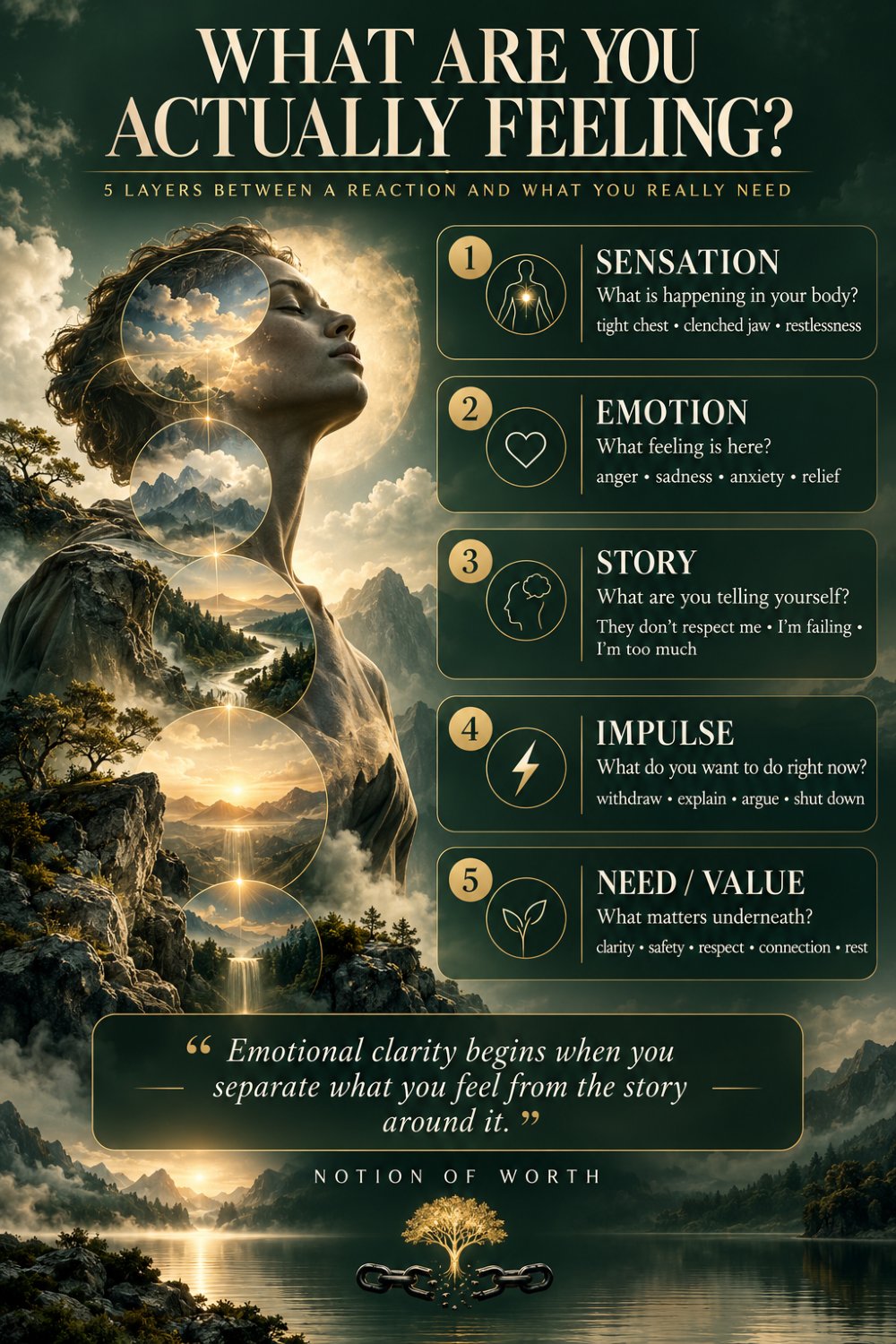
But it can be useful to separate five layers.
1. The Sensation
What is happening physically?
A tight chest.
A heavy stomach.
Heat in your face.
Restlessness.
A clenched jaw.
Low energy.
Pressure behind your eyes.
A sudden urge to move.
These sensations are information, but they are not always emotionally specific.
A racing heart can accompany fear.
Or excitement.
Or anger.
Or caffeine.
Or physical exertion.
Your body gives you clues.
Context helps you interpret them.
2. The Emotion
What emotional word comes closest?
Angry.
Anxious.
Embarrassed.
Relieved.
Lonely.
Disappointed.
Jealous.
Hopeful.
Resentful.
Grateful.
Afraid.
Sad.
This is where specificity begins.
3. The Story
What are you telling yourself about what happened?
They do not respect me.
I am going to fail.
I should have known better.
Nobody cares.
I am falling behind.
This should not bother me.
The story may contain important information.
It may even be accurate.
But it is still different from the emotion itself.
4. The Impulse
What do you immediately want to do?
Leave.
Argue.
Send the message.
Cancel the plan.
Hide.
Explain yourself.
Work harder.
Eat.
Scroll.
Shut down.
Ask for reassurance.
Your first impulse tells you something about your current state.
It does not automatically tell you what action you should take.
5. The Need or Value
What might matter underneath the emotion?
Safety.
Respect.
Clarity.
Rest.
Connection.
Autonomy.
Fairness.
Belonging.
Recognition.
Space.
Repair.
Understanding.
If identifying what you need feels difficult, explore the emotional needs we often ignore.
Not every emotion hides one simple need.
Human experience is rarely that tidy.
But separating these five layers can transform a vague reaction into something you can actually understand.
Imagine receiving unexpectedly critical feedback at work.
The experience may initially be:
I feel terrible.
Slow it down.
Your chest feels tight.
You feel embarrassed and anxious.
The thought is:
They think I’m incompetent.
The impulse is to defend yourself or disappear.
And underneath that reaction may be a desire for competence, security, clarity, or respect.
Nothing about the situation has magically changed.
But your understanding of your response has.
And that creates options.
Emotional clarity is not about
finding the perfect word
It is about creating enough space between what happened, what you felt, what you thought, and what you want to do next that they no longer have to become the same thing.
A Feeling Is Not the Same as a Thought
This distinction sounds simple.
In practice, it changes a lot.
Consider the sentence:
I feel like you don’t respect me.
It contains the word feel.
But “you don’t respect me” is not an emotion.
It is an interpretation of another person’s behavior.
The emotional experience underneath it might be:
I feel hurt.
I feel angry.
I feel dismissed.
I feel disappointed.
I feel embarrassed.
I feel unsafe.
I feel insignificant.
The interpretation may still matter.
Perhaps you really are being treated disrespectfully.
Emotional clarity is not about convincing yourself that your interpretation is wrong.
It is about separating the layers.
Compare:
I feel like nobody values my work.
with:
I feel disappointed and overlooked because my contribution wasn’t acknowledged.
The second statement gives you more information.
And therefore more choices.
You might realize you need recognition.
Or a conversation.
Or clearer expectations.
Or a boundary.
Or simply time to recover from disappointment before deciding what the event means.
When thought and emotion remain fused together, interpretation can start feeling like unquestionable fact.
Naming the emotion does not erase the story.
It simply allows you to examine both, which gives you more information and more choices.
When emotional intensity becomes too high or too low for flexible responding, the window of tolerance offers another way to understand why emotional clarity can temporarily become harder to access.
Sometimes the first impulse is not to examine either one, but to move away from the experience entirely — by staying busy, scrolling, shutting down, or finding something else to focus on. That impulse toward distraction can sometimes tell you something important about what feels difficult to face.
Emotions Are Information — Not Instructions
One of the most useful distinctions in emotional self-awareness is this:
Feeling something does not automatically require obeying it.
Anger does not automatically mean you should confront someone.
Fear does not automatically mean you should leave.
Guilt does not automatically mean you did something wrong.
Anxiety does not automatically mean something dangerous is about to happen.
Sadness does not automatically mean you made the wrong decision.
Excitement does not automatically mean something is good for you.
Emotions matter.
But they are not verdicts.
They are responses produced by a complicated interaction between the present situation, your expectations, past experiences, physical state, interpretations, relationships, and what currently matters to you.
That is why two people can experience the same event very differently.
And why you can experience the same event differently at different stages of your life.
The goal is not to distrust emotion.
It is to develop a relationship with emotion that is neither:
I must do what this feeling says
nor
This feeling is irrational and should disappear.
A more useful position is:
Something in me is responding. What can I learn before I decide what to do?
That small gap between feeling and action is where emotional awareness becomes choice.
Why Some Feelings Are Easier to Recognize Than Others
Nobody learns emotional language in isolation.
We learn it through families.
Friendships.
Culture.
School.
Relationships.
Gender expectations.
Workplaces.
The environments where we first discovered which parts of us were welcome and which created difficulty.
Some people learn that anger is unacceptable.
So anger gets translated into:
I’m tired.
I’m fine.
It doesn’t matter.
Other people learn that fear or sadness should remain invisible.
So vulnerability may first appear as:
I’m irritated.
Leave me alone.
I don’t care.
Someone may have learned to intellectualize emotion.
Instead of:
I’m hurt
they explain exactly why the other person’s behavior was logically inconsistent.
Someone else may have learned to turn every uncomfortable emotion inward.
Anger becomes self-criticism.
Disappointment becomes inadequacy.
Conflict becomes:
What did I do wrong?
And some people became so practiced at being the strong, useful, easy, responsible, or successful version of themselves that noticing an emotion seems less urgent than continuing to function.
This is where emotional awareness overlaps with the roles we learn to play.
A role can influence not only what you do.
It can influence what you allow yourself to notice.
The person who has always been “the strong one” may recognize exhaustion long before they recognize sadness.
The person who keeps the peace may recognize guilt more quickly than anger.
This can also happen when keeping the peace has become a form of people-pleasing.
The achiever may recognize frustration but overlook fear.
The independent person may notice irritation before loneliness.
None of these patterns makes the emotion less real.
They simply remind us that emotional awareness is partly learned.
And anything learned can be examined.
Similar Feelings Can Ask Very Different Questions
Emotions often travel in clusters.
That is why it can help to compare nearby experiences rather than searching for one perfect label.
Anger or Frustration?
Anger often appears when something important feels violated, blocked, unfair, or threatening.
Frustration often emerges when progress is obstructed.
You can experience both.
But the useful questions may differ.
Anger: What feels crossed, unfair, or threatened here?
Frustration: What keeps preventing movement?
Guilt or Shame?
Guilt often focuses on behavior:
I did something that conflicts with my values.
Shame tends to become more global:
Something is wrong with me.
The first may invite repair.
The second can make you want to hide.
Anxiety or Overwhelm?
Anxiety often contains anticipation.
Something might happen.
Something might go wrong.
You may not be able to handle what comes next.
Overwhelm can be less about future threat and more about current capacity:
There is simply too much happening at once.
When everything starts to feel urgent, overload can become difficult to distinguish from anxiety.
One may need reassurance or tolerance for uncertainty.
The other may need fewer inputs, fewer decisions, more time, or rest.
Disappointment or Rejection?
Disappointment happens when reality does not match an expectation or hope.
Rejection carries a more personal meaning:
I was not chosen, wanted, accepted, or included.
The event can contain both.
But recognizing the difference helps reveal what actually hurts.
Loneliness or Boredom?
Both can make you reach for stimulation.
Both can send you toward your phone.
But boredom often asks:
Is there anything engaging here?
Loneliness asks:
Is there anyone I feel meaningfully connected to?
More stimulation does not necessarily resolve a lack of connection.
Resentment or Anger?
Anger can be immediate.
Resentment often has history.
It may accumulate after repeated experiences of giving too much, remaining silent, carrying an unfair load, or allowing a boundary to move again and again.
Sometimes resentment is not one moment of anger.
It is anger that never received enough attention.
These distinctions are not formulas.
The same emotion can arise for many different reasons.
The point is not to memorize definitions.
It is to become curious enough to ask:
What kind of discomfort is this?
Jealousy or Grief?
Jealousy can look like wanting what someone else has. But sometimes the feeling is less about them — and more about what their life seems to represent.
A relationship, opportunity, achievement, or version of life can remind you of something you wanted, lost, or never received. What feels like comparison may carry grief for an unmet need, a missed possibility, a past rejection, or a version of yourself you thought you would become.
Instead of asking, “Why am I so jealous?” try asking:
“What does this remind me that I still want, miss, or mourn?”
Jealousy may point toward desire. Grief may point toward loss. Sometimes both are present at once.
The goal is not to judge the feeling, but to understand what it is trying to show you.
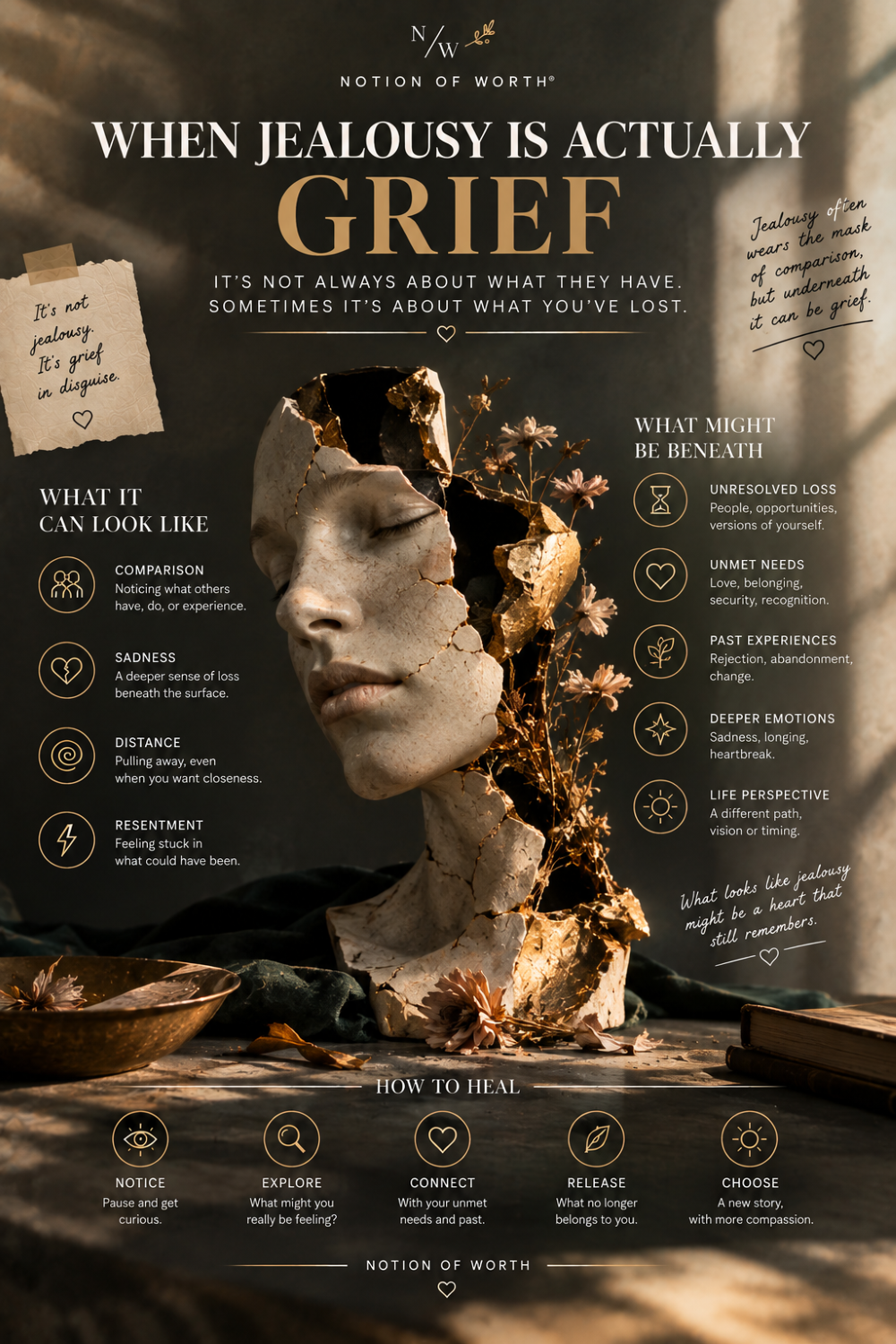
Jealousy can sometimes point toward something deeper — a loss, unmet need, or version of life you are still grieving.
Sometimes the Body Notices Before the Mind Does
Emotional awareness does not always begin with a word.
Sometimes the first signal is physical.
You realize your shoulders have been tense for an hour.
Your breathing has become shallow.
You are unusually restless.
Your jaw hurts because you have been clenching it.
You suddenly feel drained after a particular conversation.
You keep postponing opening a message.
You cannot concentrate even though nothing obvious is wrong.
It can be tempting to turn body signals into fixed emotional dictionaries:
Tight shoulders mean this.
A heavy chest means that.
A knot in your stomach means something else.
Human physiology is not that simple.
Physical sensations are clues, not translations.
Instead of asking:
What emotion does this sensation prove?
Try:
What was happening when I first noticed it?
What changed?
Who was I talking to?
What was I thinking about?
What was I trying not to think about?
What had I just agreed to?
What was I anticipating?
What had I been doing for the previous six hours?
Context helps turn sensation into information.
You Can Feel Two Opposite Things at the Same Time
One reason people struggle to identify emotions is that they expect emotional experience to be internally consistent.
If I love someone, I should not be angry with them.
If leaving was the right decision, I should not feel sad.
If I wanted this opportunity, I should not feel afraid.
If I am grateful, I should not be exhausted.
If something good happened, I should be happy.
But emotional life does not obey that kind of logic.
You can feel relieved and heartbroken.
Grateful and overwhelmed.
Excited and afraid.
Proud and embarrassed.
Love someone and need distance from them.
Know that a chapter needed to end and still grieve it.
Want change and miss what was familiar.
Sometimes emotional confusion is not caused by having no idea what you feel.
It comes from having several valid feelings at once and believing only one of them is allowed to be true.
You do not always need to decide which emotion is the “real” one.
Sometimes both realities belong in the room.
When “I Feel Nothing” Is the Most Accurate Answer You Have
Not every emotional state arrives loudly.
Sometimes what you notice is absence.
Flatness.
Distance.
A strange lack of reaction.
You think you should be angry, but you are not.
Something important happens and you feel almost nothing.
You know you care, yet everything feels strangely far away.
That experience can have many explanations.
Fatigue.
Stress.
Overstimulation.
Habitual emotional suppression.
Needing time to process.
Being so focused on functioning that emotion has not fully reached conscious awareness yet.
Sometimes the feeling arrives hours later.
Or the next morning.
Or when the immediate demands finally stop.
You do not need to force an emotion because you think one should be present.
A useful question may simply be:
If I am not ready to name what I feel, what do I notice instead?
Energy?
Tension?
Distance?
Restlessness?
An urge to withdraw?
Difficulty concentrating?
Sometimes awareness begins one step before emotion.
Persistent or distressing emotional numbness can also occur alongside mental health difficulties, and professional support may be useful when it significantly affects daily life or relationships.
But ordinary moments of not knowing do not automatically mean something is wrong.
Sometimes your system has simply not finished translating experience into language.
The Emotional Clarity Check-In
You do not need to perform a complete psychological investigation every time your mood changes.
But when a reaction feels unusually intense, confusing, or persistent, try slowing it down.
1. What happened?
Begin with observable events.
Not:
They humiliated me.
But:
I was speaking, and they interrupted me twice and dismissed my suggestion.
Separate the event from its meaning for a moment.
2. What is happening in my body?
Notice without immediately interpreting.
Tension.
Heat.
Pressure.
Restlessness.
Fatigue.
Heaviness.
Numbness.
Fast breathing.
3. What broad emotional family am I in?
Do not search for perfection yet.
Am I closer to:
Anger?
Fear?
Sadness?
Shame?
Disgust?
Joy?
Relief?
Connection?
4. Can I make it one level more specific?
Angry — or irritated, frustrated, resentful, offended?
Sad — or disappointed, lonely, grieving, discouraged?
Afraid — or anxious, uncertain, exposed, intimidated?
Happy — or relieved, proud, peaceful, grateful, excited?
5. What story appeared with the emotion?
What am I assuming?
What am I predicting?
What do I believe this event says about me?
What do I believe it says about someone else?
What part is fact, and what part is interpretation?
6. What do I want to do immediately?
Argue?
Escape?
Fix?
Explain?
Prove?
Hide?
Seek reassurance?
Shut down?
Scroll?
Work?
Do not judge the impulse.
Notice it.
7. What might actually matter here?
Do I need clarity?
Rest?
Space?
Connection?
Repair?
Respect?
More information?
A boundary?
Time before deciding?
Permission to be disappointed?
Sometimes the answer is obvious.
Sometimes it is not.
The purpose of the check-in is not to force certainty.
It is to create a little more resolution.
If the same emotions, reactions, or inner conflicts keep returning, these shadow work prompts for self-discovery can help you explore the deeper beliefs and patterns that may be sitting underneath them.
Naming an Emotion Does Not Mean You Have to Explain It Away
There is a subtle trap in self-awareness.
You become better at understanding emotions and then begin treating every feeling like a problem that needs to be solved.
Why am I feeling this?
Where did this come from?
What childhood pattern is this?
What does this say about me?
How do I fix it?
Sometimes those questions are useful.
Sometimes they become another way of refusing to simply experience something uncomfortable.
Not every sadness contains a hidden lesson.
Not every frustration is a trauma response.
Not every bad day reveals a deep psychological pattern.
Not every emotion needs an origin story.
Sometimes you are disappointed because something disappointing happened.
Sometimes you are angry because someone crossed a line.
Sometimes you are anxious because the outcome really is uncertain.
Sometimes you are tired because you have not rested enough.
Self-knowledge should make your inner life easier to inhabit.
Not turn it into a permanent research project.
Build a Larger Emotional Vocabulary — Slowly
You do not need to memorize hundreds of emotional words.
Start by becoming more precise with the ones you already use.
When you notice yourself saying:
I’m stressed
ask:
Is it pressure?
Anxiety?
Overwhelm?
Urgency?
Frustration?
Fear?
Mental exhaustion?
When you say:
I’m annoyed
ask:
Irritated?
Disrespected?
Disappointed?
Impatient?
Resentful?
Embarrassed?
When you say:
I feel good
ask:
Calm?
Relieved?
Proud?
Connected?
Safe?
Interested?
Hopeful?
Satisfied?
Research suggests that emotional differentiation is not necessarily fixed. In one study, an emotion knowledge intervention increased negative emotion differentiation, suggesting that greater emotional precision may be something people can develop over time.
The point is not vocabulary for vocabulary’s sake.
Words create distinctions.
Distinctions create information.
Information creates choice.
Be Careful With the Emotion You Reach for First
Most of us have familiar emotional territories.
Feelings we recognize quickly.
Feelings that fit the version of ourselves we already understand.
And feelings that remain harder to admit.
For one person, anger may be easy.
Sadness is harder.
For another, anxiety is familiar.
Anger feels unacceptable.
Someone else may identify disappointment easily but struggle to acknowledge jealousy.
Or loneliness.
Or relief.
Especially relief when they believe they are supposed to be grieving.
One useful question is:
Which emotions am I good at feeling — and which ones do I immediately translate into something else?
You may discover that your first label is sometimes accurate.
And sometimes habitual.
Emotional Clarity Is Not the Same as Emotional Certainty
You will sometimes get the label wrong.
You may call something anger and later realize it was shame.
Think you were anxious and discover you were excited.
Believe you were disappointed in someone else and eventually recognize that you were disappointed in yourself.
That does not mean the earlier awareness failed.
Emotional understanding can develop over time.
You are allowed to revise it.
In fact, one sign of self-awareness is becoming less invested in having an immediate explanation for everything.
Instead of:
I know exactly why I feel this way.
you become capable of saying:
Something is happening. I have a few ideas. I’m going to pay attention.
That is not confusion.
That is curiosity without premature certainty.
You do not need complete certainty to understand yourself better.
Sometimes emotional clarity is simply knowing the difference
between what you feel, what you fear, and the story
your mind is building around both.
A Small Emotional Check-In
The next time something stays with you longer than expected, sit with these questions:
What happened before my emotional state changed?
What sensations do I notice in my body?
What is the first emotion I would normally call this?
Can I make that word more specific?
Could two emotions be present at the same time?
What story am I telling myself about what happened?
Which part of that story is observable fact?
What am I immediately tempted to do?
What might I need before I act?
Is this feeling asking for action — or simply acknowledgement?
What value or boundary might this emotion be pointing toward?
Am I trying to understand the feeling, or am I trying to make it disappear?
You do not need to answer all of them.
One honest distinction can be enough.
Which emotion becomes easier to recognize when you stop asking whether you are “allowed” to feel it?
You Do Not Need to Become Less Emotional
Emotional awareness is sometimes presented as a path toward becoming calmer.
Less reactive.
More controlled.
But that misses something important.
The goal is not necessarily to feel less.
It is to become less lost inside what you feel.
To notice:
This is disappointment, not failure.
This is uncertainty, not proof that something will go wrong.
This is anger, but anger does not have to become aggression.
This is guilt, and I need to decide whether repair is appropriate.
This is shame, and shame may be telling a much larger story than the event itself.
This is loneliness, and another hour of distraction probably will not solve it.
This is overwhelm, and I do not need to turn it into a judgment about my character.
The feeling may remain.
But the fog around it begins to thin.
And that matters.
Because the way you respond to an unnamed internal state is often very different from the way you respond to something you can recognize.
Knowing Yourself Includes Knowing Your Inner Weather
We often think of self-knowledge in terms of identity.
Who am I?
What do I value?
What patterns do I repeat?
What roles have I learned to play?
Those questions matter.
But knowing yourself also includes something more immediate:
What is happening in me right now?
Before the explanation.
Before the reaction.
Before the message you send.
Before you decide what the feeling means about your future, your relationship, your worth, or yourself.
You may not always know.
That is okay.
Emotional clarity is not a permanent state.
It is a practice of becoming slightly more precise.
Of replacing:
Something is wrong
with:
I’m disappointed.
Replacing:
I can’t handle this
with:
I’m overwhelmed and I need fewer demands for a while.
Replacing:
Nobody cares
with:
I feel lonely, and I want meaningful connection.
Replacing:
I’m just angry
with:
I’m hurt, and anger arrived first.
Sometimes the difference is one word.
But one word can change the question you ask next.
And sometimes that is enough to change what you do.
You do not need to understand every feeling perfectly.
You do not need to analyze yourself endlessly.
You do not need to turn every emotion into a lesson.
You only need enough awareness to stop treating every form of discomfort as though it were the same.
Because knowing yourself is not only knowing the story of who you are.
It is learning to recognize yourself while you are actually living it.
Related Reading
Sources & Research
- Kalokerinos EK, Erbas Y, Ceulemans E, Kuppens P.
Differentiate to Regulate: Low Negative Emotion Differentiation Is Associated With Ineffective Use but Not Selection of Emotion-Regulation Strategies
Psychological Science, 2019. - Seah THS, Coifman KG.
Emotion differentiation and behavioral dysregulation in clinical and nonclinical samples: A meta-analysis
Emotion, 2022. - Erbas Y, Ceulemans E, Lee Pe M, Koval P, Kuppens P.
Emotion differentiation dissected: Between-category, within-category, and integral emotion differentiation, and their relation to well-being
2018. - Pinna T, Edwards DJ, et al.
A Systematic Review of Associations Between Interoception, Vagal Tone, and Emotional Regulation
Frontiers in Psychology, 2020. - Zamariola G, Frost N, Van Oost A, Corneille O, Luminet O.
Relationship between interoception and emotion regulation: New evidence from mixed methods
Journal of Affective Disorders, 2019.
This article is for general educational and informational purposes only. It does not diagnose, treat, or replace professional health care. Read our Editorial & Research Standards and Disclaimer for more information.
The More Clearly You See Yourself, the Less Automatically You Have to Live.
Explore reflections on identity, emotional patterns, learned roles, self-awareness, and the quieter forces shaping how you think, choose, and respond.
EXPLORE KNOW YOURSELF →A Quieter Way to Keep Going Deeper.
Occasional reflections on self-worth, emotional clarity, relationships, boundaries, and the patterns that shape your inner life.
No noise. No constant advice. Just thoughtful ideas worth sitting with.