Why You Keep People-Pleasing
- Even When It Costs You Your Sense of Self -
By Notion of Worth Editorial · October 2026
People-pleasing can look like kindness, but underneath it often lives a deeper fear of conflict, rejection, or disappointing others. Here’s how the pattern forms, why it can cost you your sense of self, and how to begin changing it without becoming less caring.

People-pleasing can look like kindness from the outside.
You are thoughtful. Flexible. Helpful. Easy to be around.
You notice what people need before they ask. You know when someone’s mood changes. You know when to soften your opinion, offer help, change the subject, say yes, or make yourself a little easier to accommodate.
People may even praise you for it.
You are considerate.
Reliable.
Selfless.
Understanding.
But there is an important difference between being kind because you want to be kind and being agreeable because disagreement feels unsafe.
That difference is where people-pleasing begins.
Because sometimes the real question underneath:
“What can I do for you?”
is:
“What do I need to do so that we stay okay?”
And when your sense of safety, belonging, or worth begins depending on keeping other people comfortable, kindness can slowly become something else.
It can become a way of protecting the relationship at the expense of your relationship with yourself.
What This Article Is Based On
This article draws on research and established psychological concepts related to approval seeking, attachment, interpersonal dependency, self-silencing, boundaries, and patterns of accommodation in relationships, combined with practical interpretation for everyday life.
People-Pleasing Is Not the Same as Kindness
Kindness is a choice.
People-pleasing often feels like an obligation.
Kindness allows you to care about someone without disappearing inside their needs.
People-pleasing says:
If they are disappointed, I have probably done something wrong.
Kindness can say yes.
It can also say no.
People-pleasing often experiences no as dangerous.
Kindness considers another person’s feelings.
People-pleasing can make another person’s feelings your responsibility.
That is where setting healthy boundaries matters: you can care about someone’s feelings without making their reaction your responsibility.
And when so much attention is directed toward someone else’s emotional state, it can become harder to recognize your own emotions clearly.
And that distinction matters.
Because you can be generous without being endlessly available.
You can be compassionate without accepting behavior that hurts you.
You can care about someone’s disappointment without reorganizing yourself to prevent them from ever feeling it.
You can be a good person and still be inconvenient sometimes.
THE DIFFERENCE
Kindness says:
Your needs matter to me.
People-pleasing says:
Your reaction determines whether my needs are allowed to matter.
That is not a small difference.
It changes the entire structure of a relationship.
For a clinical overview of the pattern, Cleveland Clinic explains how chronic people-pleasing can affect your needs, relationships, and well-being.
Why People-Pleasing Works — At First
People-pleasing usually survives because it works.
At least in the short term.
You sense tension.
You adjust.
The tension decreases.
Someone wants something from you.
You say yes.
They are pleased.
You feel relief.
Someone disagrees with you.
You soften your position.
The disagreement ends.
Someone seems distant.
You become more attentive, more helpful, more accommodating.
Connection returns.
Your nervous system learns something from that sequence:
Adjustment creates relief.
And relief is powerful.
If accommodating someone repeatedly reduces tension, conflict, uncertainty, or fear of rejection, your mind has a reason to keep using the strategy.
That does not mean the strategy is healthy.
It means it has been useful.
This is why simply telling yourself to “stop caring what people think” rarely changes much.
The behavior may be solving an emotional problem that exists underneath it.
You are not necessarily trying to make everyone happy.
You may be trying to make yourself feel safe.
When Approval Starts to Feel Like Safety
For some people, approval has never been just approval.
It has meant connection.
Over time, that need for approval can also shape the way you speak to yourself, turning other people’s possible disappointment into an internal voice that keeps correcting, warning, and judging you.
Warmth.
Belonging.
Predictability.
Maybe being easy to manage brought praise.
Maybe achievement earned attention.
Maybe being useful created closeness.
Maybe expressing anger caused conflict.
Maybe having needs made someone withdraw.
Maybe disagreement led to criticism, silence, tension, or rejection.
Maybe there was no dramatic lesson at all.
You simply learned, over many small moments, that relationships felt smoother when you required less from them.
So you adapted.
You became good at reading the room.
Good at sensing emotional weather.
Good at knowing what version of yourself would create the least friction.
And eventually, you may have internalized a quiet rule:
If people are pleased with me, I am safer.
This is also why external validation can begin to feel less like reassurance and more like emotional safety.
That rule can follow you long after the original environment has changed.
Now, a disappointed partner can feel like more than a disappointed partner.
A frustrated friend can feel like a threat to belonging.
A manager’s criticism can feel like proof that you have failed.
Someone misunderstanding you can trigger an urgent need to explain yourself until their perception changes.
In close relationships, attachment patterns can intensify the way we respond to distance, reassurance, and uncertainty.
The present situation may be small.
But the emotional meaning attached to it can be much larger.
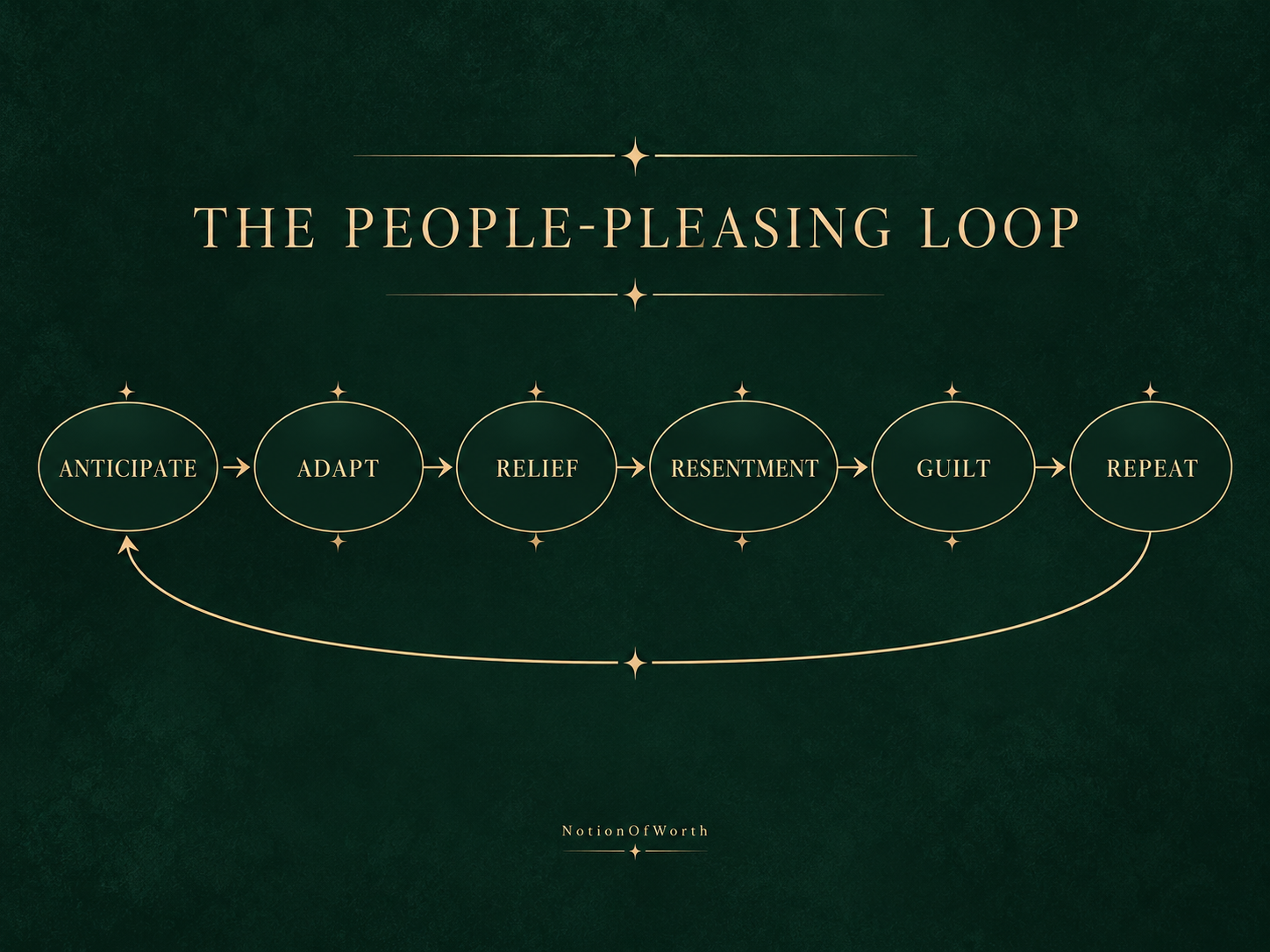
The People-Pleasing Loop
People-pleasing often follows a predictable cycle.
1. You Anticipate
Before anyone asks for anything, you are already scanning.
What do they need?
Are they upset?
Did their tone change?
Should I help?
Should I text?
Should I explain?
Should I fix this before it becomes a problem?
Your attention moves outward.
2. You Adapt
You change something.
Your answer.
Your opinion.
Your schedule.
Your boundary.
Your tone.
Your emotional expression.
Your preference.
Sometimes the adjustment is tiny.
That is why the pattern can be difficult to notice.
3. You Feel Relief
The other person seems okay.
Conflict is avoided.
The relationship feels stable again.
For a moment, the strategy appears successful.
4. Resentment Appears
Later, something feels wrong.
You are tired.
Irritated.
Overcommitted.
Invisible.
You wonder why nobody considers your needs.
You may even feel angry with people for accepting what you repeatedly offered.
5. You Feel Guilty for the Resentment
Then another layer appears.
They didn’t force me.
Maybe I’m selfish.
Why am I upset?
They needed me.
So instead of questioning the pattern, you question yourself.
6. You Repeat It
The next uncomfortable moment arrives.
And because pleasing still feels safer than disappointing, you accommodate again.
The cycle continues:
anticipate → adapt → relief → resentment → guilt → repeat
The problem is not simply that you say yes too often.
The deeper problem is that other people’s reactions begin deciding what you are allowed to say.
This is also why healthy relationships can feel so different: emotionally safe people do not require your compliance in order to continue respecting you.
People-Pleasing Can Become an Identity
Patterns repeated for long enough stop feeling like patterns.
They start feeling like personality.
You may describe yourself as:
the helpful one.
the easygoing one.
the one who never causes drama.
the reliable one.
the listener.
the strong one.
the one everyone can count on.
There may be truth in all of those descriptions.
But sometimes an identity grows around an adaptation. What begins as a way to preserve approval or connection can eventually become one of the roles you learn to mistake for personality.
You are not only helping people anymore.
You are protecting your idea of who you need to be in order to deserve your place.
Then saying no threatens more than a request.
It threatens an identity.
If I am not endlessly helpful, am I still generous?
If I stop fixing everything, will people still need me?
If I disappoint someone, am I still a good person?
If I ask for more, will I become difficult?
If I change, will the relationships built around the old version of me survive?
These questions explain why people-pleasing can remain even after you intellectually understand the pattern.
You are not merely changing a behavior.
You may be renegotiating who you believe you are allowed to be.
Why Saying No Can Feel Disproportionately Dangerous
A simple no can create an enormous internal reaction.
Your heart rate changes.
You replay the conversation.
You wonder whether you sounded rude.
You consider sending another message.
You start building a case for why your boundary is reasonable.
You imagine the other person talking about you.
You think about changing your answer.
From the outside, the situation might look simple.
From the inside, your mind may be processing:
Will this cost me the relationship?
This is why boundaries can feel emotionally expensive even when they are logically reasonable.
That same fear can explain why you keep moving your boundaries to keep the peace, even when you already know where the boundary should be.
You are not always afraid of the word no.
You are afraid of what you believe might happen after it.
Disappointment.
Conflict.
Distance.
Being misunderstood.
Being called selfish.
Someone changing how they see you.
The solution is not to guarantee that none of those things will happen.
You cannot.
Sometimes people will be disappointed.
Sometimes your boundary will inconvenience them.
Sometimes someone who benefited from your lack of boundaries will prefer the old arrangement.
The deeper work is learning:
Another person’s disappointment does not automatically mean I have done something wrong.
You May Be Managing Reactions Instead of Having Relationships
One of the subtler effects of people-pleasing is how much mental energy it consumes.
You do not simply participate in relationships.
You manage them.
You monitor tone.
Predict reactions.
Edit messages.
Adjust timing.
Rehearse conversations.
Soften requests.
Explain boundaries.
Offer reassurance.
Make yourself easier to understand.
Try to prevent misunderstandings before they happen.
Try to solve tension before anyone names it.
Eventually, connection can start feeling like emotional administration.
And when so much attention is directed toward managing how other people experience you, there is less attention left for a different question:
How do I experience them?
Do I actually enjoy this relationship?
Do I feel respected here?
Do I feel safe enough to disagree?
Can I have needs without apologizing for them?
Can I change my mind?
Can I be tired?
Can I say no?
Can I be imperfect?
Can this relationship tolerate the full range of my humanity?
People-pleasing asks:
How can I remain acceptable to them?
A healthier relationship also asks:
Is this relationship acceptable to me?
The Hidden Cost: You Stop Knowing What You Want
When you spend enough time orienting yourself around other people, your own preferences can become surprisingly difficult to hear.
Someone asks:
“What do you want to eat?”
You say:
“I don’t mind.”
Where do you want to go?
“Anywhere is fine.”
What do you think?
“I’m okay with whatever everyone else wants.”
At first, this may seem like flexibility.
But sometimes you genuinely do not know.
You became so practiced at scanning outward that scanning inward feels unfamiliar.
Over time, that distance from your own preferences can leave you feeling as though you no longer know what you actually want.
Instead of asking:
What do I want?
your mind automatically asks:
What answer will create the least friction?
Over time, this can reach much larger decisions.
Relationships.
Work.
Friendships.
Lifestyle.
Goals.
Even identity.
You may know what everyone expects from you while feeling strangely disconnected from what you would choose without an audience.
That is one of the deepest costs of chronic people-pleasing.
You do not only lose time or energy.
You can lose access to your own preferences.
Resentment Is Often Information
People-pleasers sometimes judge themselves harshly for resentment.
You helped someone.
Then felt angry about helping.
You agreed to something.
Then wished you had not.
You listened for hours.
Then felt irritated when nobody asked how you were doing.
You made yourself endlessly available.
Then started wondering why people expected you to always be available.
Resentment does not automatically mean another person has done something wrong.
But it can be information.
It may be showing you where your yes was not wholehearted.
Where you agreed out of guilt.
Where you expected someone to notice a sacrifice you never communicated.
Where you hoped generosity would eventually be repaid.
Where you ignored your own limit.
Sometimes resentment is the emotional bill that arrives after repeated self-abandonment.
Instead of asking only:
Why are they asking so much from me?
it can be useful to ask:
Why do I keep saying yes when I want to say no?
That question returns some of your agency.
People-Pleasing Does Not Always Look Passive
Not all people-pleasing looks quiet or submissive.
Sometimes it looks highly competent.
Productive.
Successful.
Helpful.
Emotionally intelligent.
You may be the person who remembers everything.
The one who solves problems before anyone notices them.
The colleague who always takes on one more task.
The friend everyone calls in a crisis.
The partner who anticipates every need.
The family member who keeps everyone connected.
From the outside, you may look strong.
But underneath all that capability there can still be fear:
If I stop providing value, will I still matter?
Usefulness can become another form of approval seeking.
When your role in relationships depends heavily on what you provide, receiving without earning can feel uncomfortable.
Rest can feel selfish.
Asking for help can feel weak.
Needing something can feel burdensome.
And being loved simply because you exist can feel less believable than being loved because you are useful.
Kindness vs. People-Pleasing
The difference is not always what you do.
Sometimes it is why you are doing it.
You can make the exact same generous choice from two very different places.
You can help someone because:
I care about you and I genuinely want to help.
Or because:
I am afraid of what you will think of me if I do not.
You can compromise because:
Both of our needs matter, and I am comfortable making this adjustment.
Or because:
I need this tension to disappear.
You can apologize because:
I understand that I hurt you and want to take responsibility.
Or because:
I cannot tolerate you being upset with me.
You can say yes because:
Yes.
Or because:
No feels too dangerous.
The behavior may look identical.
The internal experience is completely different.
A useful question is:
If I knew this person would not be angry, disappointed, distant, or critical, would I still make the same choice?
Your answer may tell you whether you are acting from generosity or fear.

What Happens When You Stop Managing Everyone’s Reactions
At first, stopping people-pleasing may not feel empowering.
It may feel uncomfortable.
You may experience guilt.
Anxiety.
Self-doubt.
You may wonder whether you are becoming selfish.
Some people may notice that you are less available.
Some may ask what changed.
Some relationships may need to adjust.
And that discomfort can tempt you to return to the old pattern.
But discomfort does not always mean you are moving in the wrong direction.
Sometimes it means you are doing something unfamiliar.
If you have spent years preventing disappointment, allowing someone to be disappointed may feel almost cruel.
If you have always explained yourself, a simple no may feel incomplete.
If you have always repaired tension immediately, letting a disagreement remain unresolved for a while can feel unbearable.
You are learning a new equation:
Discomfort does not equal danger.
Disagreement does not equal rejection.
Someone being unhappy with my decision does not automatically make my decision wrong.
And perhaps most importantly:
I am not responsible for controlling every emotion another person has in response to me.
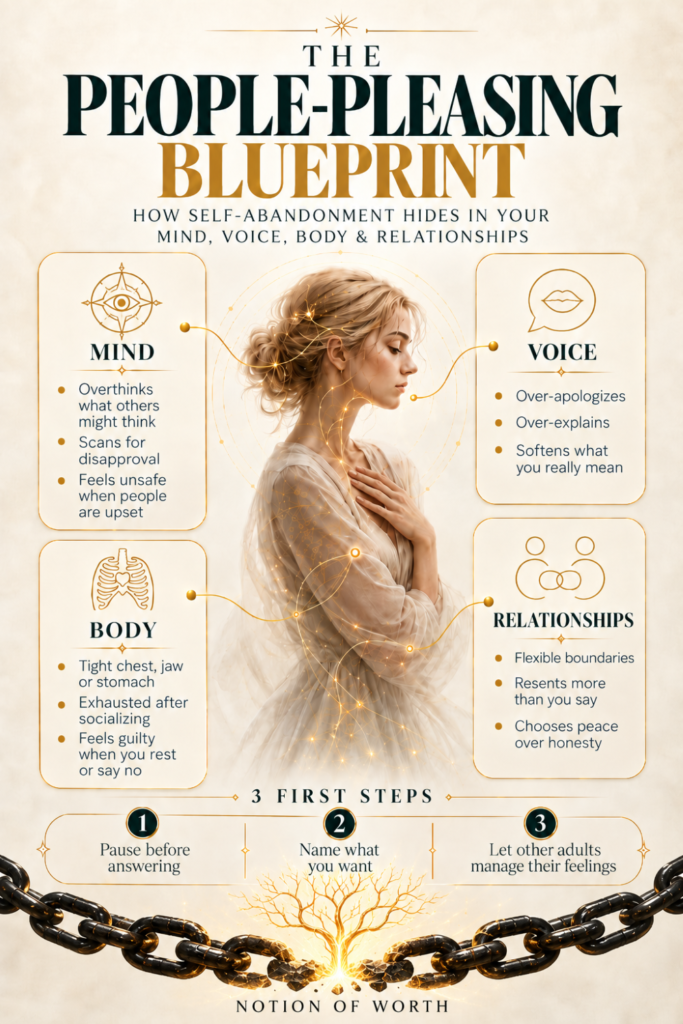
People-pleasing can affect more than what you say yes to — it can shape how you think, speak, feel, and relate to others.
How to Stop People-Pleasing Without Becoming Cold
The opposite of people-pleasing is not selfishness.
It is not indifference.
It is not refusing to compromise.
It is not becoming emotionally unavailable.
The goal is not to care less.
The goal is to stop abandoning yourself in order to prove that you care.
1. Notice the First Internal No
People-pleasing often happens before you consciously decide anything.
Someone asks.
You immediately say yes.
Only later do you notice the heaviness.
Start paying attention to the first response in your body and mind.
Do you tense?
Feel resistance?
Immediately begin calculating how inconvenient the request will be?
Hear yourself thinking:
I really don’t want to do this.
You do not have to obey every internal no.
But you should at least hear it.
Your preferences deserve to enter the conversation before everyone else’s needs decide the outcome.
2. Stop Answering Immediately
If automatic yeses are part of your pattern, create space before answering.
Try:
“I need to check before I commit.”
“Let me think about that.”
“I’ll get back to you.”
“I’m not sure yet.”
A pause gives you time to separate what you actually want from what anxiety wants you to say.
You are allowed to think before you agree.
This pause is also supported by practical guidance from the American Psychological Association on practicing healthier boundaries and resisting automatic compliance.
3. Practice Small Disappointments
You do not have to begin with the hardest relationship in your life.
Start smaller.
Decline something minor.
Express a different preference.
Do not answer a message immediately when you are busy.
Ask someone else to choose another time.
Say:
“That doesn’t work for me.”
Then notice what happens.
Especially inside you.
You may feel guilty even when nobody is angry.
That is useful information.
It shows you that some of the pressure may be coming from an internal expectation, not only an external one.
4. Let Your No Be Smaller
People-pleasers often turn boundaries into closing arguments.
You explain every detail.
Provide evidence.
Anticipate objections.
Reassure everyone involved.
Add multiple apologies.
Try to make the boundary impossible to disagree with.
But the more you try to make a boundary universally acceptable, the more authority you hand back to the other person.
Sometimes:
“I can’t do that.”
is enough.
Sometimes:
“That doesn’t work for me.”
is enough.
You can be warm without making your boundary negotiable.
5. Ask What You Are Trying to Prevent
When you feel a strong urge to please, pause.
Ask:
What am I afraid will happen if I do not accommodate this person?
They will be angry?
They will think I am selfish?
They will withdraw?
They will not need me?
They will reject me?
I will have to tolerate conflict?
The behavior often becomes clearer when you identify the fear it is trying to prevent.
6. Separate Discomfort From Responsibility
Someone can be disappointed by your decision without you being responsible for removing the disappointment.
Those two truths can exist together.
You can understand why they are upset.
And still maintain your boundary.
You can care about their feelings.
And still choose differently.
You can listen.
And still say no.
Empathy does not require surrender.
7. Start Building Evidence That You Can Stay With Yourself
Every time you express a preference and do not immediately retract it, something changes.
Every time you say no and survive the guilt.
Every time you allow someone to misunderstand you without writing another paragraph.
Every time you make a decision based on your values rather than anticipated approval.
Every time you recognize another person’s disappointment without turning it into a verdict on your character.
You are building a different kind of trust.
Trust that says:
Even when someone else is unhappy with me, I will not automatically abandon myself.
That trust is one of the foundations of a steadier sense of self-worth that does not depend on external validation.
You Do Not Need to Become Less Caring
One reason people hesitate to change this pattern is that they genuinely value kindness.
They do not want growth to make them harder.
They do not want boundaries to make them uncaring.
They do not want self-respect to become selfishness.
It does not have to.
Healthy kindness has boundaries.
Healthy generosity has choice.
Healthy relationships allow two people to exist at the same time.
Your needs do not cancel theirs.
Their needs do not cancel yours.
If recognizing your own needs feels unfamiliar, it can help to begin by understanding the emotional needs we often learn to ignore.
Sometimes love looks like helping.
Sometimes it looks like listening.
Sometimes it looks like compromise.
And sometimes it looks like:
I care about you, and my answer is still no.
That is not the absence of love.
It is love without self-erasure.
A Small Pattern Check-In
You do not need to label yourself a people-pleaser.
Just notice where the pattern appears.
Ask yourself:
- Who am I most afraid of disappointing?
- Where do I say yes before checking what I actually want?
- Whose mood do I monitor most closely?
- Where do I confuse being needed with being valued?
- What do I regularly agree to and later resent?
- Where do I over-explain because I want permission for my decision?
- Which relationships make disagreement feel dangerous?
- When someone is upset with me, do I immediately assume I am wrong?
- What version of myself am I trying hardest to maintain?
- What might change if I believed that being a good person did not require being endlessly convenient?
You do not have to answer all of them at once.
Notice which question creates the strongest reaction.
There is usually something worth understanding there.
If these questions begin uncovering patterns you do not fully understand yet, these shadow work prompts for self-discovery can help you explore the beliefs, emotions, and protective strategies underneath them.
If I stopped managing everyone else’s experience of me, what would I finally have enough space to notice about my own?
You Are Allowed to Be a Full Person in Your Relationships
People-pleasing often begins with a beautiful instinct.
You care.
You notice people.
You want relationships to feel safe.
You do not want to hurt anyone.
None of that needs to disappear.
What may need to change is the belief that safety must always be purchased with your own silence.
You are allowed to have preferences that inconvenience people.
Needs that require conversation.
Boundaries that disappoint someone.
Opinions that create disagreement.
Feelings that cannot be made tidy.
Choices other people would not make.
You are allowed to become less predictable to people who were accustomed to your automatic yes.
You are allowed to discover that some relationships become stronger when you stop performing harmony.
And you are allowed to recognize when a relationship only feels peaceful because you are carrying all the conflict inside yourself.
The goal is not to stop caring what people feel.
It is to stop treating their feelings as instructions for who you are allowed to be.
Because healthy connection does not require one person to disappear so that the other can remain comfortable.
And kindness was never supposed to cost you your sense of self.
Related Reading
SELF-ABANDONMENT
Sources & Research
- Cleveland Clinic.
Signs You’re a People-Pleaser — and How To Stop
2023. - Stringer H.
The benefits of better boundaries in clinical practice
American Psychological Association, 2025. - Fritz HL, Helgeson VS.
Distinctions of unmitigated communion from communion: Self-neglect and overinvolvement with others
Journal of Personality and Social Psychology, 1998. - Le BM, Impett EA, Lemay EP, Muise A, Tskhay KO.
Communal motivation and well-being in interpersonal relationships: An integrative review and meta-analysis
Psychological Bulletin, 2018. - Righetti F, Sakaluk JK, Faure R, Impett EA.
The link between sacrifice and relational and personal well-being: A meta-analysis
Psychological Bulletin, 2020.
This article is for general educational and informational purposes only. It does not diagnose, treat, or replace professional health care. Read our Editorial & Research Standards and Disclaimer for more information.
Real kindness includes you too.
If your compassion consistently requires you to ignore your needs, silence your preferences, move your boundaries, or earn your place through usefulness, it is worth asking whether you are choosing kindness — or protecting yourself from the risk of being fully seen.
You do not need to become less generous.
You may simply need to stop excluding yourself from your own generosity.
Ready to Build a Stronger Relationship With Yourself?
The Self-Worth Starter Guide can help you notice where approval, usefulness, and fear of disappointing others may be shaping the way you see yourself — and begin building a steadier inner standard.
Understand. Heal. Rise.
NotionOfWorth