Why You Can’t Stop Scrolling: The Psychology of Social Media Addiction
By Notion of Worth Editorial · October 2026
You open an app for a moment and look up twenty minutes later. Compulsive scrolling is not simply a failure of discipline. Here’s what keeps the loop going — and how to make your attention feel like yours again

You pick up your phone to check one thing.
A message. The weather. The time.
Then there is a notification.
A video.
A comment.
Something you might want to save.
Something mildly interesting that leads to something else.
A few minutes later, you are still scrolling — even though you are no longer particularly entertained.
That last part matters.
Because one of the strangest things about compulsive scrolling is that you do not always continue because you are enjoying it.
Sometimes you continue because stopping requires a decision that the feed never asks you to make.
And sometimes you are not really looking for more content at all.
You are looking for relief.
This is one reason social media addiction can be difficult to recognize: the behavior may begin as entertainment while gradually becoming a way to regulate boredom, discomfort, or unwanted thoughts.
From boredom. From uncertainty. From an uncomfortable thought. From the few empty seconds between one part of your life and the next.
Understanding that changes the question.
Instead of asking:
Why don’t I have enough self-control?
it may be more useful to ask:
What keeps making scrolling easier than stopping?
What This Article Is Based On
This article draws on research related to problematic social media use, reward learning, habit formation, attention, sleep, and emotional well-being, combined with practical interpretation for everyday life.
Scrolling Removed the Natural Stopping Point
Many activities contain built-in endings.
A chapter finishes.
A television episode ends.
A newspaper has a last page.
A conversation reaches a pause.
A social media feed does not have to end.
There is always another post beneath the one you are looking at.
Another video begins before you have decided whether you want to watch it.
Another recommendation appears before you have had time to notice that the previous one was not especially satisfying.
This matters because stopping normally depends partly on stopping cues.
Without them, the decision to leave has to come from you again and again.
The question is no longer:
Do I want to start?
It quietly becomes:
Do I want to stop yet?
And that is a very different psychological task.
You may have intended to spend five minutes online. But once there is no obvious ending, five minutes does not necessarily feel like a completed activity.
It simply feels like the middle of one.
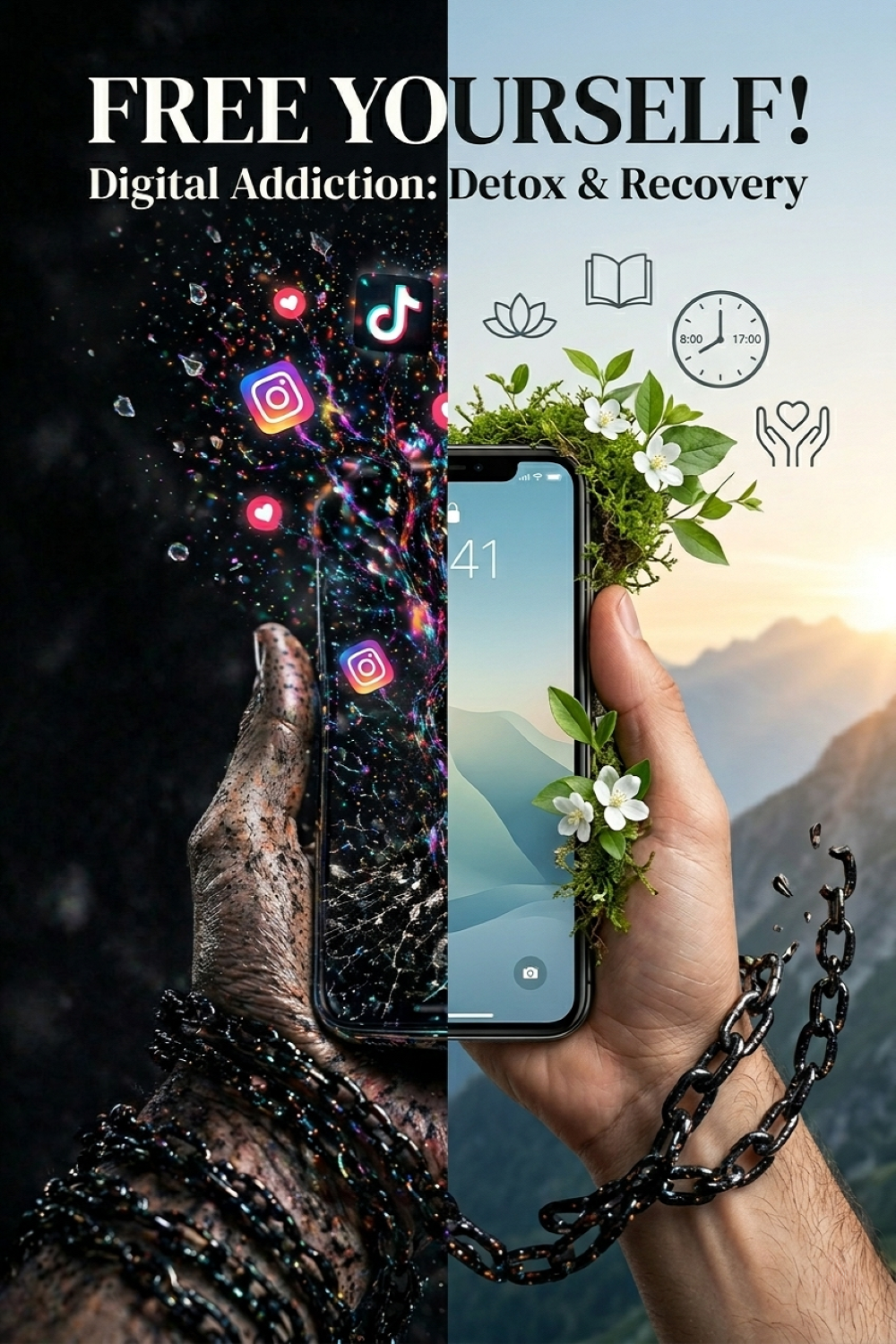
When scrolling has no natural ending, stopping becomes a decision you have to make again and again. Regaining control begins by putting choice back into the loop.
Your Brain Learns From What Sometimes Feels Rewarding
Not every scroll gives you something interesting.
That may actually be part of what keeps the behavior going.
Sometimes you find something funny.
Sometimes someone has liked your post.
Sometimes there is a message you were hoping for.
Sometimes you discover an idea that feels genuinely useful.
And many times, nothing especially rewarding happens at all.
But the possibility remains.
Research on social media behavior suggests that engagement can follow principles of reward learning: people learn from social rewards and adjust behavior in ways that make future rewards more likely.
That does not mean every swipe is a dramatic neurological event.
And it certainly does not mean that every person who enjoys social media is “addicted.”
It means something simpler:
behaviors become easier to repeat when the brain has learned that they sometimes produce something worth finding.
The next scroll might be boring.
Or it might contain exactly the thing that makes continuing feel worthwhile.
So you scroll again.
This reward-learning pattern can help explain why social media addiction may feel less like one deliberate choice and more like a sequence of small decisions that become increasingly automatic.
Novelty Makes “One More” Surprisingly Powerful
Social media does not offer one kind of reward.
It offers uncertainty.
The next post may make you laugh.
The next video may annoy you.
The next image may inspire you.
The next headline may frighten you.
The next message may reassure you.
The next comment may make you feel rejected.
The emotional direction keeps changing, but the mechanism is similar:
something new is always about to happen.
And novelty gives attention a reason to remain oriented toward what comes next.
This helps explain why scrolling can continue even when individual pieces of content are forgettable.
You are not necessarily staying because the current post is valuable.
You may be staying because the next one might be.
The Scroll Is Often Solving a Feeling
There is another layer that is easy to miss.
Sometimes the most powerful reward is not what scrolling gives you.
It is what scrolling allows you to avoid.
You feel bored.
Phone.
A difficult task becomes uncomfortable.
Phone.
You are waiting for someone to respond.
Phone.
A conversation leaves you unsettled.
Phone.
You get into bed and your thoughts become louder.
Phone.
These moments can gradually teach you a pattern:
discomfort → reach → scroll → temporary shift in attention
Nothing needs to be consciously decided.
Eventually the phone can become the fastest available answer to almost any moment you do not quite know what to do with.
Not because the content solves the feeling.
Because for a few moments, you no longer have to feel it as clearly.
Sometimes that relief points toward emotional needs that have not yet been recognized clearly enough to meet in another way.
Sometimes Distraction Works — Which Is Why You Repeat It
This is worth saying clearly:
Distraction is not inherently unhealthy.
Sometimes your nervous system genuinely benefits from a break.
Sometimes watching something funny after a difficult day is exactly what you need.
Sometimes connection online is real connection.
The problem begins when scrolling becomes the default response to almost every uncomfortable internal state.
Because temporary relief and resolution are not the same thing.
The email still needs to be written.
The loneliness is still there.
The decision remains undecided.
The conversation still hurt.
The exhaustion has not disappeared.
But scrolling has moved you far enough away from the feeling that it becomes easier to postpone meeting it.
And because postponement produces relief, the behavior becomes easier to repeat.
Why You Keep Checking Even When Nothing Happened
Sometimes you open an app without remembering deciding to open it.
That is where the behavior starts looking less like a deliberate choice and more like a habit.
You see your phone.
You have ten empty seconds.
Your hand reaches.
The app opens.
You scroll.
The important part is that the trigger may happen before conscious intention catches up.
Habits reduce the need to repeatedly decide what to do.
That is usually useful.
You do not want to consciously reconstruct the steps required to brush your teeth every morning.
But the same efficiency can work against you when a cue becomes strongly associated with a digital behavior.
Waiting becomes checking.
Boredom becomes checking.
Working becomes checking.
Watching television becomes checking something else at the same time.
Eventually, the urge can appear without a clear reason because the environment itself has become the reason.
For some people, this automatic checking becomes one of the most noticeable features of social media addiction.
Social Media Addiction Is Not Simply “Using Social Media a Lot”
This distinction is important.
Spending significant time online does not automatically mean someone is experiencing social media addiction.
Researchers increasingly study what is usually described as problematic social media use — patterns involving impaired control or continued use despite meaningful negative consequences.
Social media use disorder itself is not currently recognized as an official standalone disorder in major diagnostic systems, although researchers continue to investigate whether some patterns share important features with established addictive behaviors.
So the useful question is not simply:
How many hours am I online?
It is closer to:
What is my relationship with the behavior?
For example:
- Do you repeatedly stay longer than you intended?
- Do you automatically reach for your phone during almost every pause?
- Is scrolling regularly delaying sleep?
- Does it interfere with work, conversations, or responsibilities?
- Have you repeatedly tried to reduce your use and found yourself returning to the same pattern?
- Do you feel restless when there is nothing to check?
- Do you continue scrolling even when you are no longer enjoying what you are seeing?
This matters beyond screen-time totals: a large systematic review and meta-analysis has also examined associations between social media use, mental health, and sleep.
The number on your Screen Time report can be useful.
But loss of control and impact on your life tell you more than the number alone.
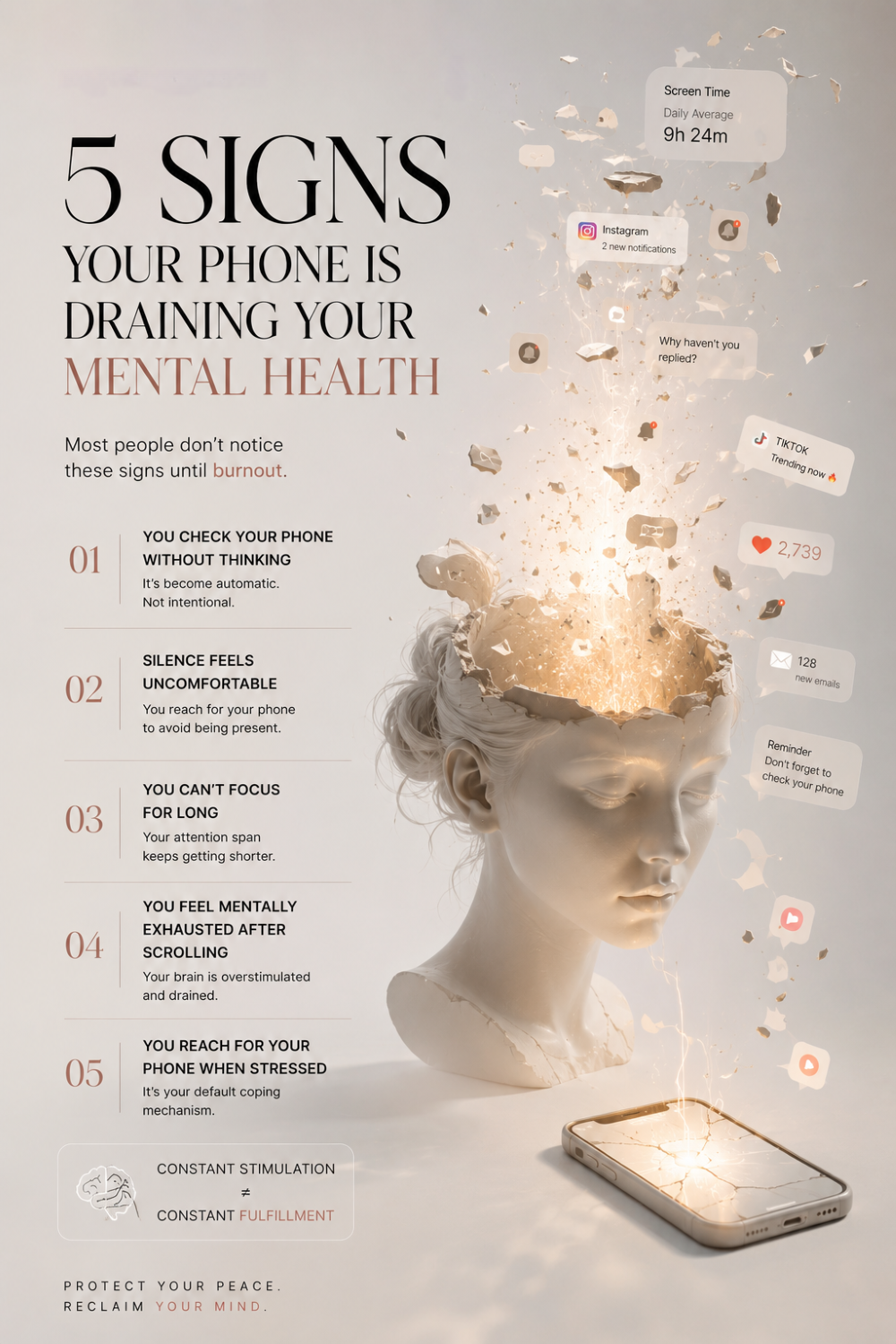
Problematic phone use is not always obvious. Sometimes it appears as fragmented attention, automatic checking, mental fatigue, and the feeling that your mind is rarely completely offline
When Scrolling Stops Feeling Like Rest
This is one of the most confusing parts.
You are exhausted, so you lie down and scroll.
For forty minutes, you technically do very little.
Yet afterward, you may not feel restored.
Your body was still.
Your attention was not. It may still have been moving through the same kind of mental overload that makes it difficult to feel fully off.
It moved through faces, opinions, jokes, headlines, products, arguments, messages, comparisons, aspirations, warnings and other people’s lives.
Your mind may have processed hundreds of small pieces of information without producing one obvious moment that felt demanding.
That is why low physical effort does not necessarily equal psychological rest.
Sometimes scrolling is relaxing.
Sometimes it is simply a different form of stimulation.
Knowing the difference matters.
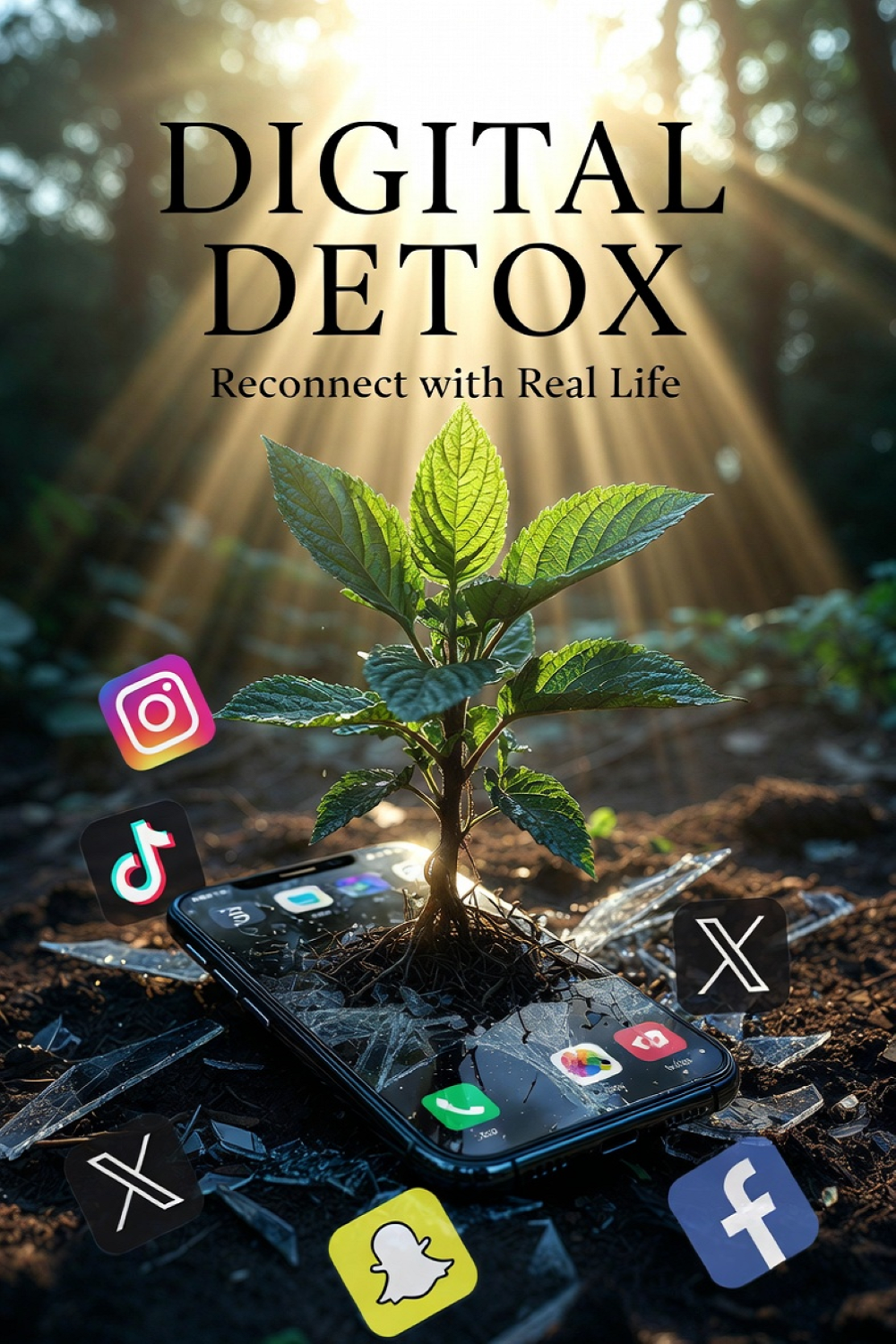
A digital detox is not about rejecting technology. It is about creating enough space to notice when a tool has started choosing where your attention goes for you.
Why Willpower Alone Usually Isn’t a Very Good System
If every unwanted behavior required only more discipline, changing habits would be straightforward.
But asking yourself to resist the same cue fifty times a day creates fifty opportunities to make a different decision.
That is not an efficient system.
The more useful question is:
How can I make the unwanted behavior less automatic?
Not impossible.
Not forbidden.
Just slightly less frictionless.
Reducing social media addiction patterns often begins with these small changes in friction, cues, and automatic access rather than relying on willpower alone.
Because even a small interruption between impulse and action can return something scrolling often removes:
a moment in which you actually choose.
How to Make Scrolling Less Automatic
You do not necessarily need to delete every app, abandon social media, or turn your phone into something you are afraid to use.
Start by changing the architecture of the habit.
1. Remove the cues you do not need
Not every app deserves permission to interrupt you.
Turn off notifications that exist primarily to bring you back rather than communicate something genuinely time-sensitive.
The fewer unnecessary cues you encounter, the fewer impulses you have to negotiate with.
2. Make opening the app intentional again
Move frequently checked apps away from your home screen.
Log out.
Use the browser instead of the app.
None of these makes social media inaccessible.
That is the point.
You are adding just enough friction for your conscious mind to catch up with your hand.
3. Decide when scrolling ends before it begins
Do not rely entirely on the feed to tell you when you are finished.
It will not.
Choose a natural boundary yourself:
- after ten minutes
- after coffee
- before getting into bed
- when the timer ends
- after replying to the messages you actually opened the app to answer
Create the stopping cue the platform does not provide.
4. Notice what happened immediately before you reached
This may be more useful than monitoring every minute of Screen Time.
Ask:
What was happening five seconds before I picked up my phone?
Was I bored?
Stuck?
Lonely?
Anxious?
Avoiding something?
Waiting?
Tired?
The answer begins revealing the actual job the behavior is performing.
5. Replace the function, not only the app
If scrolling gives you stimulation, simply removing it may leave you restless.
If it gives you connection, blocking the app may leave you lonely.
If it helps you avoid a difficult task, deleting it does not make the task easier.
If it numbs an uncomfortable emotion, the emotion remains.
A replacement works better when it addresses the same need in a different way.
6. Protect some moments from input entirely
Not every empty space needs to become productive.
And it does not need to become entertaining either.
Drink coffee without adding content.
Stand in line without automatically opening something.
Walk for five minutes without listening, watching, replying, or searching.
At first, these moments may feel strangely incomplete.
That feeling itself can teach you something.
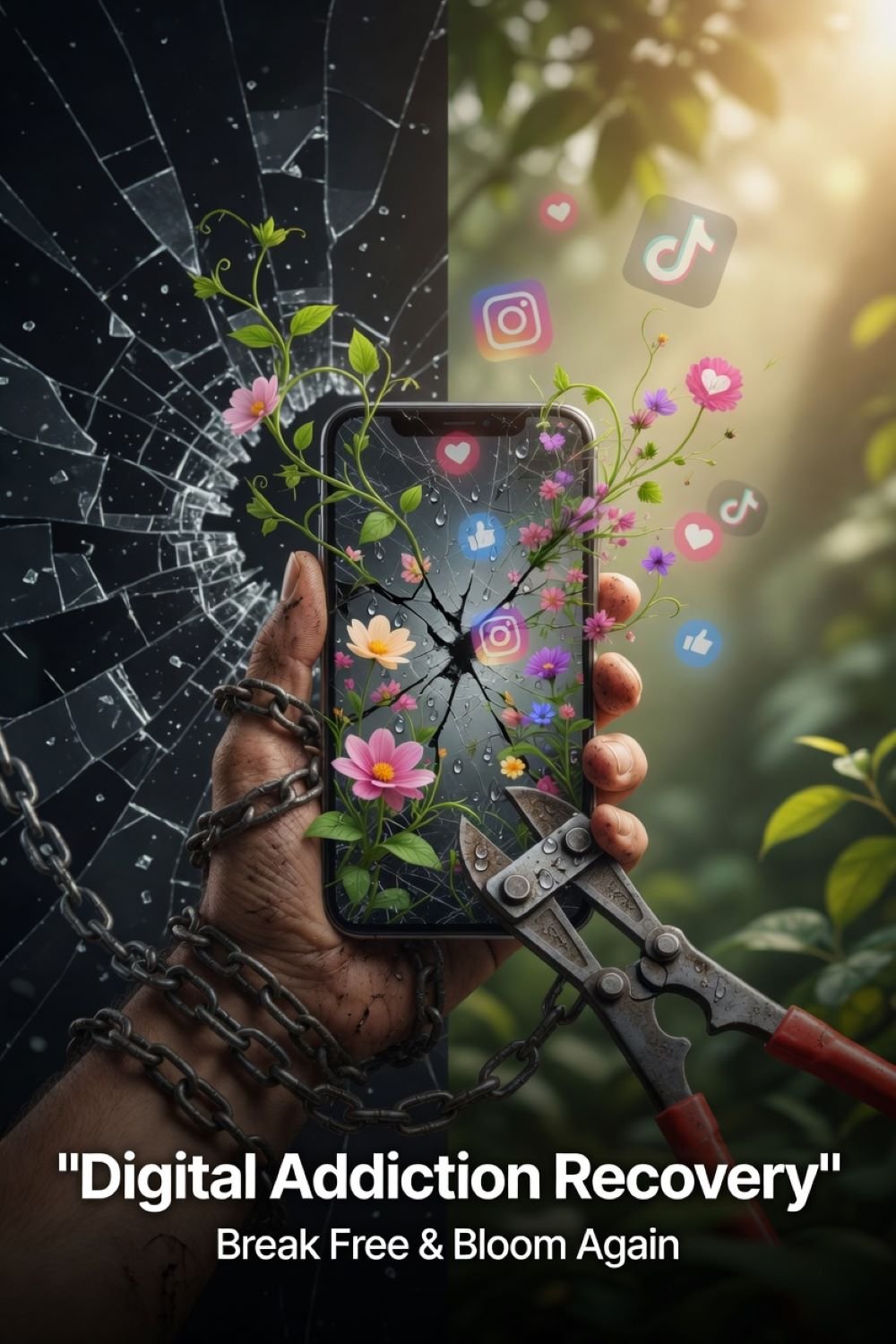
Recovery is not about eliminating technology. It is about making your attention intentional again instead of allowing every cue to decide where it goes next.
You May Not Need Less Technology. You May Need More Choice.
The goal is not to turn your phone into an enemy.
Nor is it to create another standard against which you can fail.
Technology can connect you, teach you, entertain you and make parts of life substantially easier.
The problem is not that an app can capture your attention.
The problem is when you repeatedly discover that your attention moved before you decided where you wanted it to go.
Regaining control often happens quietly.
You notice the impulse without immediately following it.
You finish what you were doing before checking.
You allow ten seconds of boredom to remain ten seconds of boredom.
You put the phone down because you have had enough — even though the feed has not ended.
These are small moments.
But they restore something important:
the difference between having access to something and being pulled toward it automatically.
You do not regain your attention by proving that you can resist every urge. You regain it by creating a life in which every urge does not require a fight.
What feeling am I most often trying not to be alone with when I start scrolling?
Do not judge the answer. Notice what the behavior may have been helping you avoid, soften, postpone, or replace.
You Don’t Have to Disappear From the Internet to Come Back to Yourself
Changing your relationship with social media does not require becoming someone who never scrolls.
It means noticing when a tool has quietly become a reflex.
It means recognizing that boredom is not an emergency.
That every notification does not deserve immediate access to you.
That an uncomfortable thought can exist for a few moments without needing to be replaced by someone else’s content.
And that your attention is not valuable only because it helps you work, achieve, or become more productive.
It is valuable because what repeatedly receives your attention eventually becomes part of your life.
You do not need to reclaim every minute.
Start by reclaiming the next one.
Related Reading
Sources & Research
- Ahmed O, Walsh EI, Dawel A, et al.
Social media use, mental health and sleep: A systematic review with meta-analyses
Journal of Affective Disorders, 2024. - Old Strategies, New Environments.
Reinforcement Learning on Social Media
Review article on reward learning, social feedback, and digital environments - Anderson K, et al.
Interplay between social media use, sleep quality, and mental health in youth: A systematic review
Sleep Medicine Reviews, 2021. - Brautsch LA, Lund L, Andersen MM, et al.
Digital media use and sleep in late adolescence and young adulthood: A systematic review
Sleep Medicine Reviews, 2023.
This article is for general educational and informational purposes only. It does not diagnose, treat, or replace professional health care. Read our Editorial & Research Standards and Disclaimer for more information.
Understand What Your Mind Has Been Trying to Tell You.
Explore the patterns behind overwhelm, emotional exhaustion, rest, attention and the ways your inner world shapes everyday life.
EXPLORE EMOTIONAL HEALTH →A Quieter Way to Keep Going Deeper.
Occasional reflections on self-worth, emotional clarity, relationships, boundaries, and the patterns that shape your inner life.
No noise. No constant advice. Just thoughtful ideas worth sitting with.