Emotional Needs We Ignore: 9 Needs That Support Mental & Emotional Wellness
We often try to fix emotional exhaustion by pushing harder, thinking more positively, or becoming more productive. But sometimes the deeper problem is simpler: an important human need has been ignored for too long.

We learn how to manage responsibilities.
How to stay productive.
How to keep going.
How to become more disciplined, resilient, efficient, or independent.
But many of us learn far less about something more basic:
the emotional needs that help us feel safe, connected, supported, and psychologically well.
So when something inside us begins to feel unsettled, we often assume the problem is our attitude.
We tell ourselves to be more grateful.
More motivated.
Less sensitive.
More positive.
More productive.
Yet emotional discomfort is not always something that needs to be silenced.
Sometimes it is information.
Sometimes exhaustion is asking for rest.
Sometimes resentment is pointing toward a missing boundary.
Sometimes loneliness is asking for connection.
Sometimes numbness is not a lack of gratitude — but a life that has become disconnected from play, purpose, choice, or hope.
Instead of immediately asking,
“What is wrong with me?”
it may be worth asking something different:
“What might I be needing?”
What Are Emotional Needs — and Why Are They Easy to Ignore?
Emotional needs are not simply things we want.
And they are not demands that other people must constantly fulfill for us.
They are better understood as conditions that help support psychological well-being — things such as feeling reasonably safe, connected, able to rest, able to make meaningful choices, and able to experience purpose and belonging.
Psychology does not offer one universally agreed list containing exactly the nine needs in this article.
Instead, this framework brings together several recurring themes found across research on psychological well-being, motivation, social connection, stress, meaning, and human development.
For example, Self-Determination Theory identifies autonomy, competence, and relatedness as fundamental psychological needs. Research and public-health guidance also increasingly recognize meaningful social connection as an important part of mental and physical well-being.
The goal is not to diagnose yourself.
It is to become more curious about your inner life.
Because ignored needs rarely disappear.
They often find another way to speak.
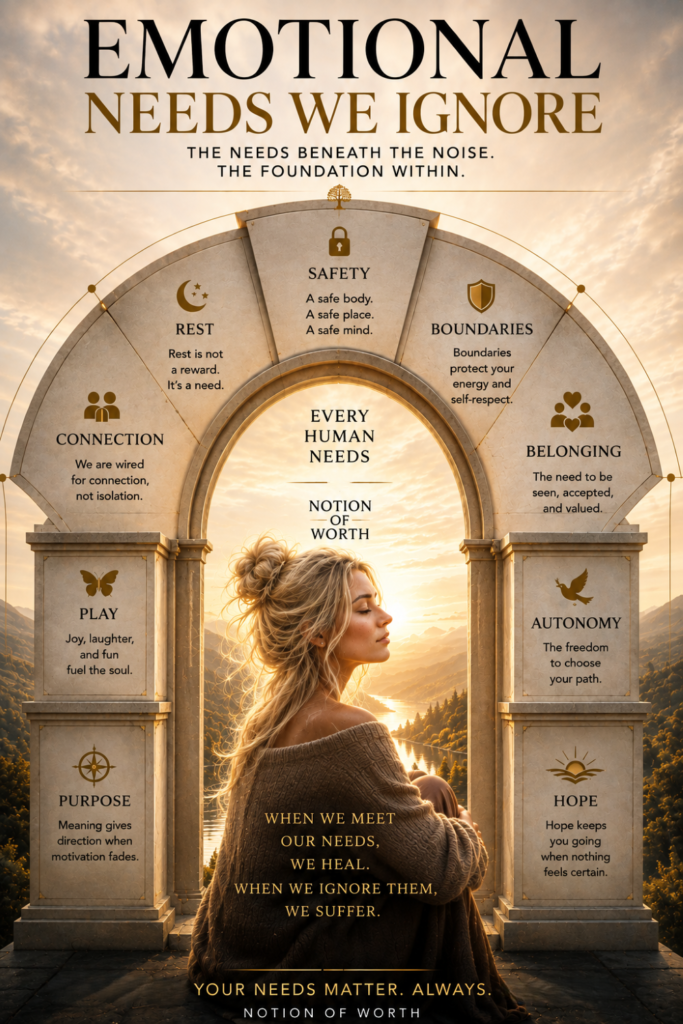
A visual map of the nine emotional needs explored in this article.
1. The Need for Safety
Before we can fully relax, connect, explore, or grow, some part of us needs to feel reasonably safe.
Safety can be physical.
But it can also be emotional.
It may mean knowing that disagreement will not automatically become humiliation.
That expressing a need will not always result in punishment.
That one mistake will not destroy your sense of worth.
That you are not constantly required to monitor someone else’s mood before deciding how much of yourself it is safe to show.
When life feels unpredictable for long enough, we may begin organizing ourselves around avoiding what could go wrong.
We overprepare.
Overthink.
Rehearse conversations.
Scan other people’s reactions.
Avoid conflict.
Seek reassurance.
Stay busy.
Or find it strangely difficult to relax even when nothing obviously dangerous is happening.
Safety does not mean eliminating uncertainty.
No life can offer that.
It means having enough stability — internally and externally — that every uncomfortable moment does not have to become an emergency.
Sometimes the more useful question is not:
“How can I become stronger?”
It is:
“Where in my life do I still not feel safe enough to soften?”
2. The Need for Rest
Many people know how to stop working.
Far fewer know how to stop being “on.”
You may be sitting on the sofa while your mind is still:
planning,
scrolling,
worrying,
anticipating,
replaying,
solving,
or preparing for tomorrow.
That is why rest and inactivity are not always the same thing.
You can take a day off and remain mentally tense throughout it.
You can sleep and wake up exhausted.
You can go on holiday and spend half of it thinking about what is waiting when you return.
Real rest involves some degree of recovery.
And what needs to recover is not always only the body.
Sometimes you need less noise.
Fewer decisions.
Less emotional responsibility.
A break from being useful.
An evening when nobody needs an immediate answer.
A few hours without trying to improve yourself.
This is something we already explored more deeply in Why Rest Doesn’t Feel Restful: When Your Nervous System Is Still on Alert.
The question is not always:
“Did I rest today?”
Sometimes it is:
“Did any part of me actually get to stop?”
3. The Need for Connection
Human beings can survive periods of solitude.
But we are not built to experience our entire emotional world alone.
Connection does not mean having hundreds of friends.
It does not mean constant socializing.
And it certainly does not mean being available to everyone.
Sometimes one meaningful relationship provides more connection than an entire crowded room.
What matters is whether somewhere in your life you experience genuine contact.
Someone you can speak to without constantly performing.
Someone who notices when your “I’m fine” sounds different.
Someone around whom silence does not feel threatening.
Someone with whom imperfection does not automatically create fear of rejection.
Strong social connection is consistently associated with better health and well-being, and the WHO now treats loneliness and social isolation as significant public-health concerns rather than merely private emotional experiences.
But modern life creates an interesting contradiction.
We may be more reachable than ever —
and still feel profoundly unseen.
Notifications are not intimacy.
Messages are not always connection.
Being surrounded by people does not guarantee being known by them.
Connection is more than proximity.
It is the experience of being met.
Ask yourself:
“Where in my life can I exist without performing a version of myself?”
4. The Need for Boundaries
Boundaries are often misunderstood as walls between us and other people.
Healthy boundaries are something different.
They are information.
They clarify:
what you can realistically give,
what behaviour you are willing to participate in,
what belongs to you,
what belongs to someone else,
and where continuing to say yes would require abandoning yourself.
Without boundaries, even good qualities can become exhausting.
Generosity becomes obligation.
Empathy becomes emotional over-responsibility.
Flexibility becomes self-erasure.
Patience becomes tolerating what repeatedly hurts you.
Being “easygoing” becomes never expressing what you actually need.
This is why resentment can sometimes carry useful information.
It does not automatically mean another person has done something wrong.
But it may indicate that somewhere you are repeatedly crossing one of your own limits.
A boundary is not:
“You must behave exactly the way I want.”
It is closer to:
“This is what I am willing to participate in — and this is what I will do if that limit is crossed.”
Protecting your peace does not require controlling everyone around you.
Sometimes it simply requires becoming clearer about where you end and someone else begins.
If setting limits often feels selfish or uncomfortable, explore The Power of Boundaries: Protecting Your Peace.
5. The Need for Belonging
Connection and belonging overlap.
But they are not quite the same.
Connection says:
“I have people around me.”
Belonging says:
“There is room for me here.”
Belonging is the experience of not having to continually audition for your place.
You do not have to become more useful.
More impressive.
More agreeable.
Less emotional.
Less complicated.
Less yourself.
The CDC describes social connectedness not only in terms of how many relationships we have, but also their quality and whether we experience the support, care, and sense of belonging we need.
That distinction matters.
Because one of the loneliest experiences is not necessarily having nobody around.
It is being surrounded by people while believing that the real version of you would not be accepted.
This can lead to a subtle habit:
you stop asking whether you belong somewhere —
and start asking what version of yourself would be most acceptable there.
Eventually, adapting becomes automatic.
You read the room.
Adjust.
Please.
Perform.
Minimize.
And sometimes you become so skilled at belonging everywhere that you no longer know where you actually feel at home.
A useful question is:
“Where do I feel accepted — rather than merely tolerated, needed, or useful?”
Sometimes the fear of losing belonging can slowly turn into losing yourself. Explore Losing Your Identity in a Relationship? | 5 Subtle Signs.
6. The Need for Play
At some point, adulthood can become almost entirely functional.
We work.
We solve problems.
We maintain homes.
Answer messages.
Pay bills.
Make decisions.
Manage calendars.
Optimize routines.
And somewhere along the way, activities with no measurable outcome begin to look unnecessary.
Play disappears.
Not because we consciously reject it.
But because usefulness slowly becomes the standard by which everything is judged.
Play is broader than games.
It can be:
music,
movement,
humour,
creativity,
curiosity,
exploration,
spontaneity,
or doing something simply because you enjoy doing it.
Its value partly comes from the fact that it does not have to produce anything.
You do not need to monetize every hobby.
You do not need to become excellent at everything you enjoy.
You do not need to turn curiosity into achievement.
Some experiences are allowed to exist simply because they make you feel alive.

Play isn’t a luxury — it’s an emotional need.
Ask yourself:
“When was the last time I did something I enjoyed without trying to make it productive?”
If you struggle to remember, that may be worth noticing.
7. The Need for Purpose
Purpose sounds like an enormous word.
It can make us imagine that everyone is supposed to discover one perfect mission that explains their entire life.
For most people, purpose is much quieter than that.
It can come from raising someone.
Building something.
Learning.
Creating.
Caring.
Teaching.
Helping.
Contributing.
Mastering a craft.
Solving a problem.
Supporting a community.
Or simply moving toward something you believe matters.
A meta-analysis of research on purpose in life found meaningful associations between a stronger sense of purpose and lower levels of depression and anxiety, although this does not mean purpose alone determines mental health.
Purpose gives direction.
And direction matters especially during times when motivation fluctuates.
You do not always need an answer to:
“What is my purpose in life?”
That question may actually be too large.
Try something smaller:
“What currently feels worth moving toward?”
The answer can change.
Purpose does not have to be permanent to be real.
8. The Need for Autonomy
Autonomy is sometimes confused with independence.
They are not the same.
You can depend on other people and still have autonomy.
You can be surrounded by people and still feel free.
And you can appear completely independent while living a life shaped almost entirely by other people’s expectations.
Autonomy is the experience that your choices are, at least meaningfully, your own.
Within Self-Determination Theory, autonomy refers to acting with a sense of willingness, personal ownership, and self-direction rather than continually feeling controlled by external or internal pressure.
Its absence can be surprisingly difficult to notice.
You may make every individual choice for a perfectly understandable reason:
to avoid disappointing someone,
to keep the peace,
to look successful,
to gain approval,
to meet expectations,
to avoid uncertainty.
None of those decisions necessarily seems important on its own.
But together they can gradually create a life you never consciously chose.
This can also happen when roles that once helped you adapt begin to feel like your personality. Explore Who Are You Beneath the Roles You Learned to Play?
This is why losing your sense of self does not always happen dramatically.
Sometimes it happens one reasonable compromise at a time.
Autonomy asks:
“Where in my life do I still feel free to choose?”
And perhaps an even harder question:
“Whose permission am I waiting for before I choose differently?”
9. The Need for Hope
Hope is often mistaken for optimism.
But they are not identical.
Optimism says:
“Things will probably work out.”
Hope can exist even when you do not know whether they will.
Hope says:
“There may still be somewhere to go from here.”
That distinction matters.
Because during difficult periods, forced positivity can feel like another task you are failing at.
You may not believe everything will be fine.
You may not feel inspired.
You may not see the entire path.
But you may still be able to see one next step.
One conversation.
One decision.
One person to contact.
One possibility that has not closed.
Research commonly finds positive associations between hope and psychological well-being, although hope is measured in different ways across studies and should not be treated as a substitute for professional support when someone is struggling.
Hope does not require certainty.
Sometimes it simply means refusing to treat your present circumstances as proof of your entire future.
You do not need to see the whole road.
Sometimes you only need enough light for the next few steps.
What Happens When Emotional Needs Go Unmet?
Ignored needs do not always announce themselves clearly.
They often appear disguised as something else.
A need for rest can look like irritability.
A need for connection can look like compulsive scrolling.
A need for autonomy can look like resentment.
A need for belonging can look like chronic people-pleasing.
A need for safety can look like constant overthinking. Chronic overload can make it even harder to recognize what you actually need. Read Why Everything Feels Urgent.
A need for play can look like emotional flatness.
A need for purpose can look like going through the motions of a life that appears perfectly functional from the outside.
A need for boundaries can look like exhaustion with people you genuinely love.
And a lack of hope can make even small difficulties feel permanent.
This does not mean that every uncomfortable emotion can be explained by one unmet emotional need.
Mental and emotional health are more complex than that.
Our biology, circumstances, relationships, past experiences, health, stress, environment, and many other factors interact.
But thinking in terms of needs gives us another lens.
Instead of treating every unpleasant feeling as a problem to eliminate, we can sometimes become curious about what it might be telling us.
A Simple Emotional Needs Check-In
You do not need to overhaul your life.
Start by noticing.
1. Where do I feel most depleted right now?
Try not to explain it immediately.
Just identify it.
Work?
Relationship?
Family?
Your body?
Your thoughts?
Your daily routine?
2. What do I keep wanting but dismissing as unimportant?
More space?
More support?
More quiet?
More affection?
More choice?
More time alone?
More time with people?
Something meaningful to look forward to?
The things we repeatedly minimize can be revealing.
3. Which of these nine needs feels most neglected?
Safety
Rest
Connection
Boundaries
Belonging
Play
Purpose
Autonomy
Hope
Do not ask which one you should need.
Ask which one feels true.
4. What have I been using instead?
Sometimes we attempt to substitute for an unmet need without realizing it.
Scrolling instead of connection.
Achievement instead of worth.
Being needed instead of belonging.
Avoidance instead of rest.
Control instead of safety.
People-pleasing instead of connection.
Busyness instead of purpose.
Reassurance instead of self-trust.
The substitute may provide temporary relief.
If reassurance and external approval have become difficult to separate from self-worth, explore Why You Keep Seeking Validation.
But temporary relief and genuine nourishment are not always the same thing.
5. What is one small way I could respond differently this week?
Not next year.
Not after you completely redesign your life.
This week.
Rest might mean protecting one evening.
Connection might mean calling someone instead of sending another reaction or message.
A boundary might mean saying:
“Let me think about it and get back to you.”
Play might mean spending an hour doing something badly and enjoying it anyway.
Autonomy might mean making one small decision without asking five people what they think.
Purpose might mean returning to something meaningful that you have neglected.
Hope might simply mean identifying the next step rather than demanding the entire solution.
Small does not mean insignificant.
Lives are built through repeated experiences, not only dramatic transformations.
You Don’t Have to Earn the Right to Have Needs
Many people learned early that being low-maintenance made life easier.
Do not ask for too much.
Do not inconvenience anyone.
Do not need reassurance.
Do not rest until everything is finished.
Do not disappoint people.
Do not be difficult.
Do not change your mind.
Be useful.
Be strong.
Keep going.
Eventually, self-neglect can begin to look like maturity.
And ignoring yourself can begin to feel like responsibility.
But having emotional needs does not make you weak, demanding, or dependent.
It makes you human.
The goal is not to expect other people to regulate your entire emotional world.
Nor is it to make every uncomfortable feeling someone else’s responsibility.
It is to become aware enough to recognize what matters.
To communicate where communication is possible.
To protect what needs protecting.
To provide for yourself where you can.
To accept support where support is available.
And to build a life that does not continually require you to disappear from yourself in order to maintain it.
Safety.
Rest.
Connection.
Boundaries.
Belonging.
Play.
Purpose.
Autonomy.
Hope.
You may not need all nine equally today.
But one of them may be trying to get your attention.
And perhaps the most useful question is no longer:
“Why am I like this?”
Perhaps it is:
“What have I been needing that I keep telling myself I shouldn’t need?”
Your needs matter — even the ones you learned to minimize.
Understanding what you need is part of understanding your worth.
If you’re ready to explore the patterns beneath self-worth, boundaries, validation, and the way you relate to yourself, begin with the Self-Worth Starter Guide.
Or join The Worth Letter for psychology-informed reflections on building a more intentional inner life.
Understand. Heal. Rise.
NotionOfWorth