Digital Detox: How to Reclaim Your Attention and Reconnect With Real Life
By Notion of Worth Editorial · October 2026
A digital detox is not about quitting technology. It is about reducing digital overload, reclaiming your attention, and creating more space for focus, presence, and a more intentional connection with real life.

You reach for your phone without deciding to.
While waiting for coffee.
Between two tasks.
Before getting out of bed.
During the few quiet seconds that used to belong to nothing.
Sometimes there is something you genuinely need to check.
But often there isn’t.
The movement happens before the intention.
And somewhere along the way, being constantly connected can begin to feel less like having access to the world — and more like the world having constant access to you.
This is where the idea of a digital detox becomes useful.
Not as punishment.
Not as a dramatic rejection of technology.
And not as another wellness challenge you complete for seven days before returning to exactly the same habits.
A meaningful digital detox is simpler than that.
It is the deliberate creation of enough distance from digital stimulation to notice what has been happening to your attention while you were busy looking at the screen.
What This Article Is Based On
This article draws on research related to digital technology use, attention, problematic smartphone and social media use, digital overload, sleep, well-being, and behavioral patterns that shape how we engage with technology, combined with practical interpretation for everyday life.
What Is a Digital Detox?
A digital detox is an intentional reduction or restructuring of your use of phones, social media, notifications, online entertainment, or other digital technology.
That distinction matters.
A digital detox does not necessarily mean abandoning your smartphone for a week or deleting every social media account.
Researchers themselves use the term in different ways — from temporary abstinence to reduced use and deliberate changes in how technology is integrated into everyday life. A 2025 theoretical review of digital detox research noted that inconsistent definitions and different understandings of what counts as a digital detox strategy are one reason findings across studies can appear mixed.
A better question, then, is not:
How long can I stay away from my phone?
It is:
How can I make technology stop deciding where my attention goes?
That is the real goal.
The Problem Is Not Simply Screen Time
It is tempting to reduce the entire conversation to hours.
Three hours is bad.
One hour is good.
Real life is more complicated.
Two people can spend the same amount of time on their phones and have completely different relationships with them.
One may intentionally read, communicate, work, create, and then put the device away.
Another may spend the same amount of time repeatedly checking, switching, refreshing, reacting, and trying to escape uncomfortable moments.
A comprehensive review of smartphone use emphasizes the importance of distinguishing purposeful or productive use from excessive or potentially problematic patterns.
The deeper issue is therefore not simply:
How much technology do you use?
It is:
How much control do you still have over when, why, and how you use it?
If checking, scrolling, or returning to social media already feels difficult to control, the psychology behind those patterns is explored more deeply in social media addiction.
1. Your Attention Is Being Interrupted Before It Can Settle
Attention needs continuity.
But much of digital life is designed around interruption.
A notification appears.
You check one message.
You see another alert.
You open an app.
Something catches your eye.
Minutes later, you are somewhere completely different from where you intended to be.
Nothing dramatic happened.
Yet your attention has changed direction six times.
Do this repeatedly throughout the day and uninterrupted attention starts becoming unusual.
Research provides some evidence that reducing constant smartphone internet access can improve sustained attention. In a randomized study in which mobile internet was blocked on participants’ smartphones for two weeks, researchers reported improvements in sustained attention as well as measures of mental health and subjective well-being.
The purpose of a digital detox is therefore not simply to create less screen time.
It is to create longer stretches of unclaimed attention.
Constant input can make fragmented attention feel normal. Creating space from digital stimulation gives your mind a chance to stay with one thing long enough for it to matter.
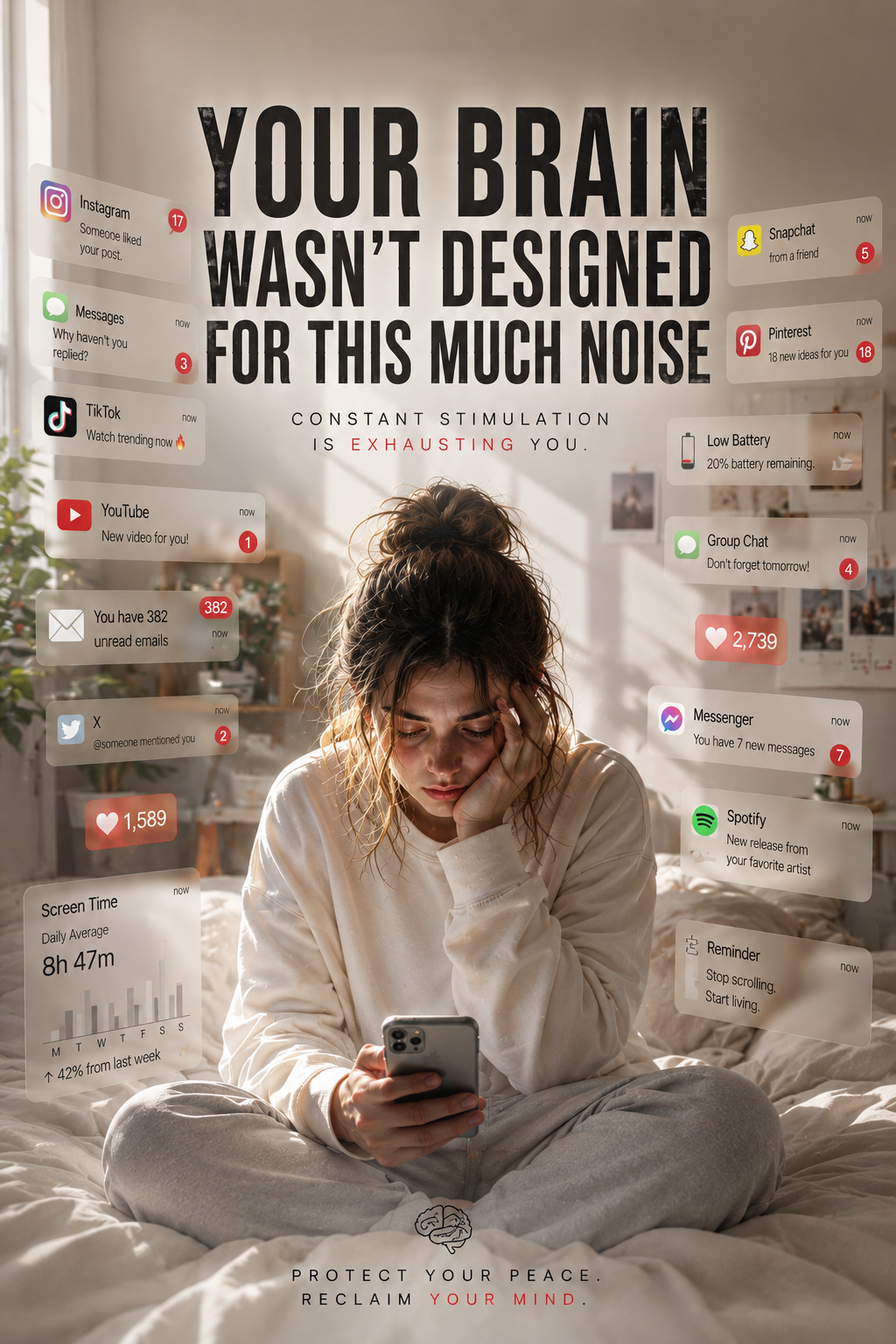
2. Constant Input Can Become Mental Noise
Digital overload does not always feel dramatic.
Sometimes it simply feels like:
- difficulty concentrating
- checking your phone without knowing why
- needing stimulation while doing something else
- feeling restless during silence
- consuming far more information than you remember
- moving constantly between unfinished thoughts
- reaching for entertainment whenever nothing is happening.
Your mind may be receiving input almost continuously without getting enough time to process it.
News.
Messages.
Podcasts.
Videos.
Opinions.
Updates.
Recommendations.
Emails.
Short-form content.
Even valuable information becomes noise when there is no space left between one thing and the next.
When constant input begins to make every thought, notification, and unfinished task feel equally urgent, it can also contribute to mental overload.
This is why digital detox is partly an information problem, not merely a device problem.
You can put the phone down and still spend the entire day filling every silence with something else.
Sometimes what your attention needs most is not better content.
It is less content.

3. Why Silence Can Start Feeling Uncomfortable
One of the strangest consequences of constant stimulation is that its absence can begin to feel wrong.
You stand in line.
Nothing is happening.
Your hand reaches for the phone.
You sit alone for five minutes.
You open something.
You finish one task.
Before deciding what comes next, you check.
This does not necessarily mean you are addicted to your phone.
It may simply mean your attention has become accustomed to rapid access to stimulation.
The result is subtle:
Boredom becomes something to eliminate.
Waiting becomes something to fill.
Silence becomes something to escape.
But those seemingly empty moments once served a purpose.
They gave your mind room to wander, notice, remember, integrate and imagine.
A digital detox brings some of those spaces back.
And at first, they may feel strangely empty.
That does not necessarily mean the detox is failing.
It may mean you are finally noticing how rarely your attention has been left alone.

4. Sometimes the Phone Is Not the Problem — It Is the Escape
There is another reason reducing screen time can be difficult.
Your phone may be doing emotional work for you.
You feel bored → scroll.
You feel awkward → check something.
You feel lonely → open social media.
You feel overwhelmed → watch something.
You do not want to start the task → browse.
You do not want to think about something → distract yourself.
In those moments, technology is not merely providing entertainment.
It is helping create distance from an internal experience.
This is why simply deleting apps does not always solve the problem.
Remove the behavior without understanding what it was helping you avoid and another source of distraction can quickly take its place.
That is why understanding why you keep distracting yourself can matter more than simply finding another way to block an app.
A healthier relationship with technology is not measured by how little you use it. It is measured by whether you can choose when to engage — and when to leave your attention where it already is.
5. A Digital Detox Should Restore Choice, Not Create Another Rule
There is an appealing fantasy behind extreme digital detoxes:
Delete everything.
Disappear for a week.
Return transformed.
Sometimes a complete break can be useful. In one randomized controlled trial, a one-week break from social media was associated with improvements in well-being, depression, and anxiety compared with continuing normal use.
Other experimental studies have produced less clear results, which is one reason a digital detox is better understood as a tool for changing patterns of use rather than a universal prescription.
The inconsistency matters.
There probably is no single detox formula that works for everyone.
And that is actually useful.
The goal does not need to be abstinence.
The goal can be agency.
Instead of asking:
What should I ban?
Ask:
Where has automatic behavior replaced deliberate choice?
That question usually reveals more.
6. Start With Friction, Not Willpower
Most people try to change digital habits using intention.
I won’t check as much today.
But the phone is still beside them.
Notifications are still active.
The distracting apps are still one tap away.
The environment has not changed.
Only the promise has.
A more effective digital reset often begins by making automatic behavior slightly less automatic.
You might:
- remove unnecessary notifications
- move high-distraction apps away from your home screen
- log out of apps you open reflexively
- leave the phone outside the room during focused work
- charge it somewhere other than beside your bed
- establish specific times for messages or social media
- use a computer rather than your phone for activities that do not need to follow you everywhere.
These changes seem small.
That is exactly why they can work.
You are not trying to win a permanent battle against temptation.
You are changing the environment so that reaching for stimulation requires one additional moment of choice.

7. Create Phone-Free Transitions
You do not necessarily need phone-free days.
Start with phone-free transitions.
The first ten minutes after waking.
The walk between two places.
Lunch.
The few minutes after completing work.
Waiting for someone.
The shower.
The last half-hour before sleep.
These small spaces are powerful precisely because they were once where thoughts naturally surfaced.
When every transition is occupied by a screen, your attention never really arrives anywhere.
It simply moves from one stream of information into another.
Try allowing some transitions to remain empty.
Walk without listening to anything.
Wait without checking.
Eat without watching.
Sit without immediately reaching for input.
You may discover that what first feels like boredom gradually becomes something else.
Presence.
8. Replace Digital Stimulation With Something Real
A digital detox becomes much harder when it is framed entirely around removal.
No scrolling.
No apps.
No phone.
No screens.
But attention does not like a vacuum.
Something needs to take the place of the behavior.
Not another productivity task.
Something tangible.
Read something that does not refresh.
Cook.
Walk.
Write by hand.
Make something.
Sit outside.
Have a conversation that cannot be paused.
Do something slowly enough that there is no next item waiting underneath it.
The point is not that offline life is morally superior to online life.
The point is that physical reality places different demands on attention.
It cannot endlessly generate the next stimulus for you.
Sometimes you have to remain long enough for something quieter to become interesting.

9. Relearn How to Be Bored
Boredom has developed a terrible reputation.
But boredom is not always evidence that something is missing.
Sometimes it is simply the space between stimulation and attention.
Stay there for thirty seconds and the mind begins looking around.
Stay longer and thoughts appear.
Memories surface.
Questions emerge.
You notice what you feel.
You notice what you have been postponing.
You may even become curious.
That is one reason constantly eliminating boredom can cost more than we realize.
A digital detox is not simply about spending less time online.
It is partly about becoming capable of not immediately replacing every empty moment.
10. Protect the First and Last Parts of Your Day
There are two moments when your attention is especially easy to surrender:
before your day has properly begun,
and after it should already be ending.
If the first thing you encounter every morning is other people’s messages, headlines, needs and updates, your attention begins the day reactively.
If the final thing you experience at night is another stream of content, the day never receives a clear ending.
You do not need an elaborate morning routine.
Create one boundary:
Let something in your own life happen before the internet does.
And at night:
Let the day become quiet before you try to sleep.
And if switching off still does not make you feel restored, the problem may extend beyond screen time into why rest sometimes does not feel restful.
That alone can fundamentally change the role your phone occupies in your life.
11. Decide What You Actually Want Technology to Be For
This may be the most important step.
Most digital habits develop without an explicit philosophy.
Apps arrive.
Notifications accumulate.
Platforms become habitual.
The phone slowly becomes the default object for boredom, information, entertainment, reassurance, navigation, communication, shopping, work, and escape.
Eventually, everything lives there.
A digital detox gives you an opportunity to ask:
What do I actually want this device to do for me?
- Communication
- Navigation
- Creation
- Learning
- Entertainment
- Connection
All of those can belong.
But when technology has no defined role, it easily becomes the answer to every moment.
And anything that becomes the answer to every moment eventually begins taking moments that belonged somewhere else.

12. A Sustainable Digital Detox Is a Return, Not an Escape
You do not need to disappear from the internet.
You need somewhere worth returning to.
Your own thoughts.
A conversation.
Work that requires concentration.
A room without background noise.
A walk.
A meal.
Something unfinished that deserves your attention.
The goal of digital wellbeing is not to create an artificial life without technology.
Technology is part of modern life.
The question is whether it remains part of your life — or quietly becomes the place where most of your life is experienced.
A meaningful digital detox restores that distinction.
Not:
online versus offline.
But:
automatic versus intentional.
fragmented versus present.
constantly stimulated versus capable of being still.
And perhaps most importantly:
having your attention repeatedly taken from you versus deciding where it belongs.
When you reach for your phone without thinking, what are you usually trying to find — stimulation, reassurance, escape, connection, or simply something to fill the silence?
Do not judge the answer. The pattern becomes easier to change once you understand what the behavior has been doing for you.
Related Reading
Sources & Research
- Marx J, Mirbabaie M, Turel O.
Digital detox: A theoretical framework and future research directions for Information Systems
Information & Management, 2025. - Nawaz S.
Distinguishing between effectual, ineffectual, and problematic smartphone use: A comprehensive review and conceptual pathways model for future research
Computers in Human Behavior Reports, 2024. - Castelo N, Kushlev K, Ward AF, Esterman M, Reiner PB.
Blocking mobile internet on smartphones improves sustained attention, mental health, and subjective well-being
PNAS Nexus, 2025. - Lambert J, Barnstable G, Minter E, Cooper J, McEwan D.
Taking a One-Week Break from Social Media Improves Well-Being, Depression, and Anxiety: A Randomized Controlled Trial
Cyberpsychology, Behavior, and Social Networking, 2022.
This article is for general educational and informational purposes only. It does not diagnose, treat, or replace professional health care. Read our Editorial & Research Standards and Disclaimer for more information.
Your attention shapes how you experience your days, make choices, and stay connected to
what matters.
Explore more on distraction, habits, intentional change, and the patterns that shape how you move through everyday life in Personal Growth.
EXPLORE Personal Growth →A Quieter Way to Keep Going Deeper.
Occasional reflections on self-worth, emotional clarity, relationships, boundaries, and the patterns that shape your inner life.
No noise. No constant advice. Just thoughtful ideas worth sitting with.