Green Flags in a Person:
9 Signs of a Light Triad Personality
Green flags are often quieter than red flags. These nine signs reveal what emotionally safe, respectful, and trustworthy character can look like through the lens of the Light Triad.

We spend a remarkable amount of time learning how to recognize what is wrong with people.
Red flags.
Manipulation.
Narcissism.
Toxic patterns.
Emotional unavailability.
There is value in knowing what can hurt you.
But eventually, another question becomes just as important:
What does healthy character actually look like when it is standing in front of you?
Not charm.
Not perfect communication.
Not someone who agrees with everything you say.
And not someone who simply knows how to use the language of boundaries, vulnerability, or emotional intelligence.
Real green flags tend to be quieter.
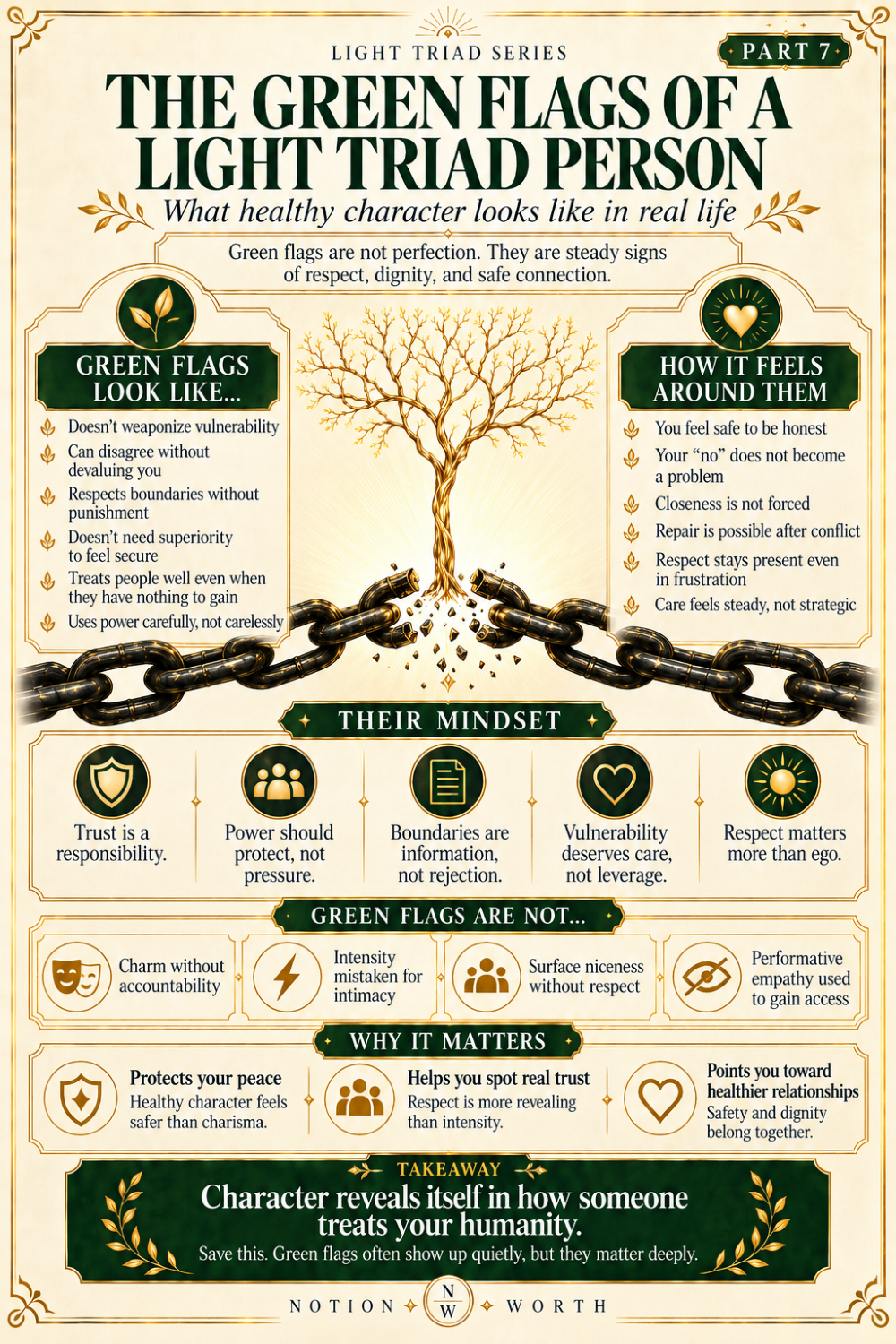
The most meaningful green flags in a person often appear in ordinary moments — especially when boundaries, disagreement, or vulnerability enter the relationship.
They appear in the way someone handles your autonomy. The way they respond when you say no. The way they behave when there is nothing to gain. The way they treat people whose approval, status, or usefulness they do not need.
Psychological research offers an interesting framework for thinking about this.
It is called the Light Triad.
What Is the Light Triad?
The Light Triad was proposed as a way of studying a more humane orientation toward other people.
Rather than focusing on manipulation, entitlement, exploitation, or emotional coldness, it looks at three tendencies:
Kantianism — treating people as individuals with value in themselves rather than merely as tools for achieving something.
Humanism — recognizing the dignity and worth of other people.
Faith in Humanity — maintaining a fundamental belief that people can be good.
The original researchers described the Light Triad as a three-part psychological orientation rather than simply the opposite of the Dark Triad. Later research has also found support for these three related dimensions, although the construct is still relatively young and should not be treated as a clinical label or personality diagnosis.
That distinction matters.
A Light Triad person is not necessarily endlessly agreeable, endlessly forgiving, or endlessly nice.
They can have boundaries.
They can become angry.
They can walk away.
They can disagree with you completely.
The difference is often found in what happens to your humanity when they do.
9 Green Flags of a Light Triad Person
1. They Do Not Turn You Into a Function
Some relationships quietly become transactional.
You become the person who listens.
The person who fixes things.
The person who reassures.
The person who provides stability.
The person who never causes trouble.
And gradually, the relationship begins to depend less on who you are and more on what you provide.
One of the clearest green flags is someone who remains interested in you even when you are not performing a useful role for them.
They do not only value your productivity, emotional availability, attractiveness, status, knowledge, or support.
You are allowed to simply be a person.
That is very close to the idea behind Kantianism within the Light Triad: people should not be treated merely as instruments for somebody else’s goals.
A healthy relationship therefore contains something surprisingly simple:
You do not constantly have to earn your place inside it.
2. Your Boundaries Do Not Become a Personal Attack
Almost anyone can seem respectful while you are giving them what they want.
Character often becomes clearer when you stop.
You say no.
You need space.
You change your mind.
You are unavailable.
You disagree.
A green flag is not that the other person never feels disappointed.
They may.
The green flag is that your boundary does not suddenly become evidence that you are selfish, cold, difficult, disloyal, or uncaring.
Healthy people can experience disappointment without turning it into punishment.
They do not need your compliance in order to preserve their affection.
And that makes something important possible:
closeness without self-erasure.
A relationship becomes safer when your “no” does not threaten your right to remain respected.
3. They Can Disagree Without Devaluing You
Conflict reveals things harmony can hide.
Pay attention to what happens when two realities no longer match.
A person can disagree with you strongly and still remain curious.
They can challenge your opinion without attacking your intelligence.
They can be angry without trying to humiliate you.
They can tell you that you hurt them without turning you into an entirely bad person.
This is one of the most meaningful forms of emotional maturity:
the ability to hold conflict without destroying complexity.
You can be wrong without becoming worthless.
They can be hurt without becoming cruel.
The relationship can contain tension without immediately becoming a battlefield.
4. Their Kindness Does Not Create Debt
Not every generous act is generosity.
Sometimes help comes with an invisible invoice.
The favour is remembered.
The sacrifice is referenced.
The emotional support becomes evidence of what you now owe.
And kindness slowly becomes leverage.
A stronger green flag is someone whose care does not repeatedly appear later as currency.
They may still expect reciprocity in a relationship — healthy relationships are rarely completely one-sided — but they do not keep a hidden emotional ledger.
Their kindness does not repeatedly communicate:
After everything I have done for you, you should…
That is the difference between connection and control disguised as generosity.
5. They Are Careful With the Power You Give Them
Every close relationship creates power.
You tell someone what hurts you.
What embarrasses you.
What you fear.
What you secretly want.
What you still have not forgiven yourself for.
Vulnerability gives another person information they could theoretically use against you.
A major green flag is what they do with that information.
They do not weaponize your insecurities during arguments.
They do not expose private things to gain social advantage.
They do not use your fears to keep you close.
They do not turn your openness into a map of where you are easiest to control.
Trust grows when vulnerability is handled with care.
Not because the other person has no power.
But because they repeatedly choose not to misuse it.
Some of the strongest green flags appear in moments when another person has the opportunity to control, diminish, or exploit you — and chooses not to.
6. Their Vulnerability Is Not a Strategy
Vulnerability can create intimacy.
It can also imitate intimacy.
Someone may reveal intensely personal information very quickly, creating the feeling that an unusually deep bond already exists.
But disclosure alone is not emotional intimacy.
A stronger green flag is when vulnerability develops alongside consistency, accountability, curiosity, and respect.
The person is not revealing themselves simply to accelerate closeness.
They are willing to know you too.
They can tolerate the gradual pace at which genuine trust develops.
Their vulnerability does not demand that you immediately match it.
It invites connection without forcing it.
Green Flags Often Feel Less Dramatic Than Red Flags
This creates an uncomfortable paradox.
Some unhealthy dynamics feel extremely intense.
There is uncertainty.
Relief.
Distance.
Reconnection.
Fear.
Reassurance.
The nervous system receives constant changes in emotional temperature.
Against that background, steadiness can initially seem almost uneventful.
Someone respects your boundary.
Nothing dramatic happens.
They reply consistently.
Nothing dramatic happens.
You disagree.
The relationship survives.
Again, nothing dramatic happens.
But perhaps that is exactly the point.
A sense of emotional safety often creates fewer emotional emergencies.
And if intensity has repeatedly been confused with closeness, that calm can take time to recognize.
7. They Do Not Need You to Become Smaller
Some people feel comfortable around you only while your life remains manageable to them.
Your confidence is fine until it becomes independence.
Your ambition is attractive until you begin succeeding.
Your opinions are interesting until you stop agreeing.
Your growth is celebrated until it changes the relationship.
A green flag is someone who does not require your smaller version in order to feel secure beside you.
They can make room for your expansion.
That does not mean jealousy, fear, or insecurity never arise.
It means those feelings do not automatically become instructions for controlling you.
Someone can struggle internally and still refuse to make their struggle your cage.
That distinction matters especially when you have learned to lose parts of yourself in a relationship to preserve closeness.
8. Their Respect Extends Beyond People They Need
One of the most revealing questions about character is not:
How do they treat you?
It is:
How do they treat people from whom they need nothing?
Watch what happens around people with less status.
Service workers.
Strangers.
People they disagree with.
People they do not find attractive.
People who cannot advance their career.
People who are no longer useful to them.
Selective kindness can sometimes be social strategy.
Humanism asks for something broader: recognizing dignity even when there is no obvious reward for doing so.
You do not need someone to love everybody.
But the absence of usefulness should not erase another person’s humanity.
Character becomes easier to see when kindness has nothing left to gain.
9. They Believe in People Without Becoming Blind to Them
Faith in humanity can easily be misunderstood.
It does not require pretending everyone is trustworthy.
It does not mean ignoring manipulation.
And it certainly does not mean staying in harmful relationships because someone “probably means well.”
Healthy faith in people can coexist with discernment.
A person can believe that human beings are capable of goodness while still paying attention to behaviour.
They can offer trust gradually.
They can hope for change without making their life dependent on it.
They can see complexity without using complexity to excuse repeated harm.
Perhaps the healthiest version of faith in humanity sounds something like this:
I do not have to assume the worst about you — and I do not have to ignore what you repeatedly show me.
Light Does Not Mean Harmless
There is an important mistake to avoid here.
We often imagine a “good person” as someone endlessly patient, endlessly accommodating, and difficult to anger.
But goodness without boundaries can easily become self-abandonment.
And kindness without discernment can become vulnerability to exploitation.
A person with healthy interpersonal qualities may sometimes disappoint you.
They may refuse something you want.
They may confront you.
They may end a relationship.
They may decide that compassion does not require continued access.
What makes these behaviours different is not that they always feel pleasant.
It is that dignity does not disappear when comfort does.
A Small Green-Flag Check-In
When looking for green flags in a person, notice what happens to you around them over time.
Do you have more room to be honest?
Can you disagree without preparing for punishment?
Can you say no without immediately managing their reaction?
Do your vulnerabilities feel protected rather than stored for later use?
Does their care leave you feeling connected rather than indebted?
Can both people remain full human beings inside the relationship?
Those questions often reveal more than charm ever could.
Are you drawn toward people who respect your humanity — or toward people whose approval makes you work hardest to prove that you deserve it?
Do not rush the answer.
Sometimes the people who feel most familiar are not the people with whom we are most free.
And sometimes a green flag is not the rush of finally being chosen.
It is discovering that you no longer have to audition.
The Quietest Green Flag
Perhaps the deepest green flag is difficult to photograph, list, or turn into a perfect sentence.
It is the experience of remaining yourself in another person’s presence.
You do not have to constantly calculate.
Perform.
Shrink.
Anticipate.
Translate every silence.
Earn every reassurance.
Or become more useful to keep your place.
There is room for difference.
Room for boundaries.
Room for imperfection.
Room for two people to remain separate without becoming disconnected.
That may be one of the clearest expressions of healthy character:
Your humanity does not become negotiable simply because the relationship becomes difficult.
And neither does theirs.
Understanding other people matters.
Understanding what you have learned to accept, chase, excuse, or mistake for connection matters too.
Explore more reflections on identity, emotional awareness, patterns, and self-understanding in Know Yourself.
A Quieter Way to Keep Going Deeper.
Occasional reflections on self-worth, emotional clarity, relationships, boundaries, and the patterns that shape your inner life.
No noise. No constant advice. Just thoughtful ideas worth sitting with.