The 5 Stages of a Relationship: How Love Changes as a Relationship Deepens
By Notion of Worth Editorial · September 2026
Love changes as relationships deepen. Explore five common stages — from attraction and reality to negotiation, intimacy, and commitment — and what each stage may ask of two people.

At the beginning of a relationship, connection can feel almost effortless.
You think about each other constantly. Differences seem small. Curiosity is high. Attraction fills in spaces where deeper knowledge has not yet had time to form.
Then something changes.
The intensity becomes less consuming. Habits become visible. Differences that once seemed interesting can become irritating. Expectations emerge. Boundaries begin to matter. The relationship starts asking questions that chemistry alone cannot answer.
For some people, this shift creates an unsettling thought:
Maybe the love is disappearing.
But relationships are not static experiences. The way two people connect can change as familiarity, intimacy, interdependence, and commitment grow.
Psychologist Robert Sternberg’s influential Triangular Theory of Love describes love through three interacting components: passion, intimacy, and commitment. Different combinations of these components can create very different experiences of love, and they do not necessarily develop at the same pace.
That gives us a more useful way to think about relationship development.
Not as a countdown.
Not as a test every couple must pass.
But as a series of psychological tasks that can become more prominent as a relationship deepens.
The five stages below are therefore best understood as a framework, not a universal timeline. Couples may move through them differently, revisit earlier challenges, or experience several at once. Research on relationship development itself supports more flexible “soft-stage” approaches rather than a compulsory sequence that everyone follows in the same way.
The better question may not be:
“What stage should we be in by now?”
It may be:
“What is this relationship asking us to learn right now?”
What This Article Is Based On
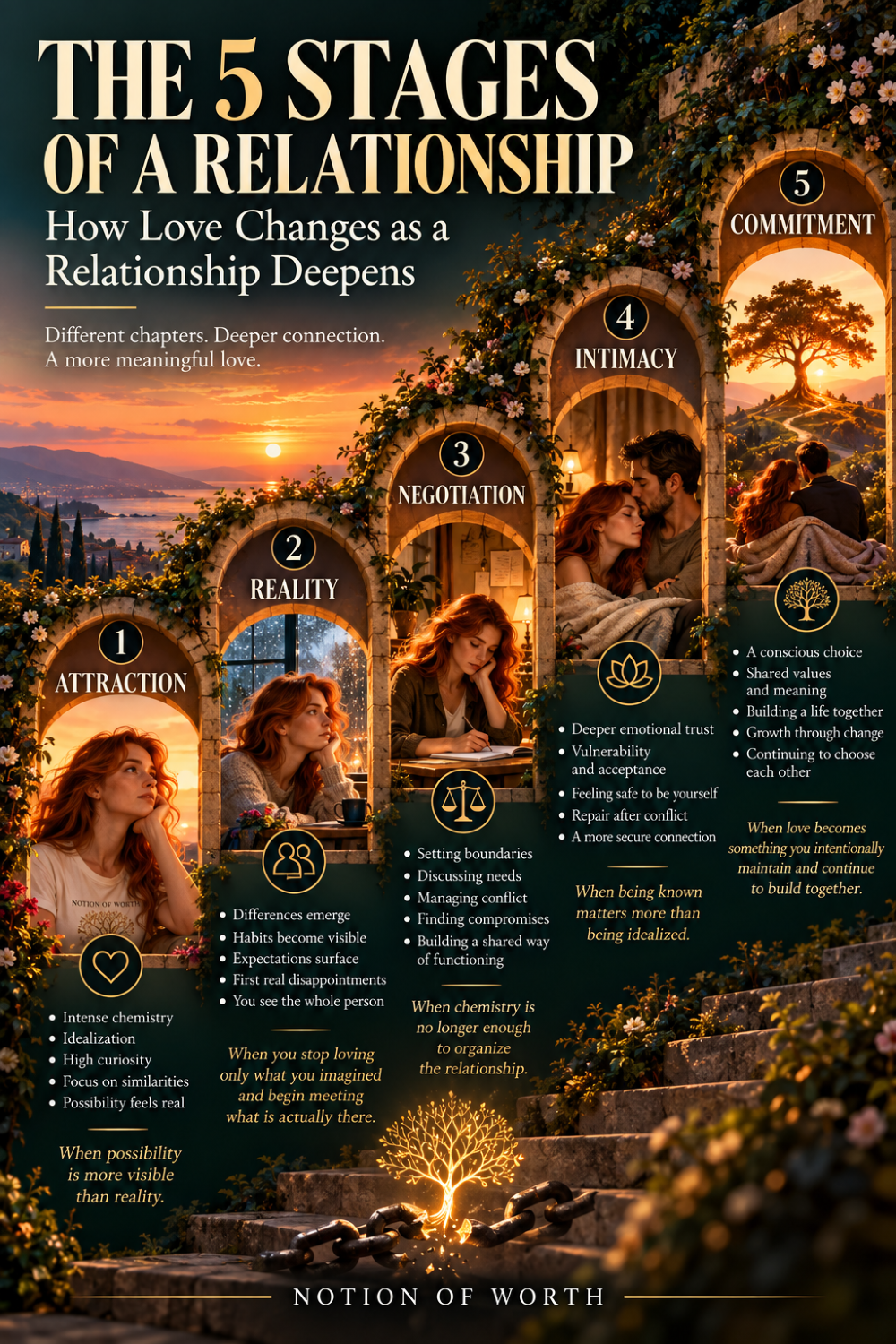
Stage 1: Attraction & Infatuation
When possibility is more visible than reality
Early attraction can feel unusually powerful for a reason.
Romantic attraction engages brain systems involved in motivation and reward. Neuroimaging research on people intensely in love has found activity in dopamine-rich reward and motivation regions, including the ventral tegmental area and caudate nucleus. Research on the neural systems involved in romantic love suggests that this focused motivational state may help explain why early attraction can feel unusually absorbing.
That does not mean early love is “fake.”
It means that the beginning of a relationship often contains something later stages cannot reproduce in exactly the same way:
novelty.
You are discovering someone.
Every conversation can reveal something new. A text message carries anticipation. A small gesture can feel unusually meaningful. Your attention becomes intensely focused on the other person.
And because there are still many things you do not know, the mind naturally fills in some of the blanks.
You may notice similarities more easily than incompatibilities.
You may interpret ambiguity generously.
You may fall in love not only with who the person is, but with everything the relationship appears capable of becoming.
This is why attraction and complete knowledge of another person are not the same thing.
You can genuinely care about someone while still knowing only part of them.
What this stage is really asking
Early attraction asks:
Do I want to move closer?
It does not yet fully answer:
Can we build a life that works when closeness becomes ordinary?
That question takes time.
Passion can begin quickly. Intimacy requires accumulated knowledge, disclosure, responsiveness, and shared experience. Commitment adds yet another dimension: the intention to maintain the relationship over time. Sternberg’s model separates precisely these different elements rather than treating “love” as one single feeling.
So there is no need to dismiss the beginning as “just chemicals.”
But there is also wisdom in remembering:
Intensity tells you that something feels important. It does not yet tell you everything about compatibility.
Stage 2: Reality & Differentiation
When you stop meeting only the person you imagined
Eventually, novelty has less work to do.
You know more.
And knowing more changes the relationship.
You begin to see how your partner handles stress.
How they respond when disappointed.
What happens when they do not get their way.
How much closeness they need.
How much space you need.
How they think about money, work, sex, family, responsibility, time, friendship, ambition, or the future.
Some differences are easy to integrate.
Others touch something deeper.
That is where a relationship can begin to feel less effortless.
The person who once seemed endlessly spontaneous may begin to feel unreliable.
The person who seemed independent may begin to feel distant.
The partner whose constant communication once felt reassuring may eventually feel demanding.
Nothing necessarily changed overnight.
More of reality simply became visible.
And this is one of the most psychologically important transitions in a relationship.
Differentiation is not disconnection
Healthy closeness does not require two people to become psychologically identical.
A relationship eventually has to make room for the reality that:
you are connected — and still separate people.
You can love each other and want different things.
You can care deeply and misunderstand each other.
You can have compatible values and different emotional rhythms.
You can need closeness without needing the same amount of closeness at the same moment.
This is differentiation: the gradual ability to remain connected without requiring sameness.
And it can be uncomfortable precisely because early infatuation makes sameness easier to see.
Reality introduces edges.
Reality doesn’t ruin intimacy.
It makes real intimacy possible.
You cannot be deeply known while only presenting the parts of yourself that are easiest to love. And you cannot deeply know another person while requiring them to remain the version you imagined at the beginning.
The end of idealization can sometimes feel like the end of love.
But those are not necessarily the same event.
Sometimes the relationship is not losing meaning.
It is losing projection.
And what replaces projection can become something much more demanding — but also much more real.
Stage 3: Negotiation & Adjustment
When chemistry is no longer enough to organize the relationship
This is where many of the practical realities of partnership become impossible to avoid.
Who compromises?
Who initiates repair?
Whose schedule takes priority?
How much time do you spend together?
What counts as privacy?
What does loyalty mean?
How do you handle money?
How do you make decisions?
What happens when one person says no?
How do you manage sex when desire is mismatched?
What happens when family expectations collide?
What kind of future is each person actually imagining?
These questions rarely appear all at once.
But over time they reveal something important:
A relationship needs more than feelings. It needs a way of functioning.
This stage often reveals character more clearly than attraction does. How someone responds to boundaries, disagreement, vulnerability, and your independence can reveal many of the green flags of a healthy person.
Conflict is not automatically evidence of incompatibility
Two people with different histories, preferences, fears, expectations, and nervous systems will sometimes disagree.
The presence of disagreement alone therefore tells us very little.
What matters more is what happens around it.
A large research project pooling 43 longitudinal couples datasets found that relationship-specific factors such as perceived partner commitment, appreciation, sexual satisfaction, perceived partner satisfaction, and conflict were among the strongest predictors of reported relationship quality. Interestingly, predicting how relationship quality would change over time proved much more difficult.
That distinction matters.
Relationships are complicated systems.
There is rarely one variable that tells you their future.
But patterns still matter.
Can disagreement happen without humiliation?
Can boundaries exist without retaliation?
Can one person express a need without the other treating it as an accusation?
Can you revisit an issue without reopening every wound that came before it?
Can two people negotiate without one person disappearing?
This is where our understanding of boundaries becomes especially important.
Adjustment is part of relationships.
Self-erasure should not be.
If keeping the relationship requires you to continually move your boundaries, suppress your needs, or become easier to manage, the issue is not simply that relationships require compromise.
Compromise and self-abandonment are different things.
If this pattern feels familiar, explore why you keep moving your boundaries — and how repeatedly adjusting your limits can slowly become a form of self-abandonment.
A healthy relationship asks you to build a shared reality.
It should not require you to abandon your individual one.
You may also want to read Losing Yourself in a Relationship: 5 Signs You’re Losing Your Identity if compromise has started to feel more like disappearing.
The Skill We Underestimate: Repair
Conflict does not end when the argument stops.
There is also what happens after it.
Do you stay emotionally flooded for hours or days?
Does silence become punishment?
Does one disagreement contaminate the rest of the evening?
Can warmth return?
Can you shift from opponent back to partner?
A longitudinal study of conflict recovery in romantic relationships found that better recovery after conflict was associated with more positive relationship emotions and greater relationship satisfaction. The study also found links between conflict-recovery dynamics, earlier attachment history, and whether relationships remained intact two years later.
The study does not mean there is a single “correct” way to repair or that one skill guarantees a relationship will last.
But it illustrates something easy to overlook:
The ability to come back from conflict can matter as much as the ability to enter conflict well.
A strong relationship is not necessarily one that never ruptures.
It is one in which rupture does not automatically become permanent distance.
Stage 4: Deep Intimacy & Trust
When being known matters more than being idealized
There is a difference between someone admiring you and someone knowing you.
Admiration can happen quickly.
Being known takes exposure.
It means your partner eventually encounters the parts of you that are less polished:
your sensitivities,
your habits,
your contradictions,
your defenses,
your fears,
your limitations,
your history,
and the needs you might prefer not to have.
Deep intimacy is not simply the accumulation of time.
Two people can stay together for years while remaining emotionally defended.
Time creates opportunity for intimacy.
It does not guarantee it.
Intimacy grows through responsiveness
Research on romantic relationships has repeatedly emphasized the importance of perceived partner responsiveness — the feeling that a partner understands, values, and responds to important needs.
In a study of 236 couples, people who perceived their partner as more responsive reported lower partner-specific attachment anxiety and avoidance. The association was particularly meaningful among people who were generally more insecure in close relationships.
That gives us a more precise way to talk about security than the old idea that “after enough years, secure attachment forms.”
Security is not a prize automatically awarded for relationship duration.
A relationship can last and remain emotionally unsafe.
Another can gradually become more secure because repeated experiences begin to teach both people:
I can reach for you without always being rejected.
I can express something difficult without automatically losing you.
We can disagree and still repair.
My boundaries do not automatically threaten our bond.
Your independence does not automatically mean abandonment.
Those repeated experiences matter.
Research on dyadic regulation in attachment relationships suggests that supportive partner responses can sometimes buffer attachment insecurities and contribute to a more secure relational environment over time.
This connects directly to our deeper guide, Attachment Styles in Relationships: Your Attachment Blueprint, because the same movement toward intimacy can feel very different depending on what closeness has historically meant to each person.
For one partner, increased intimacy may feel like safety.
For another, it may activate fear of engulfment.
For another, the smallest decrease in contact may feel like evidence of abandonment.
The relationship may be entering the same territory.
The nervous systems inside it may be reading that territory very differently.
Stage 5: Commitment & Shared Meaning
When the relationship becomes something you intentionally maintain
Early relationships often ask:
How do I feel when I am with you?
Long-term relationships eventually have to ask a different question too:
What are we choosing to build together?
Commitment is often misunderstood as the opposite of romance.
But psychologically, commitment serves a different function from passion.
Relationship researchers generally describe commitment as the intention to maintain a relationship over time. Psychological research also highlights the role commitment can play in stabilizing romantic attachment and supporting long-term relationship maintenance.
That does not mean commitment should keep people inside relationships that are harmful.
Nor does it mean love becomes merely a duty.
It means that lasting relationships eventually contain something that initial attraction cannot provide by itself:
continuity.
A shared history.
Private rituals.
Memories that only two people fully understand.
Ways of caring for each other that have been shaped through experience.
Decisions made together.
Difficult periods survived.
Plans revised.
Versions of each other witnessed and remembered.
A relationship gradually becomes part of the story both people tell about their lives.
Shared meaning does not require identical purpose
Not every couple needs one grand mission.
Shared meaning can be quieter.
Raising children.
Building a home.
Supporting each other’s separate ambitions.
Creating financial security.
Protecting time together.
Caring for family.
Traveling.
Building community.
Living according to mutually important values.
Or simply deciding that the relationship deserves intentional care rather than being left to survive on momentum.
Long-term love isn’t the absence of change.
It is the ability to keep meeting each other through change.
The person beside you will change. So will you. A lasting relationship is not built by preserving who you were at the beginning, but by continuing to discover who you are becoming together.
Does Passion Have to Disappear?
One of the most persistent stories about relationships is that passionate love belongs to the beginning, while long-term love becomes fundamentally calm and companionate.
There is some reason this story feels familiar.
Passion and novelty often change with familiarity, and Sternberg’s framework distinguishes passionate dimensions of love from intimacy and commitment.
But the simplistic version — “long relationship equals no romantic love” — goes too far.
A meta-analysis published by the American Psychological Association found evidence that romantic love can persist in long-term relationships. The researchers made an important distinction between enduring romantic love and the obsessive qualities more characteristic of some forms of early-stage infatuation.
That creates a useful distinction.
The goal is not necessarily to preserve the emotional conditions of month three forever.
Nor should every reduction in desire or affection be dismissed as “normal.”
Instead, it helps to ask:
What exactly has changed?
Has novelty decreased?
Has affection decreased?
Has emotional responsiveness disappeared?
Has resentment grown?
Has sexual desire changed?
Has life become crowded?
Has trust been damaged?
Or has the relationship simply become less consuming and more integrated into everyday life?
“The spark is gone” can describe very different realities.
It is not a diagnosis.
Do All Relationships Go Through These Five Stages?
No — not neatly.
And certainly not according to a universal clock.
Relationship-development research has proposed stage-like patterns, but those patterns should not be treated as a compulsory timetable. Researchers have described some developmental models as a “soft-stage” model, in which the pace and direction of relationship development can vary rather than following one mandatory sequence.
That is why the timelines from popular relationship graphics — six months, two years, seven years — should be treated cautiously.
A couple can encounter negotiation very early.
A major life transition can reactivate issues that seemed settled.
New parenthood can transform intimacy.
Illness can change roles.
Financial stress can reopen questions of fairness.
A move can create dependency.
Career changes can disrupt routines.
Grief can change how each person gives and receives closeness.
Even a secure relationship may temporarily return to questions that feel remarkably similar to earlier stages:
Are you still here?
Can I trust you with this version of me?
Can we adapt without losing ourselves?
Relationships are not staircases.
They are living systems.
Your Attachment Pattern Can Change How Each Stage Feels
The same relationship event can carry very different meanings for different people.
A partner asking for more space may sound like:
“They are abandoning me.”
to someone whose attachment system is highly sensitive to distance.
To someone else, increased closeness may trigger:
“I’m going to lose myself.”
Anxious and avoidant tendencies can affect how people respond to important moments of dependence and interdependence — and partner responses can also influence those dynamics.
So attachment patterns are not simply personality labels.
They can shape what we notice, what we fear, and how we interpret the ordinary developmental pressure of a relationship.
Those reactions may also be shaped by what previous relationships left behind; Emotional Baggage After a Relationship explores how unresolved experiences can continue influencing new connections.
This is why understanding your Attachment Blueprint can be useful alongside understanding relationship stages.
One framework tells you something about what the relationship may be asking.
The other can help reveal why that particular request feels so threatening — or so necessary — to you.
A Better Question Than “What Stage Are We In?”
Stage frameworks can be useful.
But they become less useful when we turn them into another way of measuring ourselves.
You do not need to determine whether your relationship is “behind.”
You do not need to force Stage 4 because you have been together for five years.
You do not need to interpret every conflict as a developmental milestone.
Instead, try asking questions that reveal how the relationship actually functions.
A Relationship Check-In
Are we seeing each other clearly — or mostly through expectation?
Can both of us disagree without immediately threatening the bond?
Can each person have boundaries without those boundaries being treated as rejection?
Do we feel able to tell each other the truth?
Are our recurring conflicts becoming more understandable, or simply more familiar?
Can we repair after disconnection?
Can both people maintain a sense of self inside the relationship?
Do we feel valued — not merely needed?
Are we still curious about who the other person is becoming?
And perhaps most importantly:
Are we intentionally building something together, or merely continuing because we already started?
What is this relationship asking you to learn right now — about closeness, boundaries, repair, trust, or yourself?
Not what should be happening.
Not what happened in someone else’s relationship.
Not what a timeline says.
What is actually being asked of you here?
Healthy Love Does Not Stay Unchanged
The beginning of love often gives us something powerful:
possibility.
Longer relationships give us something different:
information.
We learn who the other person is under stress.
We learn what happens when desire is uneven.
We learn whether boundaries can survive closeness.
We learn whether apologies lead to changed behavior.
We learn whether difficult conversations deepen understanding or slowly destroy safety.
And we learn something about ourselves too.
What we mistake for love.
What we fear losing.
What we tolerate.
What we ask for.
What we avoid saying.
What kind of intimacy makes us feel most alive — and what kind makes us disappear.
That is why relationship growth is not simply the movement from passion toward stability.
It is the movement from possibility toward knowledge.
And then the question becomes:
What will the two of you do with what you now know?
Healthy love does not remain untouched by reality.
It becomes more informed by it.
Related Reading
SELF-WORTH IN RELATIONSHIPS
HEALTHY RELATIONSHIPS
Sources & Research
- American Psychological Association.
Triangular Theory of Love
APA Dictionary of Psychology. - Fisher HE, Aron A, Brown LL.
Romantic love: A mammalian brain system for mate choice
Philosophical Transactions of the Royal Society B, 2006. - Joel S, Eastwick PW, Allison CJ, et al.
Machine learning uncovers the most robust self-report predictors of relationship quality across 43 longitudinal couples studies
Proceedings of the National Academy of Sciences, 2020. - Salvatore JE, Kuo SIC, Steele RD, Simpson JA, Collins WA.
Recovering From Conflict in Romantic Relationships: A Developmental Perspective
Psychological Science, 2011. - Rice TM, Kumashiro M, Arriaga XB.
Mind the Gap: Perceived Partner Responsiveness as a Bridge between General and Partner-Specific Attachment Security
2020. - Acevedo BP, Aron A.
Does a Long-Term Relationship Kill Romantic Love?
Review of General Psychology, 2009.
This article is for general educational and informational purposes only. It does not diagnose, treat, or replace professional health care. Read our Editorial & Research Standards and Disclaimer for more information.
Keep Exploring Relationships & Boundaries
Understanding how relationships change is only one part of understanding
how you behave inside them.
Explore Relationships & Boundaries for deeper work on attachment patterns, boundaries, identity, emotional needs, and the patterns that shape how we connect.
Keep Building From the Inside Out
The strongest relationship work often begins with understanding your own patterns more clearly. The Worth Letter explores self-worth, relationships, emotional awareness, and personal growth — without reducing complicated inner experiences to quick fixes. A quieter place to think more deeply about what shapes you, what you tolerate, and what you want to build differently.
Join The Worth Letter →